
Before Memmo my notes were scattered across PDFs. Now a workspace pulls everything into one place — I see exactly what's still left to study.
On December 5th, 1920, in Patna, the Dasnami sannyasi Sahajanand Saraswati encountered Mahatma Gandhi for the first time. Sahajanand was already known in social-reform circles in Bihar as an energetic activist and educator working to promote Bhumihar Brahman identity. Inspired by the Mahatma’s radical reformulation of Indian nationalism, ‘the Swami’ (as Sahajanand would soon come to be known) threw himself into nationalist politics and the Indian National Congress. Within a decade, moved by the plight of tenant-farmers struggling against excessive rent demands and abusive landlord ‘exactions’, the Swami had spearheaded the formation of the Bihar Provincial Kisan Sabha. This organization quickly became the largest organization of its kind in India, catapulting the Swami onto the national stage. By the early mid-1930s the Swami had publicly broken with both the Mahatma and the ‘Gandhians’ and had made common cause with the left wing of the Congress. Later, as the storm clouds of World War II gathered on the horizon, he joined forces with the Forward Bloc and the Communist Party of India. By the time of his death in 1950, the Swami, disillusioned with politics, had dissociated himself from all parties.
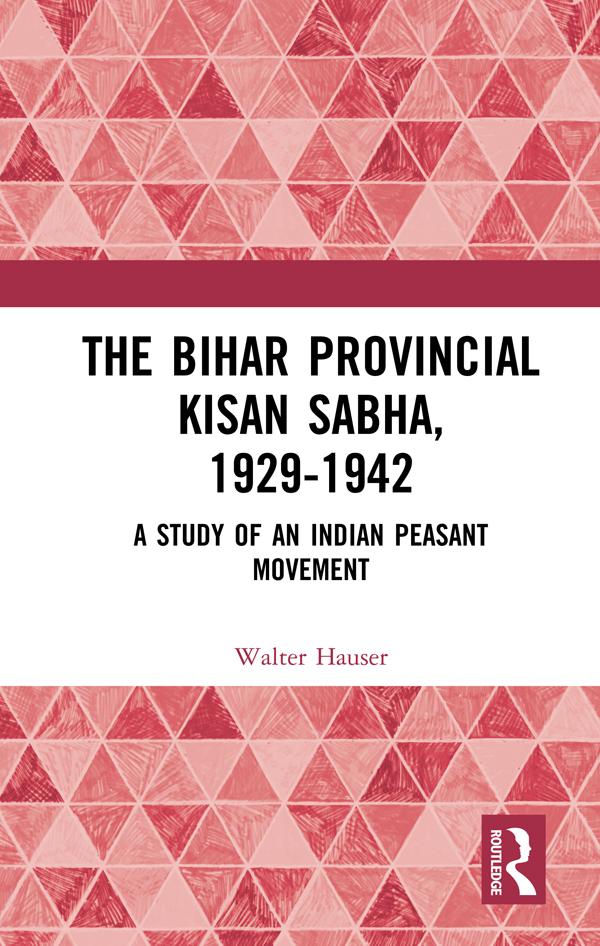
This pioneering 1961 study by Walter Hauser, tracks the history of the Bihar peasant movement as it both influenced and was buffeted by national and international politics. Hauser offers here a penetrating analysis of the character of the movement and the mind of its leader as he grappled with and gravitated toward Marxism-Leninism in the 1930s and 1940s. Initially written as a Ph.D. dissertation at the University of Chicago, Hauser’s path-breaking Bihar Provincial Kisan Sabha, 1929-1942 is now being published in its entirety for the first time. The volume includes a ‘Foreword’ by one of Hauser’s many students, William R. Pinch.
Please note: Taylor & Francis does not sell or distribute the Hardback in India, Pakistan, Nepal, Bhutan, Bangladesh and Sri Lanka
Before Memmo my notes were scattered across PDFs. Now a workspace pulls everything into one place — I see exactly what's still left to study.
Memmo's summaries are gold before exams. I don't have to re-read 800 pages two weeks before — just the important parts.
The AI chat has saved me the night before an exam more than once. I just keep asking until I get it — no waiting on a study group to reply.
The quizzes hit exactly what I need to know. Memmo tracks what I get stuck on — so I only practice what's worth it.
Flashcards with spaced repetition are magic. Memmo knows when I'm about to forget something and brings it back.
The AI podcasts are my favorite. I listen on my way to school and get a recap without sitting at a computer.

Handbok i kvalitativa metoder
281 kr

Hållbar utveckling: en introduktion för ingenjörer och andra problemlösare
334 kr

Brymans Samhällsvetenskapliga metoder
390 kr

Projektledning
491 kr

Den orättvisa hälsan: om socioekonomiska skillnader i hälsa och livslängd
326 kr

Vetenskapsteori för nybörjare
196 kr

Organizational Leadership
429 kr

På väg mot läraryrket
172 kr

Det sociala livet i skolan: Socialpsykologiska perspektiv
253 kr

Betygsättningens didaktik
151 kr

Personality
402 kr

Studying Leadership
404 kr

Managing Innovation
477 kr

Introduktion till samhällsvetenskaplig metod
347 kr

The Psychology of Sex and Gender
698 kr

Evidens och kunskap för socialt arbete
207 kr

Introduction to Leadership
605 kr