
Before Memmo my notes were scattered across PDFs. Now a workspace pulls everything into one place — I see exactly what's still left to study.
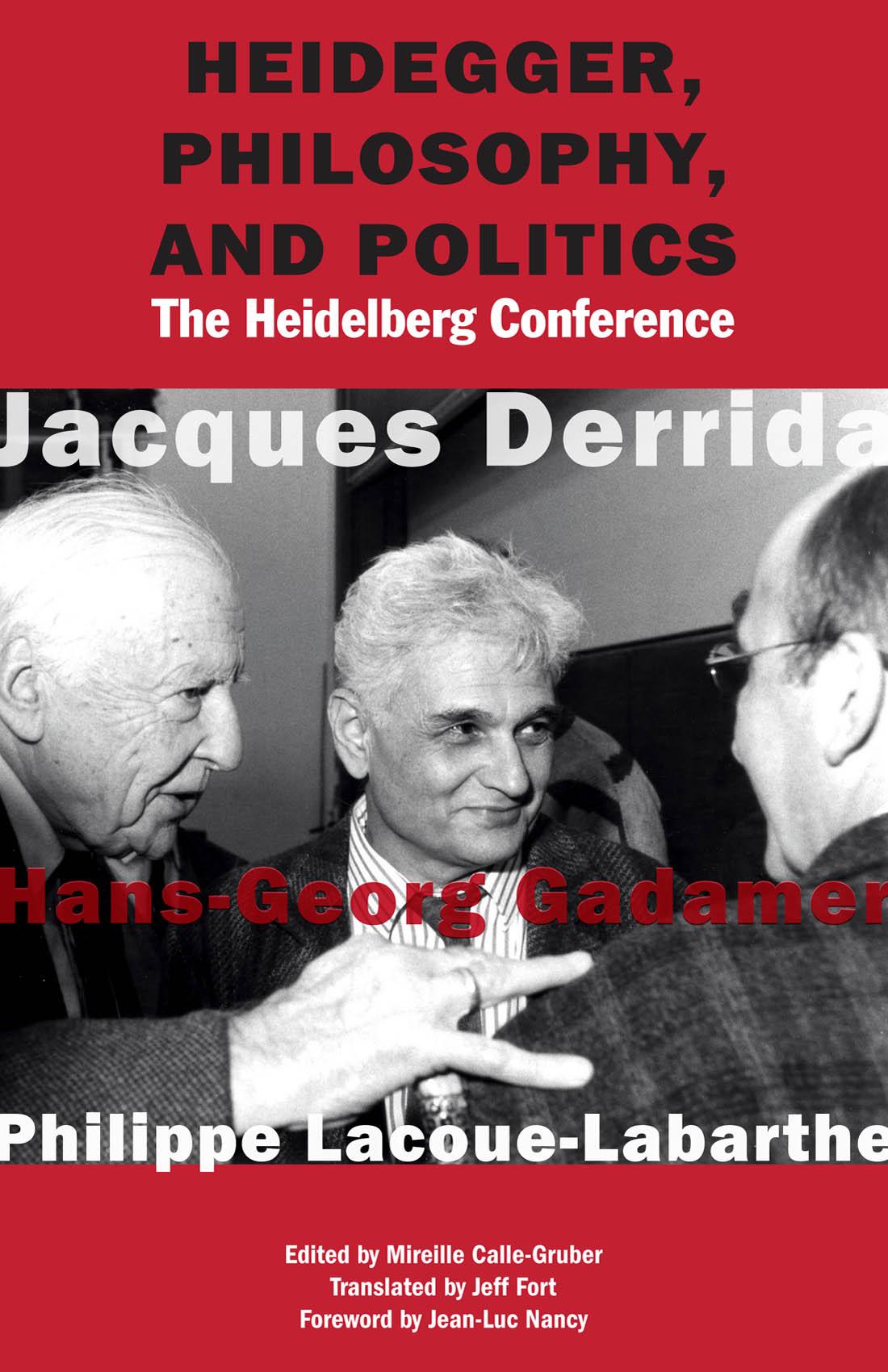
In February 1988, philosophers Jacques Derrida, Hans-Georg Gadamer, and Philippe Lacoue-Labarthe came together in Heidelberg before a large audience to discuss the philosophical and political implications of Martin Heidegger’s thought. This event took place in the very amphitheater in which, more than fifty years earlier, Heidegger, as rector of the University of Freiburg and a member of the Nazi Party, had given a speech entitled “The University in the New Reich.” Heidegger’s involvement in Nazism has always been, and will remain, an indelible scandal, but what is its real relation to his work and thought? And what are the responsibilities of those who read this work, who analyze and elaborate this thought? Conversely, what is at stake in the wholesale dismissal of this important but compromised twentieth-century philosopher?
In 1988, in the wake of the recent publication of Victor Farias’s Heidegger and Nazism, and of the heated debates that ensued, these questions had become more pressing than ever. The reflections presented by three of the most prominent of Heidegger’s readers, improvised in French and transcribed here, were an attempt to approach these questions before a broad public, but with a depth of knowledge and a complex sense of the questions at issue that have been often lacking in the press. Ranging over two days and including exchanges with one another and with the audience, the discussions pursued by these major thinkers remain highly relevant today, especially following the publication of Heidegger’s already notorious “Black Notebooks,” which have added another chapter to the ongoing debates over this contested figure. The present volume recalls a highly charged moment in this history, while also drawing the debate toward its most essential questions.
Before Memmo my notes were scattered across PDFs. Now a workspace pulls everything into one place — I see exactly what's still left to study.
Memmo's summaries are gold before exams. I don't have to re-read 800 pages two weeks before — just the important parts.
The AI chat has saved me the night before an exam more than once. I just keep asking until I get it — no waiting on a study group to reply.
The quizzes hit exactly what I need to know. Memmo tracks what I get stuck on — so I only practice what's worth it.
Flashcards with spaced repetition are magic. Memmo knows when I'm about to forget something and brings it back.
The AI podcasts are my favorite. I listen on my way to school and get a recap without sitting at a computer.

Handbok i kvalitativa metoder
281 kr

Hållbar utveckling: en introduktion för ingenjörer och andra problemlösare
334 kr

Brymans Samhällsvetenskapliga metoder
390 kr

Projektledning
491 kr

Den orättvisa hälsan: om socioekonomiska skillnader i hälsa och livslängd
326 kr

Vetenskapsteori för nybörjare
196 kr

Organizational Leadership
429 kr

På väg mot läraryrket
172 kr

Det sociala livet i skolan: Socialpsykologiska perspektiv
253 kr

Betygsättningens didaktik
151 kr

Personality
402 kr

Studying Leadership
404 kr

Managing Innovation
477 kr

Introduktion till samhällsvetenskaplig metod
347 kr

The Psychology of Sex and Gender
698 kr

Evidens och kunskap för socialt arbete
207 kr

Introduction to Leadership
605 kr