
Before Memmo my notes were scattered across PDFs. Now a workspace pulls everything into one place — I see exactly what's still left to study.
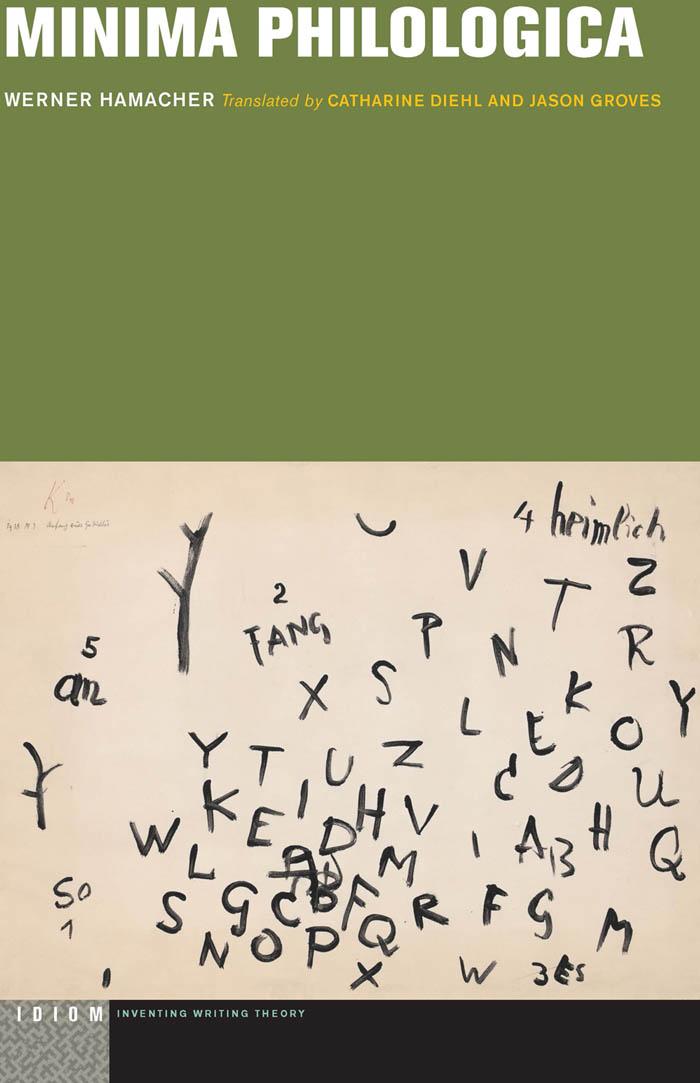
Minima Philologica brings together two essays by Werner Hamacher that are meant to revitalize philology as a practice beyond its restriction to the restoration of linguistic data and their meanings. In these two texts, “95 Theses on Philology” and “For—Philology,” Hamacher propounds a notion of generalized philology that is equivalent to the real production of linguistic utterances, and indeed utterances not limited to predicative or even discursive statements. Philology, in speaking for language where no clear and distinct language is given, exhibits and exposes the structure of language in general. The first text, “95 Theses on Philology,” challenges academic philology as well as other disciplines across the humanities and sciences that “use” language, assuming it to be a given entity and not an event. The theses develop what Hamacher calls the “idea of philology” by describing the constitution of its objects, its relation to knowledge, its suspension of consciousness, and its freedom for what remains always still to be said.
In “For—Philology,” both speaking and writing, Hamacher argues, follow, discursively and non-discursively, the desire for language. Desire—philía—is the insatiable affect that drives the movement between utterances toward the next and the one after that. Desiring language—logos—means to respond to an alien utterance that precedes you, ignorant about where the path will lead, accepting loss and uncertainty, thinking in and through language and the lack of it, exceeding, returning, responding to others, cutting into and off what is to be said. In arguing this, Hamacher responds, directly or obliquely, to other philological thinkers such as Plato and Schlegel, Nietzsche, Benjamin, and Heidegger, as well as to poets such as Rene Char, Francis Ponge, Paul Celan, and Friedrich Holderlin. Taken together, the essays of Minima Philologica constitute a manifesto for a new understanding of linguistic existence that breaks new ways of attending to language and those who live by it.
Before Memmo my notes were scattered across PDFs. Now a workspace pulls everything into one place — I see exactly what's still left to study.
Memmo's summaries are gold before exams. I don't have to re-read 800 pages two weeks before — just the important parts.
The AI chat has saved me the night before an exam more than once. I just keep asking until I get it — no waiting on a study group to reply.
The quizzes hit exactly what I need to know. Memmo tracks what I get stuck on — so I only practice what's worth it.
Flashcards with spaced repetition are magic. Memmo knows when I'm about to forget something and brings it back.
The AI podcasts are my favorite. I listen on my way to school and get a recap without sitting at a computer.

Handbok i kvalitativa metoder
281 kr

Hållbar utveckling: en introduktion för ingenjörer och andra problemlösare
334 kr

Brymans Samhällsvetenskapliga metoder
390 kr

Projektledning
491 kr

Den orättvisa hälsan: om socioekonomiska skillnader i hälsa och livslängd
326 kr

Vetenskapsteori för nybörjare
196 kr

Organizational Leadership
429 kr

På väg mot läraryrket
172 kr

Det sociala livet i skolan: Socialpsykologiska perspektiv
253 kr

Betygsättningens didaktik
151 kr

Personality
402 kr

Studying Leadership
404 kr

Managing Innovation
477 kr

Introduktion till samhällsvetenskaplig metod
347 kr

The Psychology of Sex and Gender
698 kr

Evidens och kunskap för socialt arbete
207 kr

Introduction to Leadership
605 kr