
Before Memmo my notes were scattered across PDFs. Now a workspace pulls everything into one place — I see exactly what's still left to study.
On May 11, 1911, the New York Public Library opened its “marble palace for book lovers” on Fifth Avenue and 42nd Street. This was the city’s first public library in the modern sense, a tax-supported, circulating collection free to every citizen. Since before the Revolution, however, New York’s reading publics had access to a range of “public libraries” as the term was understood by contemporaries. In its most basic sense a public library in the eighteenth and most of the nineteenth centuries simply meant a shared collection of books that was available to the general public and promoted the public good. From the founding in 1754 of the New York Society Library up to 1911, public libraries took a variety of forms. Some of them were free, charitable institutions, while others required a membership or an annual subscription. Some, such as the Biblical Library of the American Bible Society, were highly specialized; others, like the Astor Library, developed extensive, inclusive collections. What all the public libraries of this period had in common, at least ostensibly, was the conviction that good books helped ensure a productive, virtuous, orderly republic—that good reading promoted the public good.
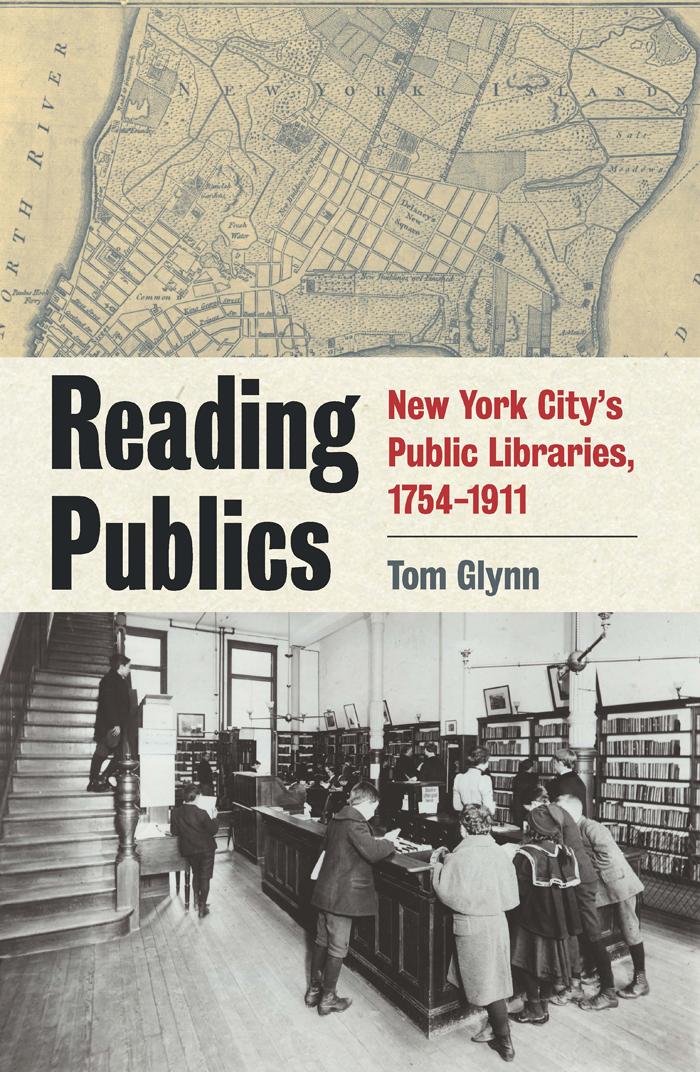
Tom Glynn’s vivid, deeply researched history of New York City’s public libraries over the course of more than a century and a half illuminates how the public and private functions of reading changed over time and how shared collections of books could serve both public and private ends. Reading Publics examines how books and reading helped construct social identities and how print functioned within and across groups, including but not limited to socioeconomic classes. The author offers an accessible while scholarly exploration of how republican and liberal values, shifting understandings of “public” and “private,” and the debate over fiction influenced the development and character of New York City’s public libraries in the eighteenth and nineteenth centuries.
Reading Publics is an important contribution to the social and cultural history of New York City that firmly places the city’s early public libraries within the history of reading and print culture in the United States.
Before Memmo my notes were scattered across PDFs. Now a workspace pulls everything into one place — I see exactly what's still left to study.
Memmo's summaries are gold before exams. I don't have to re-read 800 pages two weeks before — just the important parts.
The AI chat has saved me the night before an exam more than once. I just keep asking until I get it — no waiting on a study group to reply.
The quizzes hit exactly what I need to know. Memmo tracks what I get stuck on — so I only practice what's worth it.
Flashcards with spaced repetition are magic. Memmo knows when I'm about to forget something and brings it back.
The AI podcasts are my favorite. I listen on my way to school and get a recap without sitting at a computer.

Handbok i kvalitativa metoder
281 kr

Hållbar utveckling: en introduktion för ingenjörer och andra problemlösare
334 kr

Brymans Samhällsvetenskapliga metoder
390 kr

Projektledning
491 kr

Den orättvisa hälsan: om socioekonomiska skillnader i hälsa och livslängd
326 kr

Vetenskapsteori för nybörjare
196 kr

Organizational Leadership
429 kr

På väg mot läraryrket
172 kr

Det sociala livet i skolan: Socialpsykologiska perspektiv
253 kr

Betygsättningens didaktik
151 kr

Personality
402 kr

Studying Leadership
404 kr

Managing Innovation
477 kr

Introduktion till samhällsvetenskaplig metod
347 kr

The Psychology of Sex and Gender
698 kr

Evidens och kunskap för socialt arbete
207 kr

Introduction to Leadership
605 kr