
Before Memmo my notes were scattered across PDFs. Now a workspace pulls everything into one place — I see exactly what's still left to study.
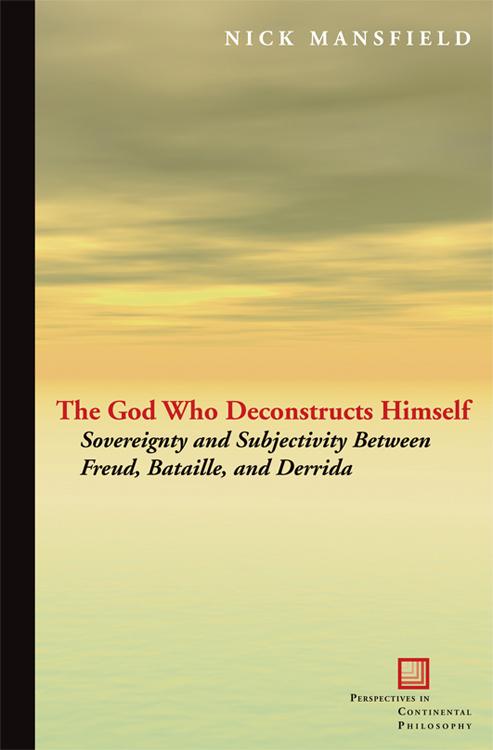
No topic has caused more discussion in recent philosophy and political theory than sovereignty. From late Foucault to Agamben, and from Guantanamo Bay to the 'war on terror,' the issue of the extent and the nature of the sovereign has given theoretical debates their currency and urgency. New thinking on sovereignty has always imagined the styles of human selfhood that each regime involves. Each denomination of sovereignty requires a specific mode of subjectivity to explain its meaning and facilitate its operation.
The aim of this book is to help outline Jacques Derrida's thinking on sovereignty - a theme which increasingly attracted Derrida towards the end of his career - in its relationship to subjectivity. It investigates the late work Rogues: Two Essays on Reason, as not only Derrida's fullest statement of his thinking on sovereignty, but also as the destination of his career-long interest in questions of politics and self-identity. The book argues that in Derrida's thinking of the relationship between sovereignty and subjectivity - and the related themes of unconditionality and ipseity - we can detect the outline of Bataille's adaptation of Freud. Freud completed his 'metapsychology,' by defining the 'economic' nature of subjectivity. In Bataille's hands, this economic theory became a key to the nature of inter-relationship in general, specifically the complex and shifting relationship between subjectivity and power. In playing with Bataille's legacy, Derrida connects not only with the irrepressibly outrageous thinking of philosophy's most self-consciously transgressive thinker, but with the early twentieth century scientific revolution through which 'energy' became ontology. As with so many of the forebears who influenced him, Derrida echoes and adapts Bataille's thinking while radically de-literalising it.
The results are crucial for understanding Derrida's views on power, subjectivity and representation, as well as all of the other key themes in late Derrida: hospitality, justice, otherness and the gift.
Before Memmo my notes were scattered across PDFs. Now a workspace pulls everything into one place — I see exactly what's still left to study.
Memmo's summaries are gold before exams. I don't have to re-read 800 pages two weeks before — just the important parts.
The AI chat has saved me the night before an exam more than once. I just keep asking until I get it — no waiting on a study group to reply.
The quizzes hit exactly what I need to know. Memmo tracks what I get stuck on — so I only practice what's worth it.
Flashcards with spaced repetition are magic. Memmo knows when I'm about to forget something and brings it back.
The AI podcasts are my favorite. I listen on my way to school and get a recap without sitting at a computer.

Handbok i kvalitativa metoder
281 kr

Hållbar utveckling: en introduktion för ingenjörer och andra problemlösare
334 kr

Brymans Samhällsvetenskapliga metoder
390 kr

Projektledning
491 kr

Den orättvisa hälsan: om socioekonomiska skillnader i hälsa och livslängd
326 kr

Organizational Leadership
429 kr

Vetenskapsteori för nybörjare
196 kr

På väg mot läraryrket
172 kr

Det sociala livet i skolan: Socialpsykologiska perspektiv
253 kr

Betygsättningens didaktik
151 kr

Personality
402 kr

Studying Leadership
404 kr

Managing Innovation
477 kr

Introduktion till samhällsvetenskaplig metod
347 kr

The Psychology of Sex and Gender
698 kr

Evidens och kunskap för socialt arbete
207 kr

Introduction to Leadership
605 kr