
Before Memmo my notes were scattered across PDFs. Now a workspace pulls everything into one place — I see exactly what's still left to study.
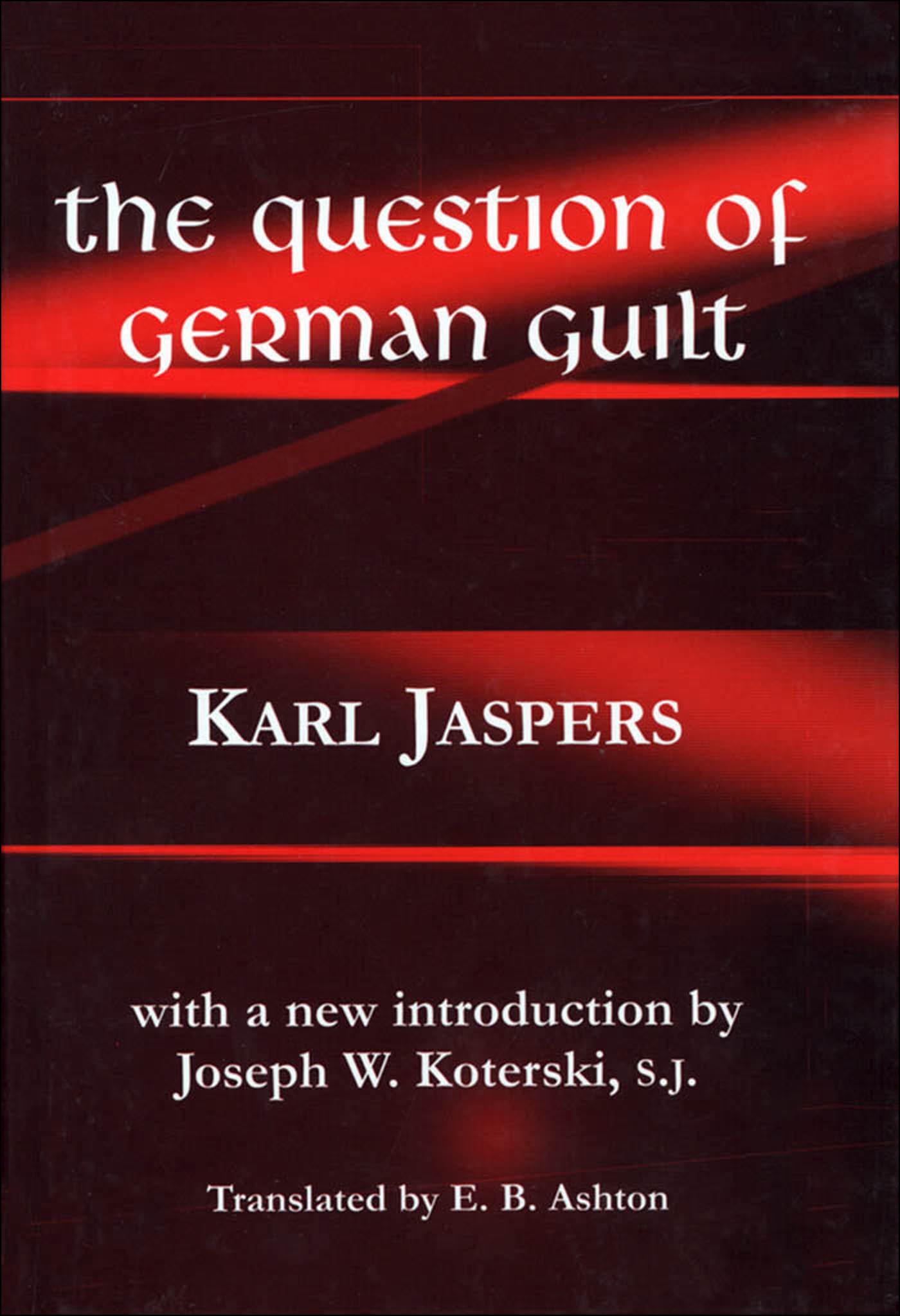
Shortly after the Nazi government fell, a philosophy professor at Heidelberg University lectured on a subject that burned the consciousness and conscience of thinking Germans. “Are the German people guilty?” These lectures by Karl Jaspers, an outstanding European philosopher, attracted wide attention among German intellectuals and students; they seemed to offer a path to sanity and morality in a disordered world.
Jaspers, a life-long liberal, attempted in this book to discuss rationally a problem that had thus far evoked only heat and fury. Neither an evasive apology nor a wholesome condemnation, his book distinguished between types of guilt and degrees of responsibility. He listed four categories of guilt: criminal guilt (the commitment of overt acts), political guilt (the degree of political acquiescence in the Nazi regime), moral guilt (a matter of private judgment among one’s friends), and metaphysical guilt (a universally shared responsibility of those who chose to remain alive rather than die in protest against Nazi atrocities).
Karl Jaspers (1883–1969) took his degree in medicine but soon became interested in psychiatry. He is the author of a standard work of psychopathology, as well as special studies on Strindberg, Van Gogh and Nietsche. After World War I he became Professor of Philosophy at Heidelberg, where he achieved fame as a brilliant teacher and an early exponent of existentialism. He was among the first to acquaint German readers with the works of Kierkegaard.
Jaspers had to resign from his post in 1935. From the total isolation into which the Hitler regime forced him, Jaspers returned in 1945 to a position of central intellectual leadership of the younger liberal elements of Germany. In his first lecture in 1945, he forcefully reminded his audience of the fate of the German Jews. Jaspers’s unblemished record as an anti-Nazi, as well as his sentient mind, have made him a rallying point center for those of his compatriots who wish to reconstruct a free and democratic Germany.
Before Memmo my notes were scattered across PDFs. Now a workspace pulls everything into one place — I see exactly what's still left to study.
Memmo's summaries are gold before exams. I don't have to re-read 800 pages two weeks before — just the important parts.
The AI chat has saved me the night before an exam more than once. I just keep asking until I get it — no waiting on a study group to reply.
The quizzes hit exactly what I need to know. Memmo tracks what I get stuck on — so I only practice what's worth it.
Flashcards with spaced repetition are magic. Memmo knows when I'm about to forget something and brings it back.
The AI podcasts are my favorite. I listen on my way to school and get a recap without sitting at a computer.

Handbok i kvalitativa metoder
281 kr

Hållbar utveckling: en introduktion för ingenjörer och andra problemlösare
334 kr

Brymans Samhällsvetenskapliga metoder
390 kr

Projektledning
491 kr

Den orättvisa hälsan: om socioekonomiska skillnader i hälsa och livslängd
326 kr

Vetenskapsteori för nybörjare
196 kr

Organizational Leadership
429 kr

På väg mot läraryrket
172 kr

Det sociala livet i skolan: Socialpsykologiska perspektiv
253 kr

Betygsättningens didaktik
151 kr

Personality
402 kr

Studying Leadership
404 kr

Managing Innovation
477 kr

Introduktion till samhällsvetenskaplig metod
347 kr

The Psychology of Sex and Gender
698 kr

Evidens och kunskap för socialt arbete
207 kr

Introduction to Leadership
605 kr