
Before Memmo my notes were scattered across PDFs. Now a workspace pulls everything into one place — I see exactly what's still left to study.
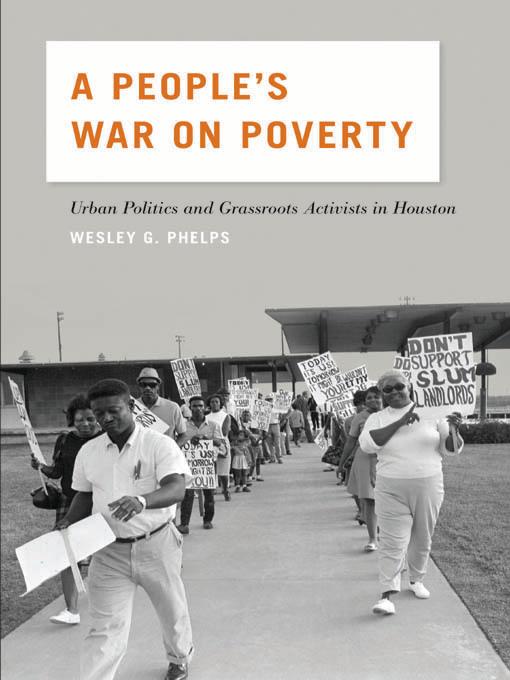
In A People’s War on Poverty, Wesley G. Phelps investigates the on-the-ground implementation of President Lyndon Johnson’s War on Poverty during the 1960s and 1970s. He argues that the fluid interaction between federal policies, urban politics, and grassroots activists created a significant site of conflict over the meaning of American democracy and the rights of citizenship that historians have largely overlooked. In Houston in particular, the War on Poverty spawned fierce political battles that revealed fundamental disagreements over what democracy meant, how far it should extend, and who should benefit from it. Many of the program’s implementers took seriously the federal mandate to empower the poor as they pushed for a more participatory form of democracy that would include more citizens in the political, cultural, and economic life of the city.
At the center of this book are the vitally important but virtually forgotten grassroots activists who administered federal War on Poverty programs, including church ministers, federal program volunteers, students, local administrators, civil rights activists, and the poor themselves. The moderate Great Society liberalism that motivated the architects of the federal programs certainly galvanized local antipoverty activists in Houston. However, their antipoverty philosophy was driven further by prophetic religious traditions and visions of participatory democracy and community organizing championed by the New Left and iconoclastic figures like Saul Alinsky. By focusing on these local actors, Phelps shows that grassroots activists in Houston were influenced by a much more diverse set of intellectual and political traditions, fueling their efforts to expand the meaning of democracy. Ultimately, this episode in Houston’s history reveals both the possibilities and the limits of urban democracy in the twentieth century.
Before Memmo my notes were scattered across PDFs. Now a workspace pulls everything into one place — I see exactly what's still left to study.
Memmo's summaries are gold before exams. I don't have to re-read 800 pages two weeks before — just the important parts.
The AI chat has saved me the night before an exam more than once. I just keep asking until I get it — no waiting on a study group to reply.
The quizzes hit exactly what I need to know. Memmo tracks what I get stuck on — so I only practice what's worth it.
Flashcards with spaced repetition are magic. Memmo knows when I'm about to forget something and brings it back.
The AI podcasts are my favorite. I listen on my way to school and get a recap without sitting at a computer.

Handbok i kvalitativa metoder
281 kr

Hållbar utveckling: en introduktion för ingenjörer och andra problemlösare
334 kr

Brymans Samhällsvetenskapliga metoder
390 kr

Projektledning
491 kr

Den orättvisa hälsan: om socioekonomiska skillnader i hälsa och livslängd
326 kr

Vetenskapsteori för nybörjare
196 kr

Organizational Leadership
429 kr

På väg mot läraryrket
172 kr

Det sociala livet i skolan: Socialpsykologiska perspektiv
253 kr

Betygsättningens didaktik
151 kr

Personality
402 kr

Studying Leadership
404 kr

Managing Innovation
477 kr

Introduktion till samhällsvetenskaplig metod
347 kr

The Psychology of Sex and Gender
698 kr

Evidens och kunskap för socialt arbete
207 kr

Introduction to Leadership
605 kr