
Before Memmo my notes were scattered across PDFs. Now a workspace pulls everything into one place — I see exactly what's still left to study.
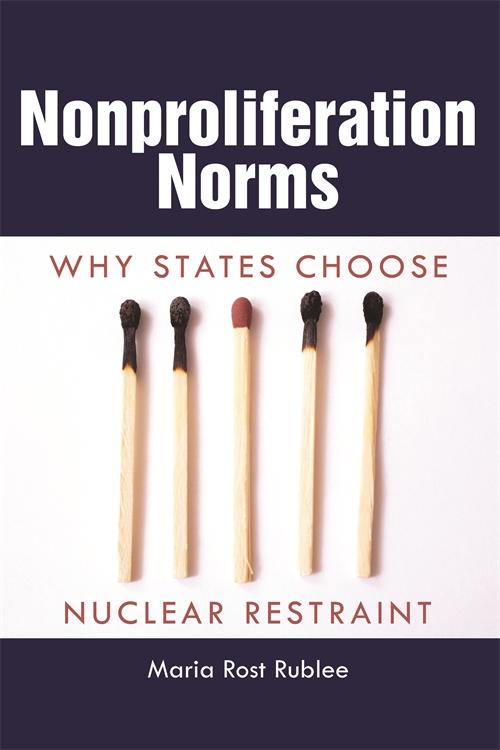
Too often, our focus on the relative handful of countries with nuclear weapons keeps us from asking an important question: Why do so many more states not have such weapons? More important, what can we learn from these examples of nuclear restraint? Maria Rost Rublee argues that in addition to understanding a state's security environment, we must appreciate the social forces that influence how states conceptualize the value of nuclear weapons. Much of what Rublee says also applies to other weapons of mass destruction, as well as national security decision making in general.
The nuclear nonproliferation movement has created an international social environment that exerts a variety of normative pressures on how state elites and policymakers think about nuclear weapons. Within a social psychology framework, Rublee examines decision making about nuclear weapons in five case studies: Japan, Egypt, Libya, Sweden, and Germany.
In each case, Rublee considers the extent to which nuclear forbearance resulted from persuasion (genuine transformation of preferences), social conformity (the desire to maximize social benefits and/or minimize social costs, without a change in underlying preferences), or identification (the desire or habit of following the actions of an important other).
The book offers bold policy prescriptions based on a sharpened knowledge of the many ways we transmit and process nonproliferation norms. The social mechanisms that encourage nonproliferation-and the regime that created them-must be preserved and strengthened, Rublee argues, for without them states that have exercised nuclear restraint may rethink their choices.
Before Memmo my notes were scattered across PDFs. Now a workspace pulls everything into one place — I see exactly what's still left to study.
Memmo's summaries are gold before exams. I don't have to re-read 800 pages two weeks before — just the important parts.
The AI chat has saved me the night before an exam more than once. I just keep asking until I get it — no waiting on a study group to reply.
The quizzes hit exactly what I need to know. Memmo tracks what I get stuck on — so I only practice what's worth it.
Flashcards with spaced repetition are magic. Memmo knows when I'm about to forget something and brings it back.
The AI podcasts are my favorite. I listen on my way to school and get a recap without sitting at a computer.

Handbok i kvalitativa metoder
281 kr

Hållbar utveckling: en introduktion för ingenjörer och andra problemlösare
334 kr

Brymans Samhällsvetenskapliga metoder
390 kr

Projektledning
491 kr

Den orättvisa hälsan: om socioekonomiska skillnader i hälsa och livslängd
326 kr

Organizational Leadership
429 kr

Vetenskapsteori för nybörjare
196 kr

På väg mot läraryrket
172 kr

Det sociala livet i skolan: Socialpsykologiska perspektiv
253 kr

Betygsättningens didaktik
151 kr

Personality
402 kr

Studying Leadership
404 kr

Managing Innovation
477 kr

Introduktion till samhällsvetenskaplig metod
347 kr

The Psychology of Sex and Gender
698 kr

Evidens och kunskap för socialt arbete
207 kr

Introduction to Leadership
605 kr