
Before Memmo my notes were scattered across PDFs. Now a workspace pulls everything into one place — I see exactly what's still left to study.
A state-of-the-art meditation on relations, theoretical and practical, among a familiar triad of themes: comunitarianism, liberalism, and democracy.
--American Political Science Review
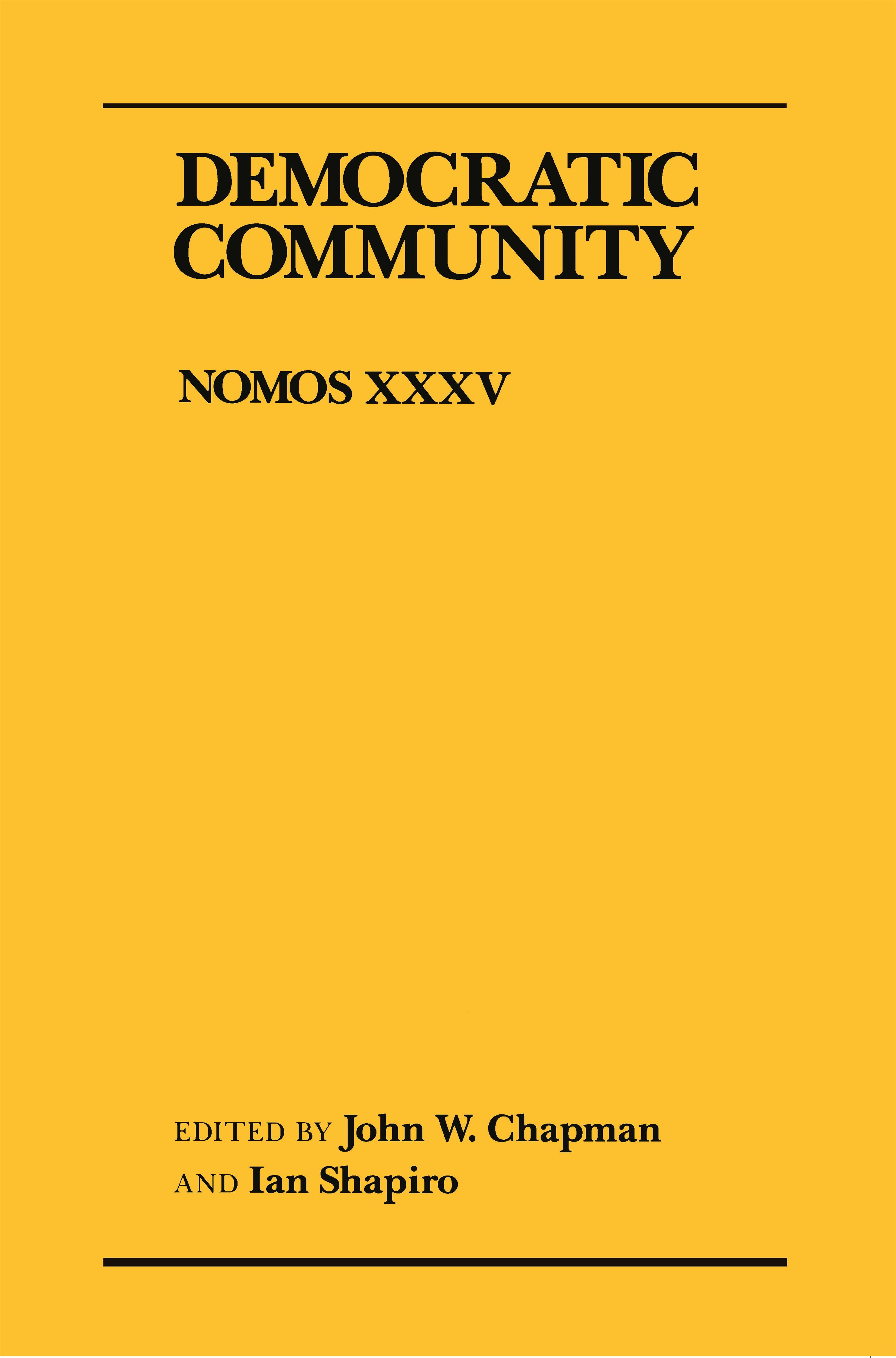
A collection of distinguished contributors, from a wide range of disciplines, examine the implications of the resurgence of interest in community. The chapters in Democratic Community consider the fundamental issues that divide liberals and communitarians, as well as the structure of communities, the roles of freedom and democratic institutions in sustaining one another, the place of a democratic civil society in a democratic polity, and the contributions of feminist thinking.
This thirty-fifth volume in the American Society of Political and Legal Philosophy series is devoted, as is each volume in the series, to a single topic-- in this case, the implications for human nature and democratic theory of the resurgence of interest in community. Democratic Community deals not only with fundamental issues that divide liberals and communitarians, but is also concerned with the structure of communities, the roles of freedom and democratic institutions in sustaining one another, the place of a democratic civil society in a democratic polity, and the contributions of feminist thinking to the great debate. The collection of distinguished contributors, from a wide range of disciplines, includes: Richard J. Arneson (University of California, San Diego), Jean Baechler (University of Paris, Sorbonne), Christopher J. Berry (University of Glasgow), Robert A. Dahl (Yale University), Martin P. Golding (Duke University), Carol C. Gould (Stevens Institute of Technology), Amy Gutmann (Princeton University), Jane Mansbridge (Northwestern University), Kenneth Minogue (London School of Economics), Robert C. Post (University of California, Berkeley), David A. J. Richards (New York University), Gerald N. Rosenberg (University of Chicago), Bruce K. Rutherford (Yale University), Alan Ryan (Princeton University), and Carmen Sirianni (Brandeis University).
Before Memmo my notes were scattered across PDFs. Now a workspace pulls everything into one place — I see exactly what's still left to study.
Memmo's summaries are gold before exams. I don't have to re-read 800 pages two weeks before — just the important parts.
The AI chat has saved me the night before an exam more than once. I just keep asking until I get it — no waiting on a study group to reply.
The quizzes hit exactly what I need to know. Memmo tracks what I get stuck on — so I only practice what's worth it.
Flashcards with spaced repetition are magic. Memmo knows when I'm about to forget something and brings it back.
The AI podcasts are my favorite. I listen on my way to school and get a recap without sitting at a computer.

Handbok i kvalitativa metoder
281 kr

Hållbar utveckling: en introduktion för ingenjörer och andra problemlösare
334 kr

Brymans Samhällsvetenskapliga metoder
390 kr

Projektledning
491 kr

Den orättvisa hälsan: om socioekonomiska skillnader i hälsa och livslängd
326 kr

Organizational Leadership
429 kr

Vetenskapsteori för nybörjare
196 kr

På väg mot läraryrket
172 kr

Det sociala livet i skolan: Socialpsykologiska perspektiv
253 kr

Betygsättningens didaktik
151 kr

Personality
402 kr

Studying Leadership
404 kr

Managing Innovation
477 kr

Introduktion till samhällsvetenskaplig metod
347 kr

The Psychology of Sex and Gender
698 kr

Evidens och kunskap för socialt arbete
207 kr

Introduction to Leadership
605 kr