
Before Memmo my notes were scattered across PDFs. Now a workspace pulls everything into one place — I see exactly what's still left to study.
Whether in the form of Christmas trees in town squares or prayer in school, fierce disputes over the separation of church and state have long bedeviled this country. Both decried and celebrated, this principle is considered by many, for right or wrong, a defining aspect of American national identity.
Nearly all discussions regarding the role of religion in American life build on two dominant assumptions: first, the separation of church and state is a constitutional principle that promotes democracy and equally protects the religious freedom of all Americans, especially religious outgroups; and second, this principle emerges as a uniquely American contribution to political theory.
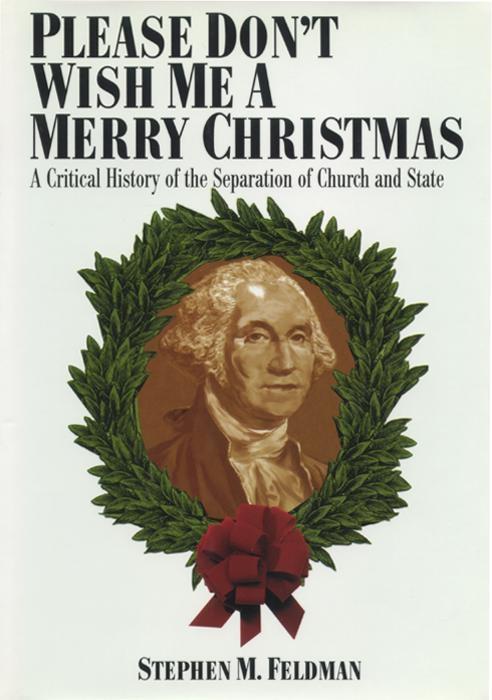
In Please Don't Wish Me a Merry Christmas, Stephen M. Feldman challenges both these assumptions. He argues that the separation of church and state primarily manifests and reinforces Christian domination in American society. Furthermore, Feldman reveals that the separation of church and state did not first arise in the United States. Rather, it has slowly evolved as a political and religious development through western history, beginning with the initial appearance of Christianity as it contentiously separated from Judaism.In tracing the historical roots of the separation of church and state within the Western world, Feldman begins with the Roman Empire and names Augustine as the first political theorist to suggest the idea. Feldman next examines how the roles of church and state variously merged and divided throughout history, during the Crusades, the Italian Renaissance, the Protestant Reformation, the British Civil War and Restoration, the early North American colonies, nineteenth-century America, and up to the present day. In challenging the dominant story of the separation of church and state, Feldman interprets the development of Christian social power vis--vis the state and religious minorities, particularly the prototypical religious outgroup, Jews.
Before Memmo my notes were scattered across PDFs. Now a workspace pulls everything into one place — I see exactly what's still left to study.
Memmo's summaries are gold before exams. I don't have to re-read 800 pages two weeks before — just the important parts.
The AI chat has saved me the night before an exam more than once. I just keep asking until I get it — no waiting on a study group to reply.
The quizzes hit exactly what I need to know. Memmo tracks what I get stuck on — so I only practice what's worth it.
Flashcards with spaced repetition are magic. Memmo knows when I'm about to forget something and brings it back.
The AI podcasts are my favorite. I listen on my way to school and get a recap without sitting at a computer.

Handbok i kvalitativa metoder
281 kr

Hållbar utveckling: en introduktion för ingenjörer och andra problemlösare
334 kr

Brymans Samhällsvetenskapliga metoder
390 kr

Projektledning
491 kr

Den orättvisa hälsan: om socioekonomiska skillnader i hälsa och livslängd
326 kr

Vetenskapsteori för nybörjare
196 kr

Organizational Leadership
429 kr

På väg mot läraryrket
172 kr

Det sociala livet i skolan: Socialpsykologiska perspektiv
253 kr

Betygsättningens didaktik
151 kr

Personality
402 kr

Studying Leadership
404 kr

Managing Innovation
477 kr

Introduktion till samhällsvetenskaplig metod
347 kr

The Psychology of Sex and Gender
698 kr

Evidens och kunskap för socialt arbete
207 kr

Introduction to Leadership
605 kr