
Before Memmo my notes were scattered across PDFs. Now a workspace pulls everything into one place — I see exactly what's still left to study.
“Many Americans are unsatisfied with politics. Simultaneously, we are hesitant to question the basic soundness of our constitutional system. In this refreshingly provocative book, David Orentlicher explains why it is due time for us to reconsider dominant ideas about the presidency, now arguably our most powerful political institution. Challenging the conventional wisdom that the best executive is necessarily a unitary executive, Orentlicher makes a wonderful case for why ‘two presidents are better than one.’ Sure to be of interest to political scientists, legal scholars, as well as informed citizens justifiably worried about the fate of American democracy, this fascinating book dares to challenge everything you thought you knew about one of our favorite political institutions.”
—William E. Scheuerman, Indiana University
“Can Orentlicher be serious in calling for a plural executive? The answer is yes, and he presents thoughtful and challenging arguments responding to likely criticisms. Any readers who are other than completely complacent about the current state of American politics will have to admire Orentlicher’s distinctive audacity and to respond themselves to his well-argued points.”
—Sanford Levinson, author of Framed: America’s 51 Constitutions and the Crisis of Governance
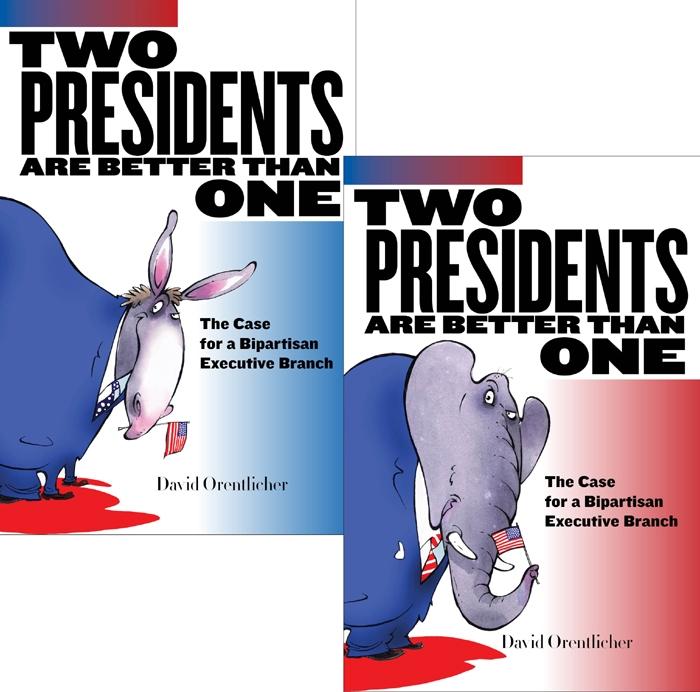
When talking heads and political pundits make their “What’s Wrong with America” lists, two concerns invariably rise to the top: the growing presidential abuse of power and the toxic political atmosphere in Washington. In Two Presidents Are Better Than One, David Orentlicher shows how the “imperial presidency” and partisan conflict are largely the result of a deeper problem—the Constitution’s placement of a single president atop the executive branch. Accordingly, writes Orentlicher, we can fix our broken political system by replacing the one person, one-party presidency with a two-person, two-party executive branch.
Orentlicher contends that our founding fathers did not anticipate the extent to which their checks and balances would fail to contain executive power and partisan discord. They also did not foresee how the imperial presidency would aggravate partisan conflict. As the stakes in presidential elections have grown ever higher since the New Deal, battles to capture the White House have greatly exacerbated partisan differences. Had the framers been able to predict the future, Orentlicher argues, they would have been far less enamored with the idea of a single leader at the head of the executive branch and far more receptive to the alternative proposals for a plural executive that they rejected. Like their counterparts in Europe, they might well have created an executive branch in which power is shared among multiple persons from multiple political parties.
Analyzing the histories of other countries with a plural executive branch and past examples of bipartisan cooperation within Congress, Orentlicher shows us why and how to implement a two-person, two-party presidency. Ultimately, Two Presidents Are Better Than One demonstrates why we need constitutional reform to rebalance power between the executive and legislative branches and contain partisan conflict in Washington.
Before Memmo my notes were scattered across PDFs. Now a workspace pulls everything into one place — I see exactly what's still left to study.
Memmo's summaries are gold before exams. I don't have to re-read 800 pages two weeks before — just the important parts.
The AI chat has saved me the night before an exam more than once. I just keep asking until I get it — no waiting on a study group to reply.
The quizzes hit exactly what I need to know. Memmo tracks what I get stuck on — so I only practice what's worth it.
Flashcards with spaced repetition are magic. Memmo knows when I'm about to forget something and brings it back.
The AI podcasts are my favorite. I listen on my way to school and get a recap without sitting at a computer.

Handbok i kvalitativa metoder
281 kr

Hållbar utveckling: en introduktion för ingenjörer och andra problemlösare
334 kr

Brymans Samhällsvetenskapliga metoder
390 kr

Projektledning
491 kr

Den orättvisa hälsan: om socioekonomiska skillnader i hälsa och livslängd
326 kr

Vetenskapsteori för nybörjare
196 kr

Organizational Leadership
429 kr

På väg mot läraryrket
172 kr

Det sociala livet i skolan: Socialpsykologiska perspektiv
253 kr

Betygsättningens didaktik
151 kr

Personality
402 kr

Studying Leadership
404 kr

Managing Innovation
477 kr

Introduktion till samhällsvetenskaplig metod
347 kr

The Psychology of Sex and Gender
698 kr

Evidens och kunskap för socialt arbete
207 kr

Introduction to Leadership
605 kr