
Before Memmo my notes were scattered across PDFs. Now a workspace pulls everything into one place — I see exactly what's still left to study.
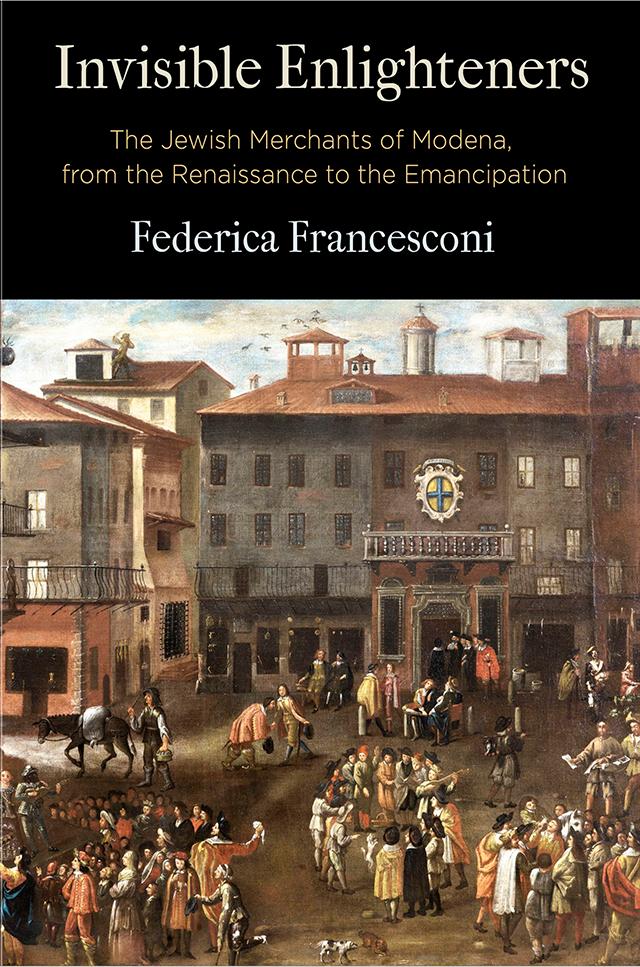
Federica Francesconi writes the history of the Jewish merchants who lived and prospered in the northern Italian city of Modena, capital city of the Este Duchy, during the seventeenth and eighteenth centuries. Her protagonists are men and women who stood out within their communities but who, despite their cultural and economic prominence, were ghettoized after 1638. Their sociocultural transformation and eventual legal and political integration evolved through a complex dialogue between their Italian and Jewish identities, and without the traumatic ruptures or dramatic divides that led to the assimilation and conversion of many Jews elsewhere in Europe.
In Modena, male and female Jewish identities were contoured by both cultural developments internal to the community and engagement with the broader society. The study of Lurianic and Cordoverian Kabbalah, liturgical and nondevotional Hebrew poetry, and Sabbateanism existed alongside interactions with Jesuits, converts, and inquisitors. If Modenese Jewish merchants were absent from the public discourse of the Estes, their businesses lives were nevertheless located at the very geographical and economic center of the city. They lived in an environment that gave rise to unique forms of Renaissance culture, early modern female agency, and Enlightenment practice. New Jewish ways of performing gender emerged in the seventeenth century, giving rise to what could be called an entrepreneurial female community devoted to assisting, employing, and socializing in the ghetto. Indeed, the ghetto leadership prepared both Jewish men and women for the political and legal emancipation they would eventually obtain under Napoleon. It was the cultured Modenese merchants who combined active participation in the political struggle for Italian Jewish emancipation with the creation of a special form of the Enlightenment embedded in scholarly and French-oriented lay culture that emerged within the European context.
Before Memmo my notes were scattered across PDFs. Now a workspace pulls everything into one place — I see exactly what's still left to study.
Memmo's summaries are gold before exams. I don't have to re-read 800 pages two weeks before — just the important parts.
The AI chat has saved me the night before an exam more than once. I just keep asking until I get it — no waiting on a study group to reply.
The quizzes hit exactly what I need to know. Memmo tracks what I get stuck on — so I only practice what's worth it.
Flashcards with spaced repetition are magic. Memmo knows when I'm about to forget something and brings it back.
The AI podcasts are my favorite. I listen on my way to school and get a recap without sitting at a computer.

Handbok i kvalitativa metoder
281 kr

Hållbar utveckling: en introduktion för ingenjörer och andra problemlösare
334 kr

Brymans Samhällsvetenskapliga metoder
390 kr

Projektledning
491 kr

Den orättvisa hälsan: om socioekonomiska skillnader i hälsa och livslängd
326 kr

Vetenskapsteori för nybörjare
196 kr

Organizational Leadership
429 kr

På väg mot läraryrket
172 kr

Det sociala livet i skolan: Socialpsykologiska perspektiv
253 kr

Betygsättningens didaktik
151 kr

Personality
402 kr

Studying Leadership
404 kr

Managing Innovation
477 kr

Introduktion till samhällsvetenskaplig metod
347 kr

The Psychology of Sex and Gender
698 kr

Evidens och kunskap för socialt arbete
207 kr

Introduction to Leadership
605 kr