
Before Memmo my notes were scattered across PDFs. Now a workspace pulls everything into one place — I see exactly what's still left to study.
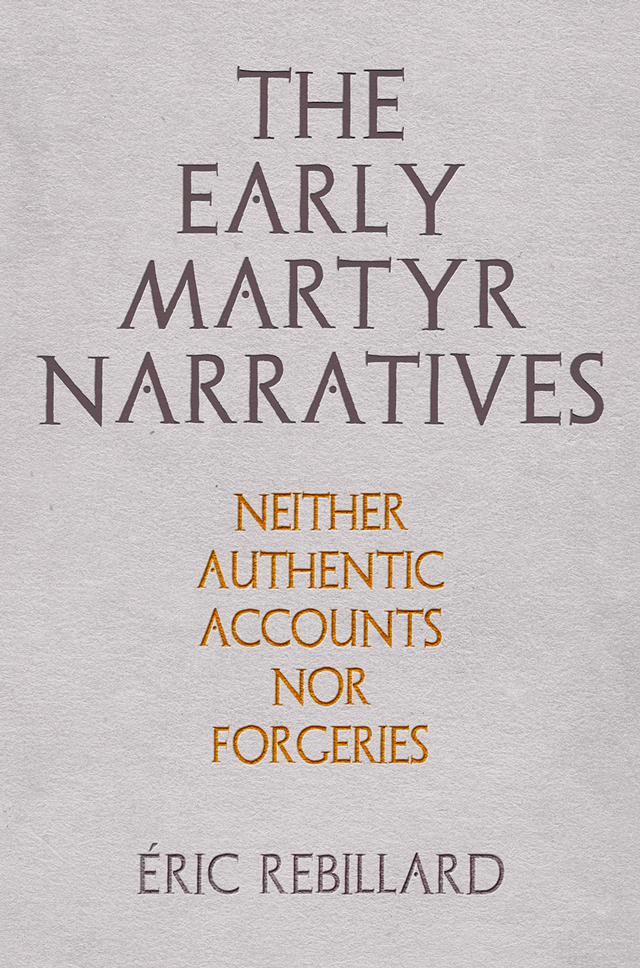
From Eusebius of Caesarea, who first compiled a collection of martyr narratives around 300, to Thierry Ruinart, whose Acta primorum martyrum sincera et selecta was published in 1689, the selection and study of early hagiographic narratives has been founded on an assumption that there existed documents written at the time of martyrdom, or very close to it. As a result, a search for authenticity has been and continues to be central, even in the context of today's secular scholarship. But, as Éric Rebillard contends, the alternative approach, to set aside entirely the question of the historical reliability of martyr narratives, is not satisfactory either. Instead, he argues that martyr narratives should be consider as fluid "living texts," written anonymously and received by audiences not as precise historical reports but as versions of the story. In other words, the form these texts took, between fact and fiction, made it possible for audiences to readily accept the historicity of the martyr while at the same time not expect to hear or read a truthful account.
In The Early Martyr Narratives, Rebillard considers only accounts of Christian martyrs supposed to have been executed before 260, and only those whose existence is attested in sources that can be dated to before 300. The resulting small corpus contains no texts in the form of legal protocols, traditionally viewed as the earliest, most official and authentic records, nor does it include any that can be dated to a period during which persecution of Christians is known to have taken place. Rather than deduce from this that they are forgeries written for the sake of polemic or apologetic, Rebillard demonstrates how the literariness of the narratives creates a fictional complicity that challenges and complicates any claims of these narratives to be truthful.
Before Memmo my notes were scattered across PDFs. Now a workspace pulls everything into one place — I see exactly what's still left to study.
Memmo's summaries are gold before exams. I don't have to re-read 800 pages two weeks before — just the important parts.
The AI chat has saved me the night before an exam more than once. I just keep asking until I get it — no waiting on a study group to reply.
The quizzes hit exactly what I need to know. Memmo tracks what I get stuck on — so I only practice what's worth it.
Flashcards with spaced repetition are magic. Memmo knows when I'm about to forget something and brings it back.
The AI podcasts are my favorite. I listen on my way to school and get a recap without sitting at a computer.

Handbok i kvalitativa metoder
281 kr

Hållbar utveckling: en introduktion för ingenjörer och andra problemlösare
334 kr

Brymans Samhällsvetenskapliga metoder
390 kr

Projektledning
491 kr

Den orättvisa hälsan: om socioekonomiska skillnader i hälsa och livslängd
326 kr

Organizational Leadership
429 kr

Vetenskapsteori för nybörjare
196 kr

På väg mot läraryrket
172 kr

Det sociala livet i skolan: Socialpsykologiska perspektiv
253 kr

Betygsättningens didaktik
151 kr

Personality
402 kr

Studying Leadership
404 kr

Managing Innovation
477 kr

Introduktion till samhällsvetenskaplig metod
347 kr

The Psychology of Sex and Gender
698 kr

Evidens och kunskap för socialt arbete
207 kr

Introduction to Leadership
605 kr