
Before Memmo my notes were scattered across PDFs. Now a workspace pulls everything into one place — I see exactly what's still left to study.
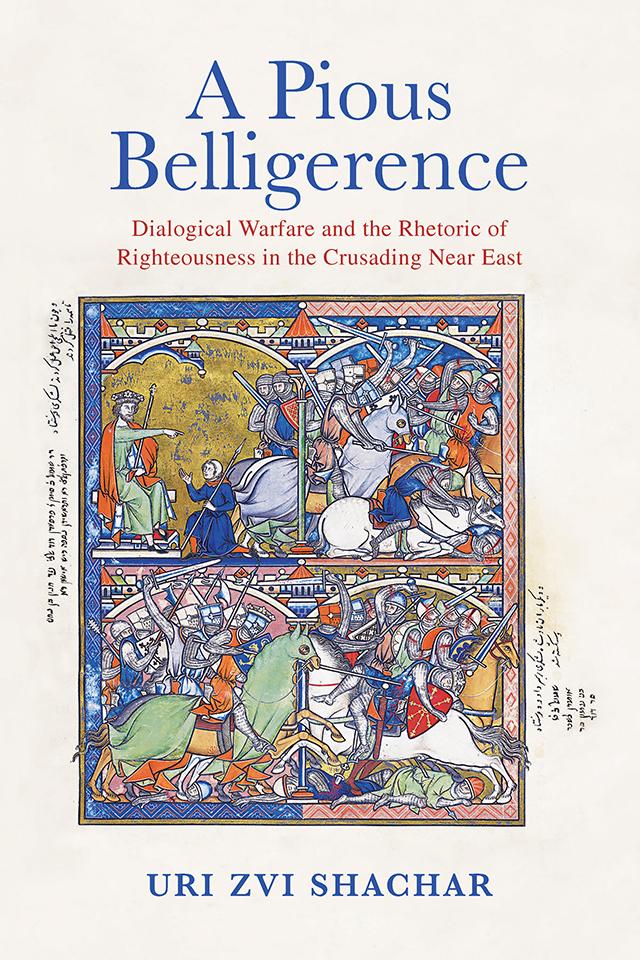
In A Pious Belligerence Uri Zvi Shachar examines one of the most contested and ideologically loaded issues in medieval history, the clash between Christians, Muslims, and Jews that we call the Crusades. He does so not to write about the ways these three groups waged war to hold onto their distinct identities, but rather to think about how these identities were framed in relation to one another. Notions of militant piety in particular provided Muslims, Christians, and Jews paths for thinking about both cultural boundaries and codependencies. Ideas about holy warfare, Shachar contends, were not shaped along sectarian lines, but were dynamically coproduced among the three religions.
The final decades of the twelfth century saw a rapid collapse of the Frankish and Ayyubid hegemonies in the Levant, followed by struggles for political dominion that lasted for most of the thirteenth century. The fragmented political landscape gave rise to the formation of multiple coalitions across political, religious, and linguistic divides. Alongside a growing anxiety about the instability of cultural boundaries, there emerged a discourse that sought to realign and reevaluate questions of similarity and difference. Where Christians and Muslims regularly joined forces against their own coreligionists, Shachar writes, warriors were no longer assumed to mark or protect lines of physical or political separation. Contemporary authors recounting these events describe a landscape of questionable loyalties, shifting identities, and unstable appearances.
Shachar demonstrates how in chronicles, apocalyptic treatises, and a variety of literary texts in Latin, French, Arabic, Hebrew, and Judeo-Arabic holy warriors are increasingly presented as having been rhetorically and anthropologically shaped through their contacts with their neighbors and adversaries. Writers articulated their thoughts about pious warfare through rhetorical devices that crossed confessional lines, and the meaning and force of these articulations lay in their invocation of tropes and registers that had purchase in the various literary communities of the Near East. By the late twelfth century, he argues, there had emerged a notion that threads through Christian, Muslim, and Jewish texts alike: that the Holy Land itself generates a particular breed of pious warriors by virtue of the hybridity that it encompasses.
Before Memmo my notes were scattered across PDFs. Now a workspace pulls everything into one place — I see exactly what's still left to study.
Memmo's summaries are gold before exams. I don't have to re-read 800 pages two weeks before — just the important parts.
The AI chat has saved me the night before an exam more than once. I just keep asking until I get it — no waiting on a study group to reply.
The quizzes hit exactly what I need to know. Memmo tracks what I get stuck on — so I only practice what's worth it.
Flashcards with spaced repetition are magic. Memmo knows when I'm about to forget something and brings it back.
The AI podcasts are my favorite. I listen on my way to school and get a recap without sitting at a computer.

Handbok i kvalitativa metoder
281 kr

Hållbar utveckling: en introduktion för ingenjörer och andra problemlösare
334 kr

Brymans Samhällsvetenskapliga metoder
390 kr

Projektledning
491 kr

Den orättvisa hälsan: om socioekonomiska skillnader i hälsa och livslängd
326 kr

Vetenskapsteori för nybörjare
196 kr

Organizational Leadership
429 kr

På väg mot läraryrket
172 kr

Det sociala livet i skolan: Socialpsykologiska perspektiv
253 kr

Betygsättningens didaktik
151 kr

Personality
402 kr

Studying Leadership
404 kr

Managing Innovation
477 kr

Introduktion till samhällsvetenskaplig metod
347 kr

The Psychology of Sex and Gender
698 kr

Evidens och kunskap för socialt arbete
207 kr

Introduction to Leadership
605 kr