
Before Memmo my notes were scattered across PDFs. Now a workspace pulls everything into one place — I see exactly what's still left to study.
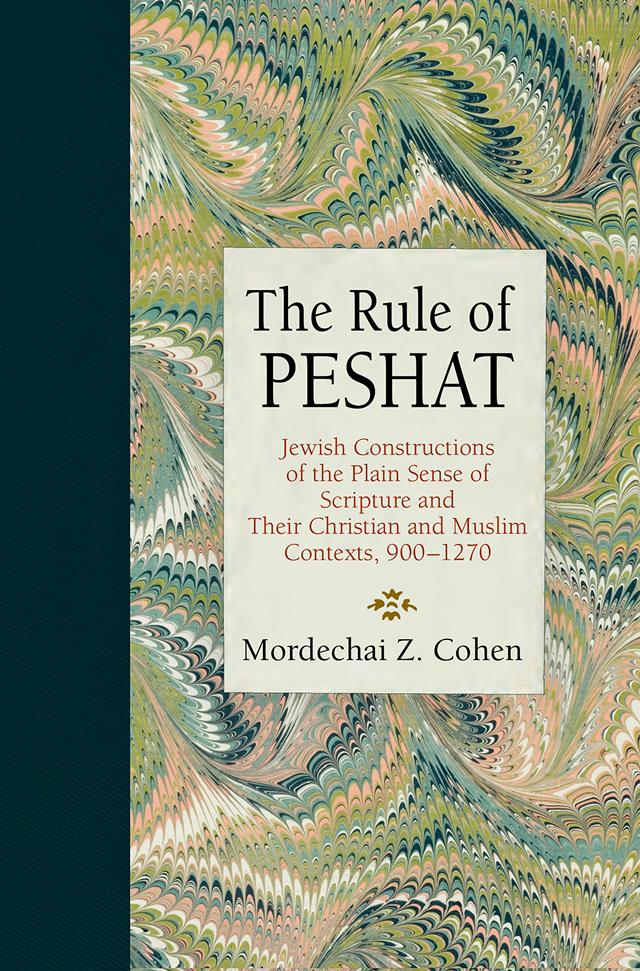
An exploration of the theoretical underpinnings of the philological method of Jewish Bible interpretation known as peshat
Within the rich tradition of Jewish biblical interpretation, few concepts are as vital as peshat, often rendered as the "plain sense" of Scripture. Generally contrasted with midrash—the creative and at times fanciful mode of reading put forth by the rabbis of Late Antiquity—peshat came to connote the systematic, philological-contextual, and historically sensitive analysis of the Hebrew Bible, coupled with an appreciation of the text's literary quality. In The Rule of "Peshat," Mordechai Z. Cohen explores the historical, geographical, and theoretical underpinnings of peshat as it emerged between 900 and 1270.
Adopting a comparative approach that explores Jewish interactions with Muslim and Christian learning, Cohen sheds new light on the key turns in the vibrant medieval tradition of Jewish Bible interpretation. Beginning in the tenth century, Jews in the Middle East drew upon Arabic linguistics and Qur'anic study to open new avenues of philological-literary exegesis. This Judeo-Arabic school later moved westward, flourishing in al-Andalus in the eleventh century. At the same time, a revolutionary peshat school was pioneered in northern France by the Ashkenazic scholar Rashi and his circle of students, whose methods are illuminated by contemporaneous trends in Latinate learning in the Cathedral Schools of France. Cohen goes on to explore the heretofore little-known Byzantine Jewish exegetical tradition, basing his examination on recently discovered eleventh-century commentaries and their offshoots in southern Italy in the twelfth century. Lastly, this study focuses on three pivotal figures who represent the culmination of the medieval Jewish exegetical tradition: Abraham Ibn Ezra, Moses Maimonides, and Moses Nahmanides. Cohen weaves together disparate Jewish disciplines and external cultural influences through chapters that trace the increasing force acquired by the peshat model until it could be characterized, finally, as the "rule of peshat": the central, defining feature of Jewish hermeneutics into the modern period.
Before Memmo my notes were scattered across PDFs. Now a workspace pulls everything into one place — I see exactly what's still left to study.
Memmo's summaries are gold before exams. I don't have to re-read 800 pages two weeks before — just the important parts.
The AI chat has saved me the night before an exam more than once. I just keep asking until I get it — no waiting on a study group to reply.
The quizzes hit exactly what I need to know. Memmo tracks what I get stuck on — so I only practice what's worth it.
Flashcards with spaced repetition are magic. Memmo knows when I'm about to forget something and brings it back.
The AI podcasts are my favorite. I listen on my way to school and get a recap without sitting at a computer.

Handbok i kvalitativa metoder
281 kr

Hållbar utveckling: en introduktion för ingenjörer och andra problemlösare
334 kr

Brymans Samhällsvetenskapliga metoder
390 kr

Projektledning
491 kr

Den orättvisa hälsan: om socioekonomiska skillnader i hälsa och livslängd
326 kr

Vetenskapsteori för nybörjare
196 kr

Organizational Leadership
429 kr

På väg mot läraryrket
172 kr

Det sociala livet i skolan: Socialpsykologiska perspektiv
253 kr

Betygsättningens didaktik
151 kr

Personality
402 kr

Studying Leadership
404 kr

Managing Innovation
477 kr

Introduktion till samhällsvetenskaplig metod
347 kr

The Psychology of Sex and Gender
698 kr

Evidens och kunskap för socialt arbete
207 kr

Introduction to Leadership
605 kr