
Before Memmo my notes were scattered across PDFs. Now a workspace pulls everything into one place — I see exactly what's still left to study.
In 2011, the United States launched its third regime-change attempt in a decade. Like earlier targets, Libya's Muammar Qaddafi had little hope of defeating the forces stacked against him. He seemed to recognize this when calling for a cease-fire just after the intervention began. But by then, the United States had determined it was better to oust him than negotiate and thus backed his opposition. The history of foreign-imposed regime change is replete with leaders like Qaddafi, overthrown after wars they seemed unlikely to win. From the British ouster of Afghanistan's Sher Ali in 1878 to the Soviet overthrow of Hungary's Imre Nagy in 1956, regime change has been imposed on the weak and the friendless.
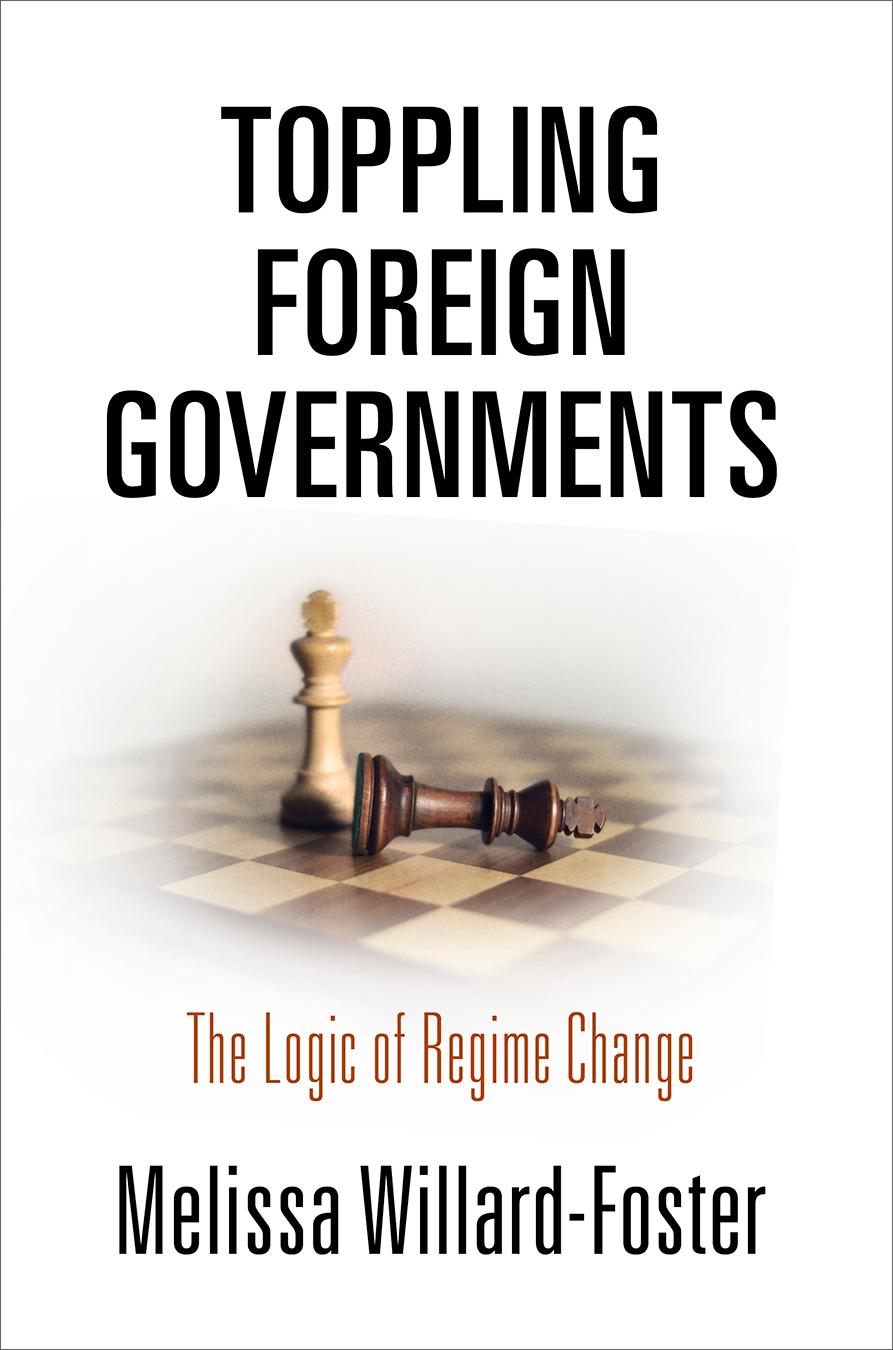
In Toppling Foreign Governments, Melissa Willard-Foster explores the question of why stronger nations overthrow governments when they could attain their aims at the bargaining table. She identifies a central cause—the targeted leader's domestic political vulnerability—that not only gives the leader motive to resist a stronger nation's demands, making a bargain more difficult to attain, but also gives the stronger nation reason to believe that regime change will be comparatively cheap. As long as the targeted leader's domestic opposition is willing to collaborate with the foreign power, the latter is likely to conclude that ousting the leader is more cost effective than negotiating.
Willard-Foster analyzes 133 instances of regime change, ranging from covert operations to major military invasions, and spanning over two hundred years. She also conducts three in-depth case studies that support her contention that domestically and militarily weak leaders appear more costly to coerce than overthrow and, as long as they remain ubiquitous, foreign-imposed regime change is likely to endure.
Before Memmo my notes were scattered across PDFs. Now a workspace pulls everything into one place — I see exactly what's still left to study.
Memmo's summaries are gold before exams. I don't have to re-read 800 pages two weeks before — just the important parts.
The AI chat has saved me the night before an exam more than once. I just keep asking until I get it — no waiting on a study group to reply.
The quizzes hit exactly what I need to know. Memmo tracks what I get stuck on — so I only practice what's worth it.
Flashcards with spaced repetition are magic. Memmo knows when I'm about to forget something and brings it back.
The AI podcasts are my favorite. I listen on my way to school and get a recap without sitting at a computer.

Handbok i kvalitativa metoder
281 kr

Hållbar utveckling: en introduktion för ingenjörer och andra problemlösare
334 kr

Brymans Samhällsvetenskapliga metoder
390 kr

Projektledning
491 kr

Den orättvisa hälsan: om socioekonomiska skillnader i hälsa och livslängd
326 kr

Vetenskapsteori för nybörjare
196 kr

Organizational Leadership
429 kr

På väg mot läraryrket
172 kr

Det sociala livet i skolan: Socialpsykologiska perspektiv
253 kr

Betygsättningens didaktik
151 kr

Personality
402 kr

Studying Leadership
404 kr

Managing Innovation
477 kr

Introduktion till samhällsvetenskaplig metod
347 kr

The Psychology of Sex and Gender
698 kr

Evidens och kunskap för socialt arbete
207 kr

Introduction to Leadership
605 kr