
Before Memmo my notes were scattered across PDFs. Now a workspace pulls everything into one place — I see exactly what's still left to study.
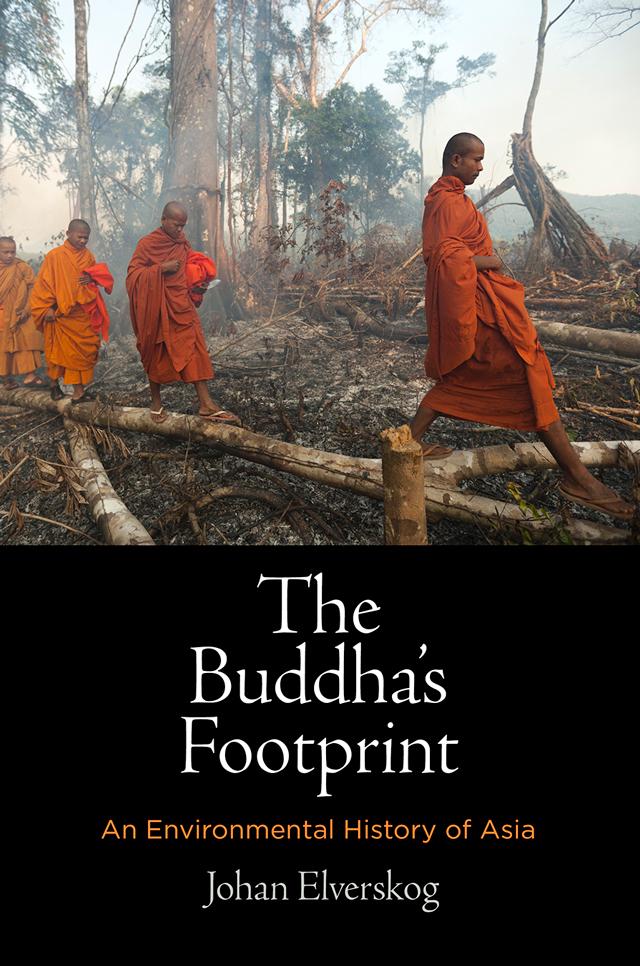
A corrective to the contemporary idea that Buddhism has always been an environmentally friendly religion
In the current popular imagination, Buddhism is often understood to be a religion intrinsically concerned with the environment. The Dharma, the name given to Buddhist teachings by Buddhists, states that all things are interconnected. Therefore, Buddhists are perceived as extending compassion beyond people and animals to include plants and the earth itself out of a concern for the total living environment. In The Buddha's Footprint, Johan Elverskog contends that only by jettisoning this contemporary image of Buddhism as a purely ascetic and apolitical tradition of contemplation can we see the true nature of the Dharma. According to Elverskog, Buddhism is, in fact, an expansive religious and political system premised on generating wealth through the exploitation of natural resources.
Elverskog surveys the expansion of Buddhism across Asia in the period between 500 BCE and 1500 CE, when Buddhist institutions were built from Iran and Azerbaijan in the west, to Kazakhstan and Siberia in the north, Japan in the east, and Sri Lanka and Indonesia in the south. He examines the prosperity theology at the heart of the Dharma that declared riches to be a sign of good karma and the means by which spritiual status could be elevated through donations bequeathed to Buddhist institutions. He demonstrates how this scriptural tradition propelled Buddhists to seek wealth and power across Asia and to exploit both the people and the environment.
Elverskog shows the ways in which Buddhist expansion not only entailed the displacement of local gods and myths with those of the Dharma—as was the case with Christianity and Islam—but also involved fundamentally transforming earlier social and political structures and networks of economic exchange. The Buddha's Footprint argues that the institutionalization of the Dharma was intimately connected to agricultural expansion, resource extraction, deforestation, urbanization, and the monumentalization of Buddhism itself.
Before Memmo my notes were scattered across PDFs. Now a workspace pulls everything into one place — I see exactly what's still left to study.
Memmo's summaries are gold before exams. I don't have to re-read 800 pages two weeks before — just the important parts.
The AI chat has saved me the night before an exam more than once. I just keep asking until I get it — no waiting on a study group to reply.
The quizzes hit exactly what I need to know. Memmo tracks what I get stuck on — so I only practice what's worth it.
Flashcards with spaced repetition are magic. Memmo knows when I'm about to forget something and brings it back.
The AI podcasts are my favorite. I listen on my way to school and get a recap without sitting at a computer.

Handbok i kvalitativa metoder
281 kr

Hållbar utveckling: en introduktion för ingenjörer och andra problemlösare
334 kr

Brymans Samhällsvetenskapliga metoder
390 kr

Projektledning
491 kr

Den orättvisa hälsan: om socioekonomiska skillnader i hälsa och livslängd
326 kr

Vetenskapsteori för nybörjare
196 kr

Organizational Leadership
429 kr

På väg mot läraryrket
172 kr

Det sociala livet i skolan: Socialpsykologiska perspektiv
253 kr

Betygsättningens didaktik
151 kr

Personality
402 kr

Studying Leadership
404 kr

Managing Innovation
477 kr

Introduktion till samhällsvetenskaplig metod
347 kr

The Psychology of Sex and Gender
698 kr

Evidens och kunskap för socialt arbete
207 kr

Introduction to Leadership
605 kr