
Before Memmo my notes were scattered across PDFs. Now a workspace pulls everything into one place — I see exactly what's still left to study.
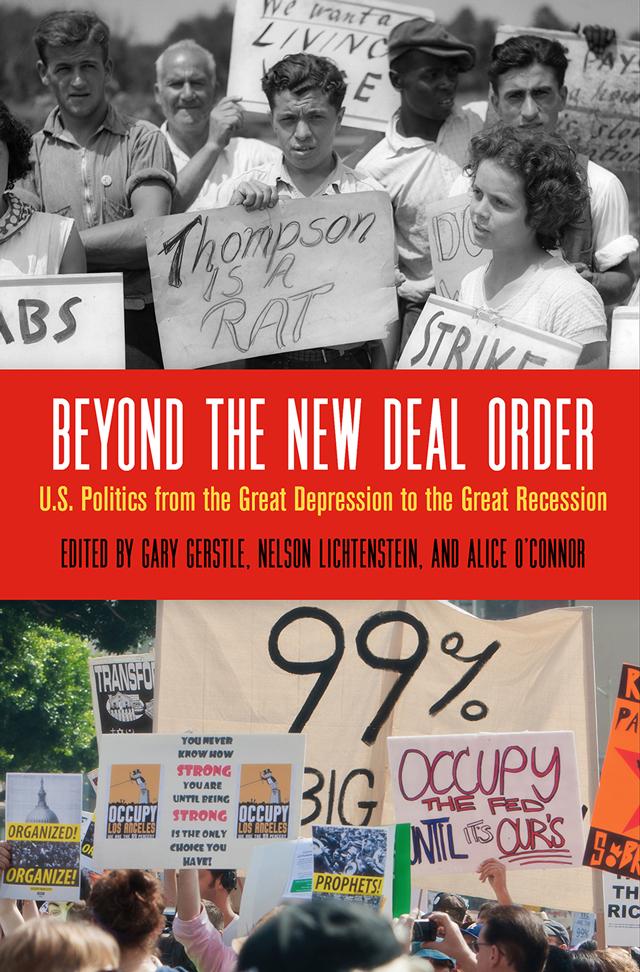
Ever since introducing the concept in the late 1980s, historians have been debating the origins, nature, scope, and limitations of the New Deal order—the combination of ideas, electoral and governing strategies, redistributive social policies, and full employment economics that became the standard-bearer for political liberalism in the wake of the Great Depression and commanded Democratic majorities for decades. In the decline and break-up of the New Deal coalition historians found keys to understanding the transformations that, by the late twentieth century, were shifting American politics to the right.
In Beyond the New Deal Order, contributors bring fresh perspective to the historic meaning and significance of New Deal liberalism while identifying the elements of a distinctively "neoliberal" politics that emerged in its wake. Part I offers contemporary interpretations of the New Deal with essays that focus on its approach to economic security and inequality, its view of participatory governance, and its impact on the Republican party as well as Congressional politics. Part II features essays that examine how intersectional inequities of class, race, and gender were embedded in New Deal labor law, labor standards, and economic policy and brought demands for employment, economic justice, and collective bargaining protections to the forefront of civil rights and social movement agendas throughout the postwar decades. Part III considers the precepts and defining narratives of a "post" New Deal political structure, while the closing essay contemplates the extent to which we may now be witnessing the end of a neoliberal system anchored in free-market ideology, neo-Victorian moral aspirations, and post-Communist global politics.
Contributors: Eileen Boris, Angus Burgin, Gary Gerstle, Romain Huret, Meg Jacobs, Michael Kazin, Sophia Lee, Nelson Lichtenstein, Joe McCartin, Alice O'Connor, Paul Sabin, Reuel Schiller, Kit Smemo, David Stein, Jean-Christian Vinel, Julian Zelizer.
Before Memmo my notes were scattered across PDFs. Now a workspace pulls everything into one place — I see exactly what's still left to study.
Memmo's summaries are gold before exams. I don't have to re-read 800 pages two weeks before — just the important parts.
The AI chat has saved me the night before an exam more than once. I just keep asking until I get it — no waiting on a study group to reply.
The quizzes hit exactly what I need to know. Memmo tracks what I get stuck on — so I only practice what's worth it.
Flashcards with spaced repetition are magic. Memmo knows when I'm about to forget something and brings it back.
The AI podcasts are my favorite. I listen on my way to school and get a recap without sitting at a computer.

Handbok i kvalitativa metoder
281 kr

Hållbar utveckling: en introduktion för ingenjörer och andra problemlösare
334 kr

Brymans Samhällsvetenskapliga metoder
390 kr

Projektledning
491 kr

Den orättvisa hälsan: om socioekonomiska skillnader i hälsa och livslängd
326 kr

Organizational Leadership
429 kr

Vetenskapsteori för nybörjare
196 kr

På väg mot läraryrket
172 kr

Det sociala livet i skolan: Socialpsykologiska perspektiv
253 kr

Betygsättningens didaktik
151 kr

Personality
402 kr

Studying Leadership
404 kr

Managing Innovation
477 kr

Introduktion till samhällsvetenskaplig metod
347 kr

The Psychology of Sex and Gender
698 kr

Evidens och kunskap för socialt arbete
207 kr

Introduction to Leadership
605 kr