
Before Memmo my notes were scattered across PDFs. Now a workspace pulls everything into one place — I see exactly what's still left to study.
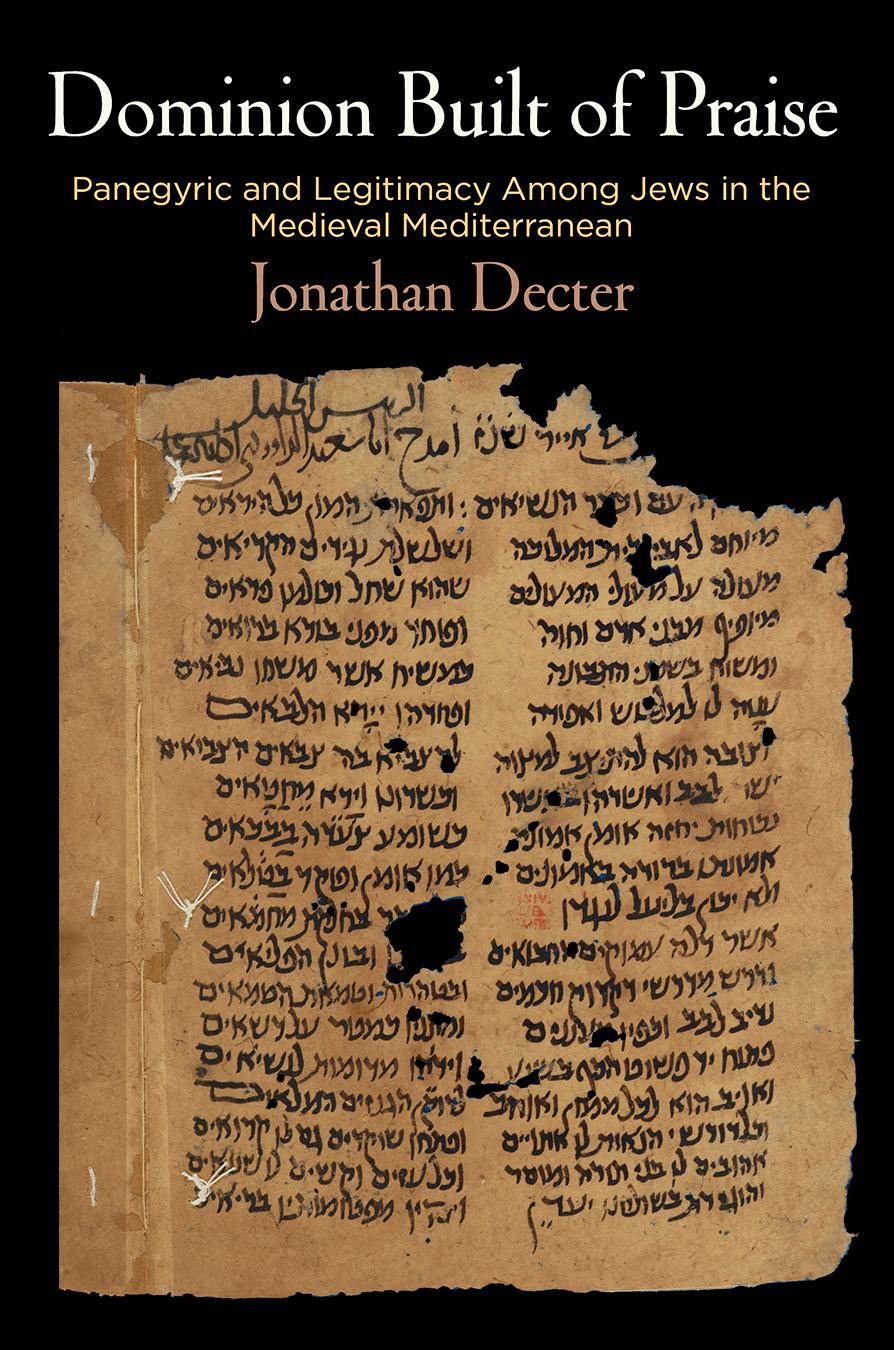
A constant feature of Jewish culture in the medieval Mediterranean was the dedication of panegyric texts in Hebrew, Judeo-Arabic, and other languages to men of several ranks: scholars, communal leaders, courtiers, merchants, patrons, and poets. Although the imagery of nature and eroticism in the preludes to these poems is often studied, the substance of what follows is generally neglected, as it is perceived to be repetitive, obsequious, and less aesthetically interesting than other types of poetry from the period. In Dominion Built of Praise, Jonathan Decter demurs. As is the case with visual portraits, panegyrics operate according to a code of cultural norms that tell us at least as much about the society that produced them as the individuals they portray. Looking at the phenomenon of panegyric in Mediterranean Jewish culture from several overlapping perspectives—social, historical, ethical, poetic, political, and theological—he finds that they offer representations of Jewish political leadership as it varied across geographic area and evolved over time.
Decter focuses his analysis primarily on Jewish centers in the Islamic Mediterranean between the tenth and thirteenth centuries and also includes a chapter on Jews in the Christian Mediterranean through the fifteenth century. He examines the hundreds of panegyrics that have survived: some copied repeatedly in luxurious anthologies, others discarded haphazardly in the Cairo Geniza. According to Decter, the poems extolled conventional character traits ascribed to leaders not only diachronically within the Jewish political tradition but also synchronically within Islamic and, to a lesser extent, Christian civilization and political culture. Dominion Built of Praise reveals more than a superficial and functional parallel between Muslim and Jewish forms of statecraft and demonstrates how ideas of Islamic political legitimacy profoundly shaped the ways in which Jews conceptualized and portrayed their own leadership.
Before Memmo my notes were scattered across PDFs. Now a workspace pulls everything into one place — I see exactly what's still left to study.
Memmo's summaries are gold before exams. I don't have to re-read 800 pages two weeks before — just the important parts.
The AI chat has saved me the night before an exam more than once. I just keep asking until I get it — no waiting on a study group to reply.
The quizzes hit exactly what I need to know. Memmo tracks what I get stuck on — so I only practice what's worth it.
Flashcards with spaced repetition are magic. Memmo knows when I'm about to forget something and brings it back.
The AI podcasts are my favorite. I listen on my way to school and get a recap without sitting at a computer.

Handbok i kvalitativa metoder
281 kr

Hållbar utveckling: en introduktion för ingenjörer och andra problemlösare
334 kr

Brymans Samhällsvetenskapliga metoder
390 kr

Projektledning
491 kr

Den orättvisa hälsan: om socioekonomiska skillnader i hälsa och livslängd
326 kr

Organizational Leadership
429 kr

Vetenskapsteori för nybörjare
196 kr

På väg mot läraryrket
172 kr

Det sociala livet i skolan: Socialpsykologiska perspektiv
253 kr

Betygsättningens didaktik
151 kr

Personality
402 kr

Studying Leadership
404 kr

Managing Innovation
477 kr

Introduktion till samhällsvetenskaplig metod
347 kr

The Psychology of Sex and Gender
698 kr

Evidens och kunskap för socialt arbete
207 kr

Introduction to Leadership
605 kr