
Before Memmo my notes were scattered across PDFs. Now a workspace pulls everything into one place — I see exactly what's still left to study.
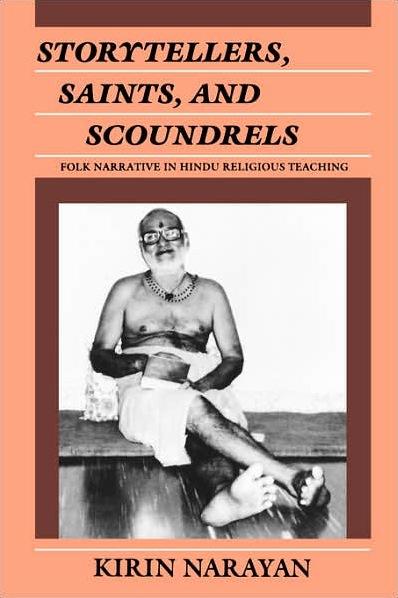
Swamiji, a Hindu holy man, is the central character of Storytellers, Saints, and Scoundrels. He reclines in a deck chair in his modern apartment in western India, telling subtle and entertaining folk narratives to his assorted gatherings. Among the listeners is Kirin Narayan, who knew Swamiji when she was a child in India and who has returned from America as an anthropologist. In her book Narayan builds on Swamiji's tales and his audiences' interpretations to ask why religious teachings the world over are so often couched in stories.
For centuries, religious teachers from many traditions have used stories to instruct their followers. When Swamiji tells a story, the local barber rocks in helpless laughter, and a sari-wearing French nurse looks on enrapt. Farmers make decisions based on the tales, and American psychotherapists take notes that link the storytelling to their own practices. Narayan herself is a key character in this ethnography. As both a local woman and a foreign academic, she is somewhere between participant and observer, reacting to the nuances of fieldwork with a sensitivity that only such a position can bring.
Each story s reproduced in its evocative performance setting. Narayan supplements eight folk narratives with discussions of audience participation and response as well as relevant Hindu themes. All these stories focus on the complex figure of the Hindu ascetic and so sharpen our understanding of renunciation and gurus in South Asia.
While Storytellers, Saints, and Scoundrels raises provocative theoretical issues, it is also a moving human document. Swamiji, with his droll characterizations, inventive mind, and generous spirit, is a memorable character. The book contributes to a growing interdisciplinary literature on narrative. It will be particularly valuable to students and scholars of anthropology, folklore, performance studies, religions, and South Asian studies.
Before Memmo my notes were scattered across PDFs. Now a workspace pulls everything into one place — I see exactly what's still left to study.
Memmo's summaries are gold before exams. I don't have to re-read 800 pages two weeks before — just the important parts.
The AI chat has saved me the night before an exam more than once. I just keep asking until I get it — no waiting on a study group to reply.
The quizzes hit exactly what I need to know. Memmo tracks what I get stuck on — so I only practice what's worth it.
Flashcards with spaced repetition are magic. Memmo knows when I'm about to forget something and brings it back.
The AI podcasts are my favorite. I listen on my way to school and get a recap without sitting at a computer.

Handbok i kvalitativa metoder
281 kr

Hållbar utveckling: en introduktion för ingenjörer och andra problemlösare
334 kr

Brymans Samhällsvetenskapliga metoder
390 kr

Projektledning
491 kr

Den orättvisa hälsan: om socioekonomiska skillnader i hälsa och livslängd
326 kr

Organizational Leadership
429 kr

Vetenskapsteori för nybörjare
196 kr

På väg mot läraryrket
172 kr

Det sociala livet i skolan: Socialpsykologiska perspektiv
253 kr

Betygsättningens didaktik
151 kr

Personality
402 kr

Studying Leadership
404 kr

Managing Innovation
477 kr

Introduktion till samhällsvetenskaplig metod
347 kr

The Psychology of Sex and Gender
698 kr

Evidens och kunskap för socialt arbete
207 kr

Introduction to Leadership
605 kr