
Before Memmo my notes were scattered across PDFs. Now a workspace pulls everything into one place — I see exactly what's still left to study.
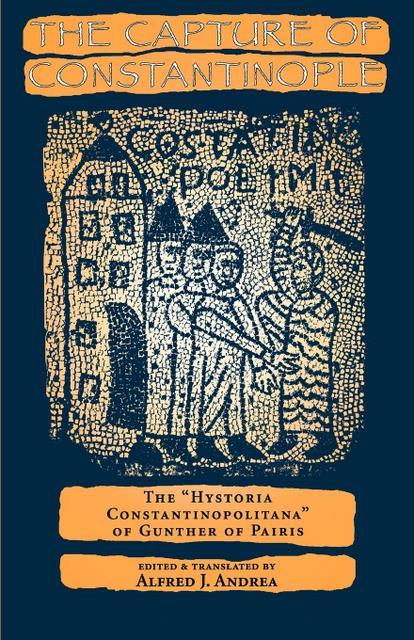
The armies of the Fourth Crusade that left Western Europe at the beginning of the thirteenth century never reached the Holy Land to fight the Infidel; they stopped instead at Byzantium and sacked that capital of eastern Christendom. Much of what we know today of those events comes from contemporary accounts by secular writers; their perspective is balanced by a document written from a monastic point of view and now available for the first time in English.
The Hystoria Constantinopolitana relates the adventures of Martin of Pairis, an abbot of the Cistercian Order who participated in the plunder of the city, as recorded by his monk Gunther. Written to justify the abbot's pious pilferage of scared relics and his transporting them back to his monastery in Alsace, it is a work of Christian metahistory that shows how the sack of Constantinople fits into God's plan for humanity, and that deeds done under divine guidance are themselves holy and righteous.
The Hystoria Constantinopolitana is one of the most complex and sophisticated historiographical work of its time, deftly interweaving moods and motifs, themes and scenes. In producing the first English translation and analysis of this work, Alfred Andrea has captured the full flavor of the original with its alternating section of prose and poetry. His introduction to the text provides background on Gunther's life and work and explores the monk's purpose in writing the Hystoria Constantinopolitana—not the least of which was extolling the virtues of Abbott Martin, who was sometimes accuse of laxity by his superiors in the Order.
Gunther's work is significant for its effort to deal with problems raised by the participation of monks in the Crusades, making it a valuable contribution to both crusading and monastic history. The Capture of Constantinople adds to our knowledge of the Fourth Crusade and provides unusual insight into the attitudes of the participants and the cultural-intellectual history of the early thirteenth century.
Before Memmo my notes were scattered across PDFs. Now a workspace pulls everything into one place — I see exactly what's still left to study.
Memmo's summaries are gold before exams. I don't have to re-read 800 pages two weeks before — just the important parts.
The AI chat has saved me the night before an exam more than once. I just keep asking until I get it — no waiting on a study group to reply.
The quizzes hit exactly what I need to know. Memmo tracks what I get stuck on — so I only practice what's worth it.
Flashcards with spaced repetition are magic. Memmo knows when I'm about to forget something and brings it back.
The AI podcasts are my favorite. I listen on my way to school and get a recap without sitting at a computer.

Handbok i kvalitativa metoder
281 kr

Hållbar utveckling: en introduktion för ingenjörer och andra problemlösare
334 kr

Brymans Samhällsvetenskapliga metoder
390 kr

Projektledning
491 kr

Den orättvisa hälsan: om socioekonomiska skillnader i hälsa och livslängd
326 kr

Vetenskapsteori för nybörjare
196 kr

Organizational Leadership
429 kr

På väg mot läraryrket
172 kr

Det sociala livet i skolan: Socialpsykologiska perspektiv
253 kr

Betygsättningens didaktik
151 kr

Personality
402 kr

Studying Leadership
404 kr

Managing Innovation
477 kr

Introduktion till samhällsvetenskaplig metod
347 kr

The Psychology of Sex and Gender
698 kr

Evidens och kunskap för socialt arbete
207 kr

Introduction to Leadership
605 kr