
Before Memmo my notes were scattered across PDFs. Now a workspace pulls everything into one place — I see exactly what's still left to study.
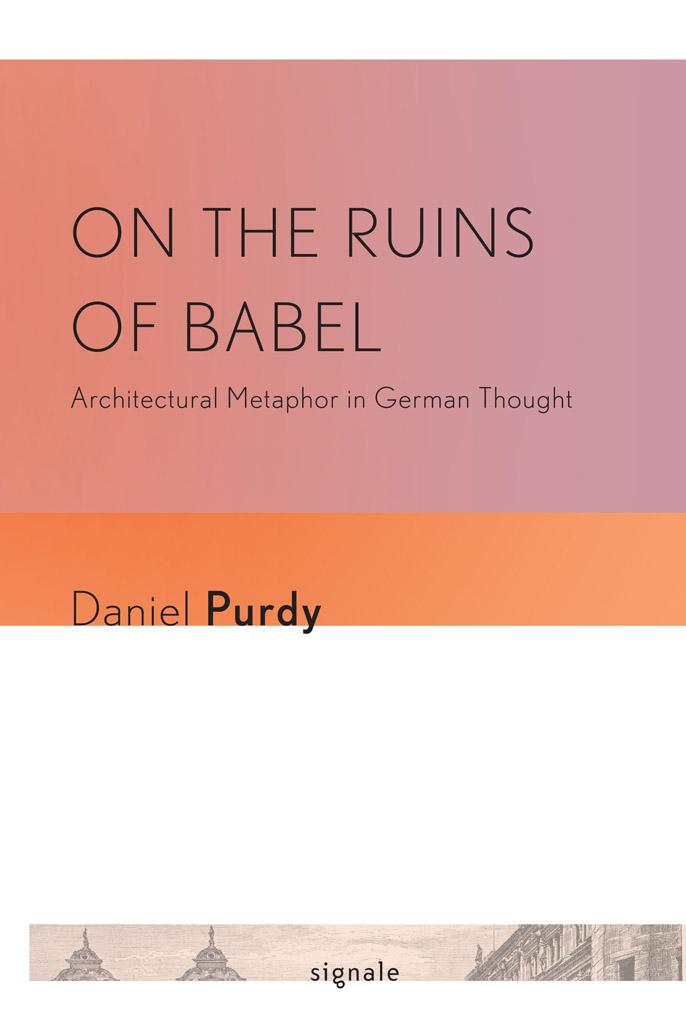
The eighteenth century struggled to define architecture as either an art or a science—the image of the architect as a grand figure who synthesizes all other disciplines within a single master plan emerged from this discourse. Immanuel Kant and Johann Wolfgang Goethe described the architect as their equal, a genius with godlike creativity. For writers from Descartes to Freud, architectural reasoning provided a method for critically examining consciousness. The architect, as philosophers liked to think of him, was obligated by the design and construction process to mediate between the abstract and the actual.
In On the Ruins of Babel, Daniel Purdy traces this notion back to its wellspring. He surveys the volatile state of architectural theory in the Enlightenment, brought on by the newly emerged scientific critiques of Renaissance cosmology, then shows how German writers redeployed Renaissance terminology so that "harmony," "unity," "synthesis," "foundation," and "orderliness" became states of consciousness, rather than terms used to describe the built world. Purdy's distinctly new interpretation of German theory reveals how metaphors constitute interior life as an architectural space to be designed, constructed, renovated, or demolished. He elucidates the close affinity between Hegel's Romantic aesthetic of space and Daniel Libeskind's deconstruction of monumental architecture in Berlin's Jewish Museum.
Through a careful reading of Walter Benjamin's writing on architecture as myth, Purdy details how classical architecture shaped Benjamin's modernist interpretations of urban life, particularly his elaboration on Freud's archaeology of the unconscious. Benjamin's essays on dreams and architecture turn the individualist sensibility of the Enlightenment into a collective and mythic identification between humans and buildings.
Before Memmo my notes were scattered across PDFs. Now a workspace pulls everything into one place — I see exactly what's still left to study.
Memmo's summaries are gold before exams. I don't have to re-read 800 pages two weeks before — just the important parts.
The AI chat has saved me the night before an exam more than once. I just keep asking until I get it — no waiting on a study group to reply.
The quizzes hit exactly what I need to know. Memmo tracks what I get stuck on — so I only practice what's worth it.
Flashcards with spaced repetition are magic. Memmo knows when I'm about to forget something and brings it back.
The AI podcasts are my favorite. I listen on my way to school and get a recap without sitting at a computer.

Handbok i kvalitativa metoder
281 kr

Hållbar utveckling: en introduktion för ingenjörer och andra problemlösare
334 kr

Brymans Samhällsvetenskapliga metoder
390 kr

Projektledning
491 kr

Den orättvisa hälsan: om socioekonomiska skillnader i hälsa och livslängd
326 kr

Vetenskapsteori för nybörjare
196 kr

Organizational Leadership
429 kr

På väg mot läraryrket
172 kr

Det sociala livet i skolan: Socialpsykologiska perspektiv
253 kr

Betygsättningens didaktik
151 kr

Personality
402 kr

Studying Leadership
404 kr

Managing Innovation
477 kr

Introduktion till samhällsvetenskaplig metod
347 kr

The Psychology of Sex and Gender
698 kr

Evidens och kunskap för socialt arbete
207 kr

Introduction to Leadership
605 kr