
Before Memmo my notes were scattered across PDFs. Now a workspace pulls everything into one place — I see exactly what's still left to study.
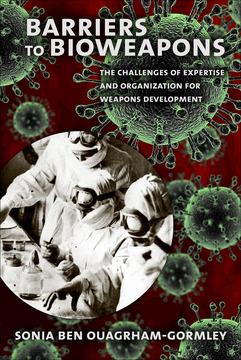
[Barriers to Bioweapons] is a must-read for nonproliferation experts and should be a standard text for understanding biological weapons development for some time to come.â•David W. Kearn, Perspectives on Politics
In both the popular imagination and among lawmakers and national security experts, there exists the belief that with sufficient motivation and material resources, states or terrorist groups can produce bioweapons easily, cheaply, and successfully. In Barriers to Bioweapons, Sonia Ben Ouagrham-Gormley challenges this perception by showing that bioweapons development is a difficult, protracted, and expensive endeavor, rarely achieving the expected results whatever the magnitude of investment.
Her findings are based on extensive interviews she conducted with former U.S. and Soviet-era bioweapons scientists and on careful analysis of archival data and other historical documents related to various state and terrorist bioweapons programs.
Bioweapons development relies on living organisms that are sensitive to their environment and handling conditions, and therefore behave unpredictably. These features place a greater premium on specialized knowledge. Ben Ouagrham-Gormley posits that lack of access to such intellectual capital constitutes the greatest barrier to the making of bioweapons. She integrates theories drawn from economics, the sociology of science, organization, and management with her empirical research. The resulting theoretical framework rests on the idea that the pace and success of a bioweapons development program can be measured by its ability to ensure the creation and transfer of scientific and technical knowledge. The specific organizational, managerial, social, political, and economic conditions necessary for success are difficult to achieve, particularly in covert programs where the need to prevent detection imposes managerial and organizational conditions that conflict with knowledge production.
Before Memmo my notes were scattered across PDFs. Now a workspace pulls everything into one place — I see exactly what's still left to study.
Memmo's summaries are gold before exams. I don't have to re-read 800 pages two weeks before — just the important parts.
The AI chat has saved me the night before an exam more than once. I just keep asking until I get it — no waiting on a study group to reply.
The quizzes hit exactly what I need to know. Memmo tracks what I get stuck on — so I only practice what's worth it.
Flashcards with spaced repetition are magic. Memmo knows when I'm about to forget something and brings it back.
The AI podcasts are my favorite. I listen on my way to school and get a recap without sitting at a computer.

Handbok i kvalitativa metoder
281 kr

Hållbar utveckling: en introduktion för ingenjörer och andra problemlösare
334 kr

Brymans Samhällsvetenskapliga metoder
390 kr

Projektledning
491 kr

Den orättvisa hälsan: om socioekonomiska skillnader i hälsa och livslängd
326 kr

Vetenskapsteori för nybörjare
196 kr

Organizational Leadership
429 kr

På väg mot läraryrket
172 kr

Det sociala livet i skolan: Socialpsykologiska perspektiv
253 kr

Betygsättningens didaktik
151 kr

Personality
402 kr

Studying Leadership
404 kr

Managing Innovation
477 kr

Introduktion till samhällsvetenskaplig metod
347 kr

The Psychology of Sex and Gender
698 kr

Evidens och kunskap för socialt arbete
207 kr

Introduction to Leadership
605 kr