
Before Memmo my notes were scattered across PDFs. Now a workspace pulls everything into one place — I see exactly what's still left to study.
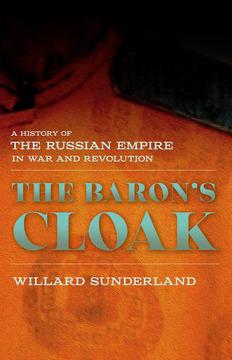
Baron Roman Fedorovich von Ungern-Sternberg (1885–1921) was a Baltic German aristocrat and tsarist military officer who fought against the Bolsheviks in Eastern Siberia during the Russian Civil War. From there he established himself as the de facto warlord of Outer Mongolia, the base for a fantastical plan to restore the Russian and Chinese empires, which then ended with his capture and execution by the Red Army as the war drew to a close.
In The Baron's Cloak, Willard Sunderland tells the epic story of the Russian Empire's final decades through the arc of the Baron's life, which spanned the vast reaches of Eurasia. Tracking Ungern's movements, he transits through the Empire's multinational borderlands, where the country bumped up against three other doomed empires, the Habsburg, Ottoman, and Qing, and where the violence unleashed by war, revolution, and imperial collapse was particularly vicious. In compulsively readable prose that draws on wide-ranging research in multiple languages, Sunderland re-creates Ungern's far-flung life and uses it to tell a compelling and original tale of imperial success and failure in a momentous time.
Sunderland visited the many sites that shaped Ungern's experience, from Austria and Estonia to Mongolia and China, and these travels help give the book its arresting geographical feel. In the early chapters, where direct evidence of Ungern's activities is sparse, he evokes peoples and places as Ungern would have experienced them, carefully tracing the accumulation of influences that ultimately came together to propel the better documented, more notorious phase of his career.
Recurring throughout Sunderland's magisterial account is a specific artifact: the Baron's cloak, an essential part of the cross-cultural uniform Ungern chose for himself by the time of his Mongolian campaign: an orangey-gold Mongolian kaftan embroidered in the Khalkha fashion yet outfitted with tsarist-style epaulettes on the shoulders. Like his cloak, Ungern was an imperial product. He lived across the Russian Empire, combined its contrasting cultures, fought its wars, and was molded by its greatest institutions and most volatile frontiers. By the time of his trial and execution mere months before the decree that created the USSR, he had become a profoundly contradictory figure, reflecting both the empire's potential as a multinational society and its ultimately irresolvable limitations.
Before Memmo my notes were scattered across PDFs. Now a workspace pulls everything into one place — I see exactly what's still left to study.
Memmo's summaries are gold before exams. I don't have to re-read 800 pages two weeks before — just the important parts.
The AI chat has saved me the night before an exam more than once. I just keep asking until I get it — no waiting on a study group to reply.
The quizzes hit exactly what I need to know. Memmo tracks what I get stuck on — so I only practice what's worth it.
Flashcards with spaced repetition are magic. Memmo knows when I'm about to forget something and brings it back.
The AI podcasts are my favorite. I listen on my way to school and get a recap without sitting at a computer.

Handbok i kvalitativa metoder
281 kr

Hållbar utveckling: en introduktion för ingenjörer och andra problemlösare
334 kr

Brymans Samhällsvetenskapliga metoder
390 kr

Projektledning
491 kr

Den orättvisa hälsan: om socioekonomiska skillnader i hälsa och livslängd
326 kr

Vetenskapsteori för nybörjare
196 kr

Organizational Leadership
429 kr

På väg mot läraryrket
172 kr

Det sociala livet i skolan: Socialpsykologiska perspektiv
253 kr

Betygsättningens didaktik
151 kr

Personality
402 kr

Studying Leadership
404 kr

Managing Innovation
477 kr

Introduktion till samhällsvetenskaplig metod
347 kr

The Psychology of Sex and Gender
698 kr

Evidens och kunskap för socialt arbete
207 kr

Introduction to Leadership
605 kr