
Before Memmo my notes were scattered across PDFs. Now a workspace pulls everything into one place — I see exactly what's still left to study.
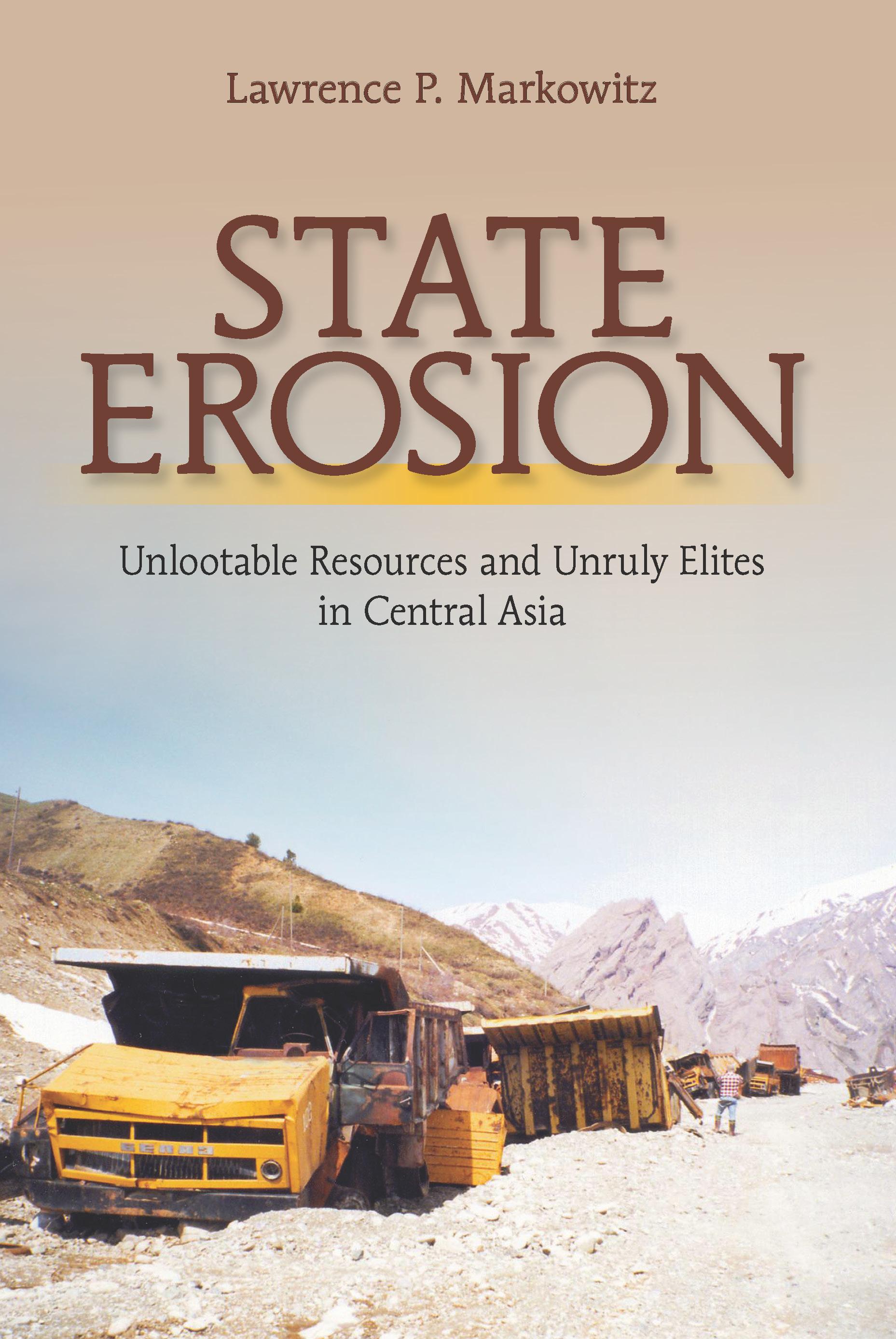
State failure is a central challenge to international peace and security in the post–Cold War era. Yet theorizing on the causes of state failure remains surprisingly limited. In State Erosion, Lawrence P. Markowitz draws on his extensive fieldwork in two Central Asian republics—Tajikistan, where state institutions fragmented into a five-year civil war from 1992 through 1997, and Uzbekistan, which constructed one of the largest state security apparatuses in post-Soviet Eurasia—to advance a theory of state failure focused on unlootable resources, rent seeking, and unruly elites.
In Tajikistan, Uzbekistan, and other countries with low capital mobility—where resources cannot be extracted, concealed, or transported to market without state intervention—local elites may control resources, but they depend on patrons to convert their resources into rents. Markowitz argues that different rent-seeking opportunities either promote the cooptation of local elites to the regime or incite competition over rents, which in turn lead to either cohesion or fragmentation. Markowitz distinguishes between weak states and failed states, challenges the assumption that state failure in a country begins at the center and radiates outward, and expands the "resource curse" argument to include cash crop economies, where mechanisms of state failure differ from those involved in fossil fuels and minerals. Broadening his argument to weak states in the Middle East (Syria and Lebanon) and Africa (Zimbabwe and Somalia), Markowitz shows how the distinct patterns of state failure in weak states with immobile capital can inform our understanding of regime change, ethnic violence, and security sector reform.
Before Memmo my notes were scattered across PDFs. Now a workspace pulls everything into one place — I see exactly what's still left to study.
Memmo's summaries are gold before exams. I don't have to re-read 800 pages two weeks before — just the important parts.
The AI chat has saved me the night before an exam more than once. I just keep asking until I get it — no waiting on a study group to reply.
The quizzes hit exactly what I need to know. Memmo tracks what I get stuck on — so I only practice what's worth it.
Flashcards with spaced repetition are magic. Memmo knows when I'm about to forget something and brings it back.
The AI podcasts are my favorite. I listen on my way to school and get a recap without sitting at a computer.

Handbok i kvalitativa metoder
281 kr

Hållbar utveckling: en introduktion för ingenjörer och andra problemlösare
334 kr

Brymans Samhällsvetenskapliga metoder
390 kr

Projektledning
491 kr

Den orättvisa hälsan: om socioekonomiska skillnader i hälsa och livslängd
326 kr

Vetenskapsteori för nybörjare
196 kr

Organizational Leadership
429 kr

På väg mot läraryrket
172 kr

Det sociala livet i skolan: Socialpsykologiska perspektiv
253 kr

Betygsättningens didaktik
151 kr

Personality
402 kr

Studying Leadership
404 kr

Managing Innovation
477 kr

Introduktion till samhällsvetenskaplig metod
347 kr

The Psychology of Sex and Gender
698 kr

Evidens och kunskap för socialt arbete
207 kr

Introduction to Leadership
605 kr