
Before Memmo my notes were scattered across PDFs. Now a workspace pulls everything into one place — I see exactly what's still left to study.
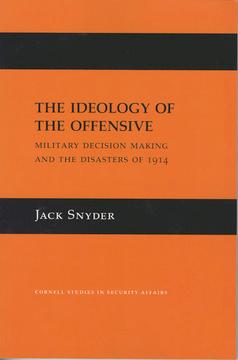
Jack Snyder's analysis of the attitudes of military planners in the years prior to the Great War offers new insight into the tragic miscalculations of that era and into their possible parallels in present-day war planning. By 1914, the European military powers had adopted offensive military strategies even though there was considerable evidence to support the notion that much greater advantage lay with defensive strategies. The author argues that organizational biases inherent in military strategists' attitudes make war more likely by encouraging offensive postures even when the motive is self-defense.
Drawing on new historical evidence of the specific circumstances surrounding French, German, and Russian strategic policy, Snyder demonstrates that it is not only rational analysis that determines strategic doctrine, but also the attitudes of military planners. Snyder argues that the use of rational calculation often falls victim to the pursuit of organizational interests such as autonomy, prestige, growth, and wealth. Furthermore, efforts to justify the preferred policy bring biases into strategists' decisions—biases reflecting the influences of parochial interests and preconceptions, and those resulting from attempts to simplify unduly their analytical tasks.The frightening lesson here is that doctrines can be destabilizing even when weapons are not, because doctrine may be more responsive to the organizational needs of the military than to the implications of the prevailing weapons technology. By examining the historical failure of offensive doctrine, Jack Snyder makes a valuable contribution to the literature on the causes of war.
Before Memmo my notes were scattered across PDFs. Now a workspace pulls everything into one place — I see exactly what's still left to study.
Memmo's summaries are gold before exams. I don't have to re-read 800 pages two weeks before — just the important parts.
The AI chat has saved me the night before an exam more than once. I just keep asking until I get it — no waiting on a study group to reply.
The quizzes hit exactly what I need to know. Memmo tracks what I get stuck on — so I only practice what's worth it.
Flashcards with spaced repetition are magic. Memmo knows when I'm about to forget something and brings it back.
The AI podcasts are my favorite. I listen on my way to school and get a recap without sitting at a computer.

Handbok i kvalitativa metoder
281 kr

Hållbar utveckling: en introduktion för ingenjörer och andra problemlösare
334 kr

Brymans Samhällsvetenskapliga metoder
390 kr

Projektledning
491 kr

Den orättvisa hälsan: om socioekonomiska skillnader i hälsa och livslängd
326 kr

Vetenskapsteori för nybörjare
196 kr

Organizational Leadership
429 kr

På väg mot läraryrket
172 kr

Det sociala livet i skolan: Socialpsykologiska perspektiv
253 kr

Betygsättningens didaktik
151 kr

Personality
402 kr

Studying Leadership
404 kr

Managing Innovation
477 kr

Introduktion till samhällsvetenskaplig metod
347 kr

The Psychology of Sex and Gender
698 kr

Evidens och kunskap för socialt arbete
207 kr

Introduction to Leadership
605 kr