
Before Memmo my notes were scattered across PDFs. Now a workspace pulls everything into one place — I see exactly what's still left to study.
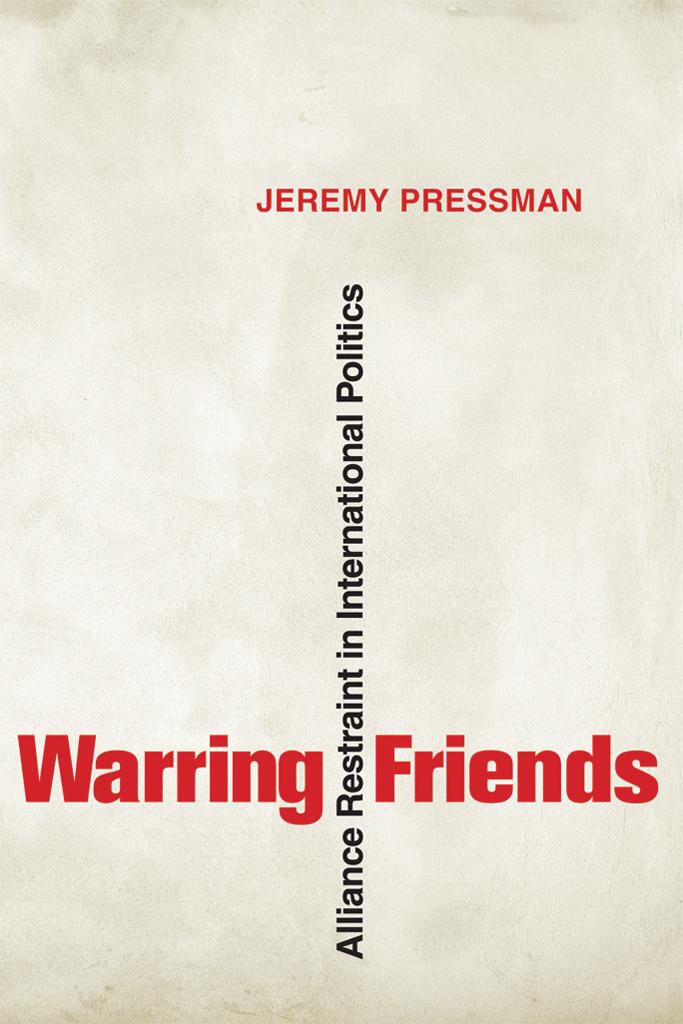
Allied nations often stop each other from going to war. Some countries even form alliances with the specific intent of restraining another power and thereby preventing war. Furthermore, restraint often becomes an issue in existing alliances as one ally wants to start a war, launch a military intervention, or pursue some other risky military policy while the other ally balks. In Warring Friends, Jeremy Pressman draws on and critiques realist, normative, and institutionalist understandings of how alliance decisions are made.
Alliance restraint often has a role to play both in the genesis of alliances and in their continuation. As this book demonstrates, an external power can apply the brakes to an incipient conflict, and even unheeded advice can aid in clarifying national goals. The power differentials between allies in these partnerships are influenced by leadership unity, deception, policy substitutes, and national security priorities.
Recent controversy over the complicated relationship between the U.S. and Israeli governments—especially in regard to military and security concerns—is a reminder that the alliance has never been easy or straightforward. Pressman highlights multiple episodes during which the United States attempted to restrain Israel's military policies: Israeli nuclear proliferation during the Kennedy Administration; the 1967 Arab-Israeli War; preventing an Israeli preemptive attack in 1973; a small Israeli operation in Lebanon in 1977; the Israeli invasion of Lebanon in 1982; and Israeli action during the Gulf War of 1991. As Pressman shows, U.S. initiatives were successful only in 1973, 1977, and 1991, and tensions have flared up again recently as a result of Israeli arms sales to China.
Pressman also illuminates aspects of the Anglo-American special relationship as revealed in several cases: British nonintervention in Iran in 1951; U.S. nonintervention in Indochina in 1954; U.S. commitments to Taiwan that Britain opposed, 1954-1955; and British intervention and then withdrawal during the Suez War of 1956. These historical examples go far to explain the context within which the Blair administration failed to prevent the U.S. government from pursuing war in Iraq at a time of unprecedented American power.
Before Memmo my notes were scattered across PDFs. Now a workspace pulls everything into one place — I see exactly what's still left to study.
Memmo's summaries are gold before exams. I don't have to re-read 800 pages two weeks before — just the important parts.
The AI chat has saved me the night before an exam more than once. I just keep asking until I get it — no waiting on a study group to reply.
The quizzes hit exactly what I need to know. Memmo tracks what I get stuck on — so I only practice what's worth it.
Flashcards with spaced repetition are magic. Memmo knows when I'm about to forget something and brings it back.
The AI podcasts are my favorite. I listen on my way to school and get a recap without sitting at a computer.

Handbok i kvalitativa metoder
281 kr

Hållbar utveckling: en introduktion för ingenjörer och andra problemlösare
334 kr

Brymans Samhällsvetenskapliga metoder
390 kr

Projektledning
491 kr

Den orättvisa hälsan: om socioekonomiska skillnader i hälsa och livslängd
326 kr

Organizational Leadership
429 kr

Vetenskapsteori för nybörjare
196 kr

På väg mot läraryrket
172 kr

Det sociala livet i skolan: Socialpsykologiska perspektiv
253 kr

Betygsättningens didaktik
151 kr

Personality
402 kr

Studying Leadership
404 kr

Managing Innovation
477 kr

Introduktion till samhällsvetenskaplig metod
347 kr

The Psychology of Sex and Gender
698 kr

Evidens och kunskap för socialt arbete
207 kr

Introduction to Leadership
605 kr