
Before Memmo my notes were scattered across PDFs. Now a workspace pulls everything into one place — I see exactly what's still left to study.
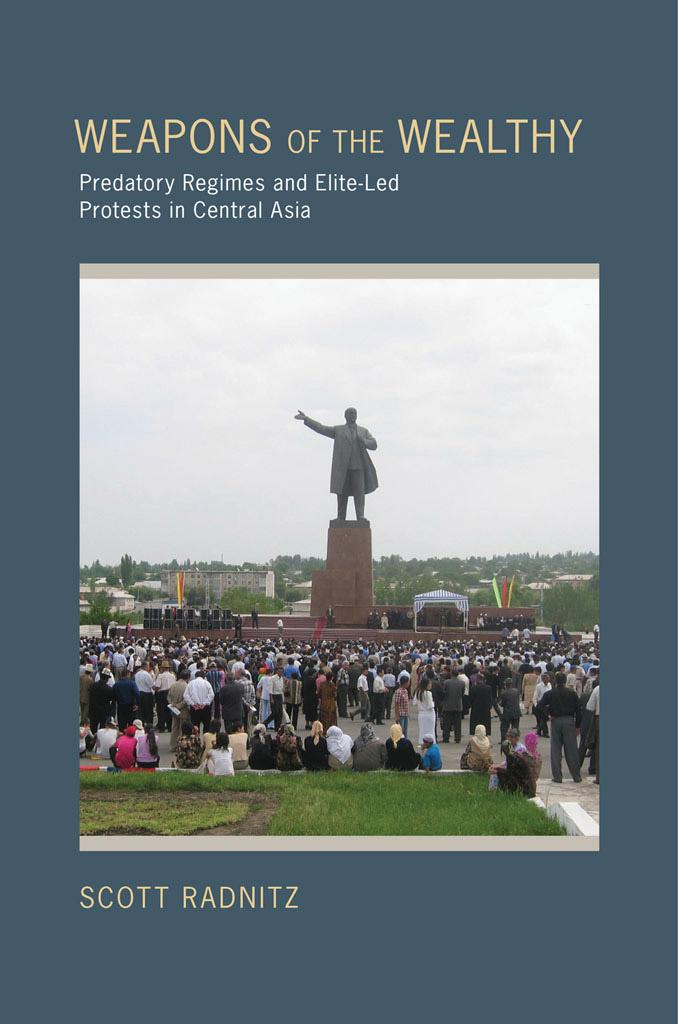
Mass mobilization is among the most dramatic and inspiring forces for political change. When ordinary citizens take to the streets in large numbers, they can undermine and even topple undemocratic governments, as the recent wave of peaceful uprisings in several postcommunist states has shown. However, investigation into how protests are organized can sometimes reveal that the origins and purpose of "people power" are not as they appear on the surface. In particular, protest can be used as an instrument of elite actors to advance their own interests rather than those of the masses.
Weapons of the Wealthy focuses on the region of post-Soviet Central Asia to investigate the causes of elite-led protest. In nondemocratic states, economic and political opportunities can give rise to elites who are independent of the regime, yet vulnerable to expropriation and harassment from above. In conditions of political uncertainty, elites have an incentive to cultivate support in local communities, which elites can then wield as a "weapon" against a predatory regime. Scott Radnitz builds on his in-depth fieldwork and analysis of the spatial distribution of protests to demonstrate how Kyrgyzstan's post-independence development laid the groundwork for elite-led mobilization, whereas Uzbekistan's did not. Elites often have the wherewithal and the motivation to trigger protests, as is borne out by Radnitz's more than one hundred interviews with those who participated in, observed, or avoided protests.
Even Kyrgyzstan's 2005 "Tulip Revolution," which brought about the first peaceful change of power in Central Asia since independence, should be understood as a strategic action of elites rather than as an expression of the popular will. This interpretation helps account for the undemocratic nature of the successor government and the 2010 uprising that toppled it. It also serves as a warning for scholars to look critically at bottom-up political change.
Before Memmo my notes were scattered across PDFs. Now a workspace pulls everything into one place — I see exactly what's still left to study.
Memmo's summaries are gold before exams. I don't have to re-read 800 pages two weeks before — just the important parts.
The AI chat has saved me the night before an exam more than once. I just keep asking until I get it — no waiting on a study group to reply.
The quizzes hit exactly what I need to know. Memmo tracks what I get stuck on — so I only practice what's worth it.
Flashcards with spaced repetition are magic. Memmo knows when I'm about to forget something and brings it back.
The AI podcasts are my favorite. I listen on my way to school and get a recap without sitting at a computer.

Handbok i kvalitativa metoder
281 kr

Hållbar utveckling: en introduktion för ingenjörer och andra problemlösare
334 kr

Brymans Samhällsvetenskapliga metoder
390 kr

Projektledning
491 kr

Den orättvisa hälsan: om socioekonomiska skillnader i hälsa och livslängd
326 kr

Vetenskapsteori för nybörjare
196 kr

Organizational Leadership
429 kr

På väg mot läraryrket
172 kr

Det sociala livet i skolan: Socialpsykologiska perspektiv
253 kr

Betygsättningens didaktik
151 kr

Personality
402 kr

Studying Leadership
404 kr

Managing Innovation
477 kr

Introduktion till samhällsvetenskaplig metod
347 kr

The Psychology of Sex and Gender
698 kr

Evidens och kunskap för socialt arbete
207 kr

Introduction to Leadership
605 kr