
Before Memmo my notes were scattered across PDFs. Now a workspace pulls everything into one place — I see exactly what's still left to study.
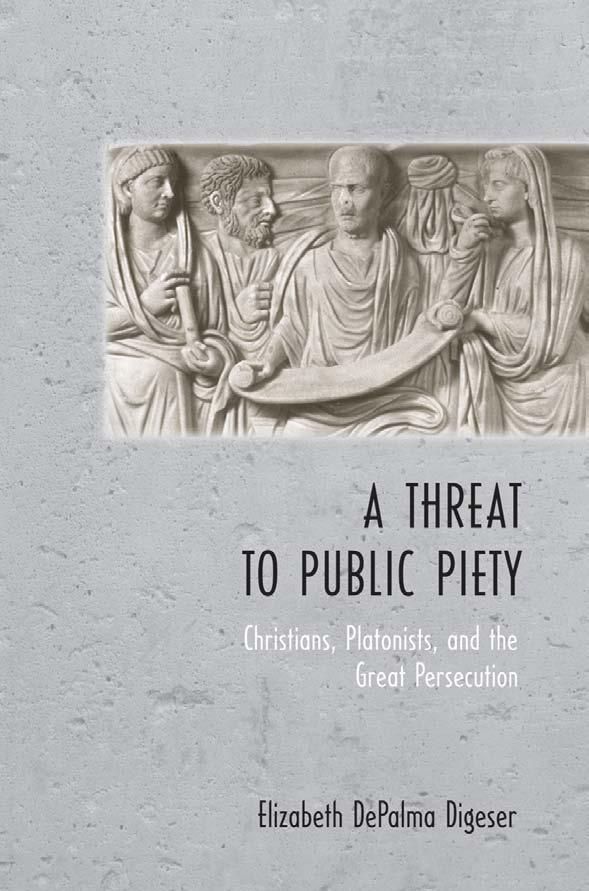
In A Threat to Public Piety, Elizabeth DePalma Digeser reexamines the origins of the Great Persecution (AD 303–313), the last eruption of pagan violence against Christians before Constantine enforced the toleration of Christianity within the Empire. Challenging the widely accepted view that the persecution enacted by Emperor Diocletian was largely inevitable, she points out that in the forty years leading up to the Great Persecution Christians lived largely in peace with their fellow Roman citizens. Why, Digeser asks, did pagans and Christians, who had intermingled cordially and productively for decades, become so sharply divided by the turn of the century?
Making use of evidence that has only recently been dated to this period, Digeser shows that a falling out between Neoplatonist philosophers, specifically Iamblichus and Porphyry, lit the spark that fueled the Great Persecution. In the aftermath of this falling out, a group of influential pagan priests and philosophers began writing and speaking against Christians, urging them to forsake Jesus-worship and to rejoin traditional cults while Porphyry used his access to Diocletian to advocate persecution of Christians on the grounds that they were a source of impurity and impiety within the empire.
The first book to explore in depth the intellectual social milieu of the late third century, A Threat to Public Piety revises our understanding of the period by revealing the extent to which Platonist philosophers (Ammonius, Plotinus, Porphyry, and Iamblichus) and Christian theologians (Origen, Eusebius) came from a common educational tradition, often studying and teaching side by side in heterogeneous groups.
Before Memmo my notes were scattered across PDFs. Now a workspace pulls everything into one place — I see exactly what's still left to study.
Memmo's summaries are gold before exams. I don't have to re-read 800 pages two weeks before — just the important parts.
The AI chat has saved me the night before an exam more than once. I just keep asking until I get it — no waiting on a study group to reply.
The quizzes hit exactly what I need to know. Memmo tracks what I get stuck on — so I only practice what's worth it.
Flashcards with spaced repetition are magic. Memmo knows when I'm about to forget something and brings it back.
The AI podcasts are my favorite. I listen on my way to school and get a recap without sitting at a computer.

Handbok i kvalitativa metoder
281 kr

Hållbar utveckling: en introduktion för ingenjörer och andra problemlösare
334 kr

Brymans Samhällsvetenskapliga metoder
390 kr

Projektledning
491 kr

Den orättvisa hälsan: om socioekonomiska skillnader i hälsa och livslängd
326 kr

Organizational Leadership
429 kr

Vetenskapsteori för nybörjare
196 kr

På väg mot läraryrket
172 kr

Det sociala livet i skolan: Socialpsykologiska perspektiv
253 kr

Betygsättningens didaktik
151 kr

Personality
402 kr

Studying Leadership
404 kr

Managing Innovation
477 kr

Introduktion till samhällsvetenskaplig metod
347 kr

The Psychology of Sex and Gender
698 kr

Evidens och kunskap för socialt arbete
207 kr

Introduction to Leadership
605 kr