
Before Memmo my notes were scattered across PDFs. Now a workspace pulls everything into one place — I see exactly what's still left to study.
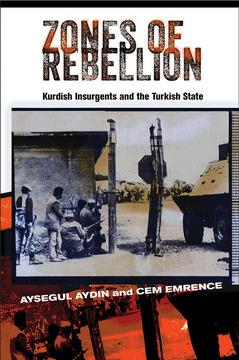
How do insurgents and governments select their targets? Which ideological discourses and organizational policies do they adopt to win civilian loyalties and control territory? Aysegul Aydin and Cem Emrence suggest that both insurgents and governments adopt a wide variety of coercive strategies in war environments. Zones of Rebellion integrates Turkish-Ottoman history with social science theory and unveils long-term policies that continue to inform the distribution of violence in Anatolia. The authors show the astonishing similarity in combatants' practices over time and their resulting inability to consolidate Kurdish people and territory around their respective political agendas.
The Kurdish insurgency in Turkey is one of the longest-running civil wars in the Middle East. For the first time, Zones of Rebellion demonstrates how violence in this conflict has varied geographically. Identifying distinct zones of violence, Aydin and Emrence show why Kurds and Kurdish territories have followed different political trajectories, guaranteeing continued strife between Kurdish insurgents and the Turkish state in an area where armed groups organized along ethnic lines have battled the central state since Ottoman times.
Aydin and Emrence present the first empirical analysis of Kurdish insurgency, relying on original data. These new datasets include information on the location, method, timing, target, and outcome of more than ten thousand insurgent attacks and counterinsurgent operations between 1984 and 2008. Another data set registers civilian unrest in Kurdish urban centers for the same period, including nearly eight hundred incidents ranging from passive resistance to active challenges to Turkey's security forces. The authors argue that both state agents and insurgents are locked into particular tactics in their conduct of civil war and that the inability of combatants to switch from violence to civic politics leads to a long-running stalemate. Such rigidity blocks negotiations and prevents battlefield victories from being translated into political solutions and lasting agreements.
Before Memmo my notes were scattered across PDFs. Now a workspace pulls everything into one place — I see exactly what's still left to study.
Memmo's summaries are gold before exams. I don't have to re-read 800 pages two weeks before — just the important parts.
The AI chat has saved me the night before an exam more than once. I just keep asking until I get it — no waiting on a study group to reply.
The quizzes hit exactly what I need to know. Memmo tracks what I get stuck on — so I only practice what's worth it.
Flashcards with spaced repetition are magic. Memmo knows when I'm about to forget something and brings it back.
The AI podcasts are my favorite. I listen on my way to school and get a recap without sitting at a computer.

Handbok i kvalitativa metoder
281 kr

Hållbar utveckling: en introduktion för ingenjörer och andra problemlösare
334 kr

Brymans Samhällsvetenskapliga metoder
390 kr

Projektledning
491 kr

Den orättvisa hälsan: om socioekonomiska skillnader i hälsa och livslängd
326 kr

Vetenskapsteori för nybörjare
196 kr

Organizational Leadership
429 kr

På väg mot läraryrket
172 kr

Det sociala livet i skolan: Socialpsykologiska perspektiv
253 kr

Betygsättningens didaktik
151 kr

Personality
402 kr

Studying Leadership
404 kr

Managing Innovation
477 kr

Introduktion till samhällsvetenskaplig metod
347 kr

The Psychology of Sex and Gender
698 kr

Evidens och kunskap för socialt arbete
207 kr

Introduction to Leadership
605 kr