
Before Memmo my notes were scattered across PDFs. Now a workspace pulls everything into one place — I see exactly what's still left to study.
"Oil is a fairy tale, and, like every fairy tale, is a bit of a lie."—Ryzard Kapuscinski, Shah of Shahs
The scale and reach of the global oil and gas industry, valued at several trillions of dollars, is almost impossible to grasp. Despite its vast technical expertise and scientific sophistication, the industry betrays a startling degree of inexactitude and empirical disagreement about foundational questions of quantity, output, and price. As an industry typified by concentrated economic and political power, its operations are obscured by secrecy and security. Perhaps it is not surprising, then, that the social sciences typically approach oil as a metonym—of modernity, money, geopolitics, violence, corruption, curse, ur-commodity—rather than considering the daily life of the industry itself and of the hydrocarbons around which it is built.
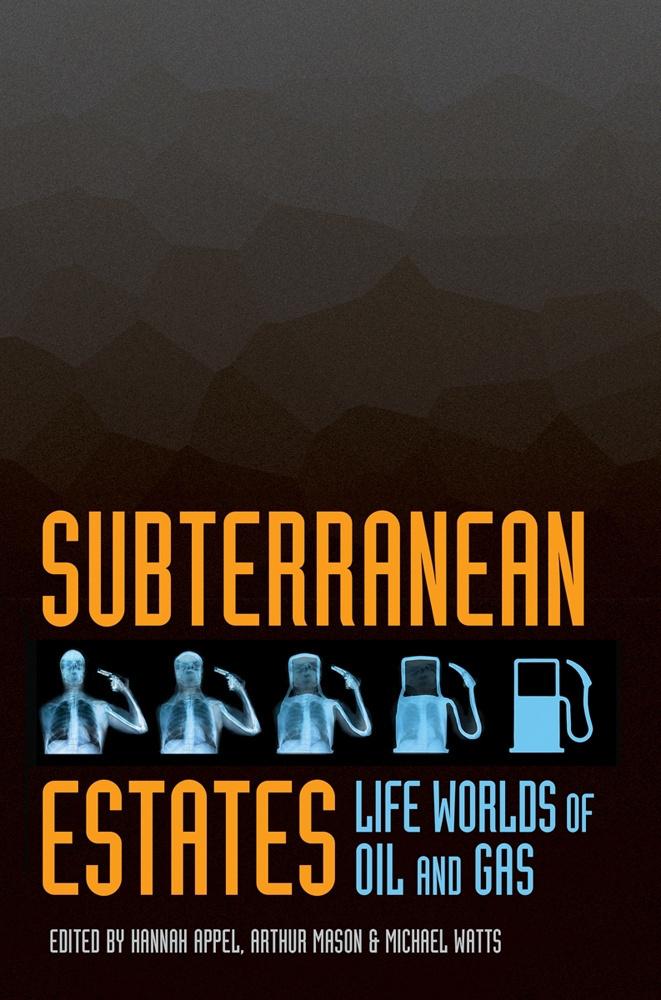
Subterranean Estates gathers an interdisciplinary group of scholars and experts to instead provide a critical topography of the hydrocarbon industry, understood not solely as an assemblage of corporate forms but rather as an expansive and porous network of laborers and technologies, representation and expertise, and the ways of life oil and gas produce at points of extraction, production, marketing, consumption, and combustion. By accounting for oil as empirical and experiential, the contributors begin to demystify a commodity too often given almost demiurgic power.
Subterranean Estates shifts critical attention away from an exclusive focus on global oil firms toward often overlooked aspects of the industry, including insurance, finance, law, and the role of consultants and community organizations. Based on ethnographic research from around the world (Equatorial Guinea, Nigeria, Oman, the United States, Ecuador, Chad, the United Kingdom, Kazakhstan, Canada, Iran, and Russia), and featuring a photoessay on the lived experiences of those who inhabit a universe populated by oil rigs, pipelines, and gas flares, this innovative volume provides a new perspective on the material, symbolic, cultural, and social meanings of this multidimensional world.
Before Memmo my notes were scattered across PDFs. Now a workspace pulls everything into one place — I see exactly what's still left to study.
Memmo's summaries are gold before exams. I don't have to re-read 800 pages two weeks before — just the important parts.
The AI chat has saved me the night before an exam more than once. I just keep asking until I get it — no waiting on a study group to reply.
The quizzes hit exactly what I need to know. Memmo tracks what I get stuck on — so I only practice what's worth it.
Flashcards with spaced repetition are magic. Memmo knows when I'm about to forget something and brings it back.
The AI podcasts are my favorite. I listen on my way to school and get a recap without sitting at a computer.

Handbok i kvalitativa metoder
281 kr

Hållbar utveckling: en introduktion för ingenjörer och andra problemlösare
334 kr

Brymans Samhällsvetenskapliga metoder
390 kr

Projektledning
491 kr

Den orättvisa hälsan: om socioekonomiska skillnader i hälsa och livslängd
326 kr

Organizational Leadership
429 kr

Vetenskapsteori för nybörjare
196 kr

På väg mot läraryrket
172 kr

Det sociala livet i skolan: Socialpsykologiska perspektiv
253 kr

Betygsättningens didaktik
151 kr

Personality
402 kr

Studying Leadership
404 kr

Managing Innovation
477 kr

Introduktion till samhällsvetenskaplig metod
347 kr

The Psychology of Sex and Gender
698 kr

Evidens och kunskap för socialt arbete
207 kr

Introduction to Leadership
605 kr