
Before Memmo my notes were scattered across PDFs. Now a workspace pulls everything into one place — I see exactly what's still left to study.
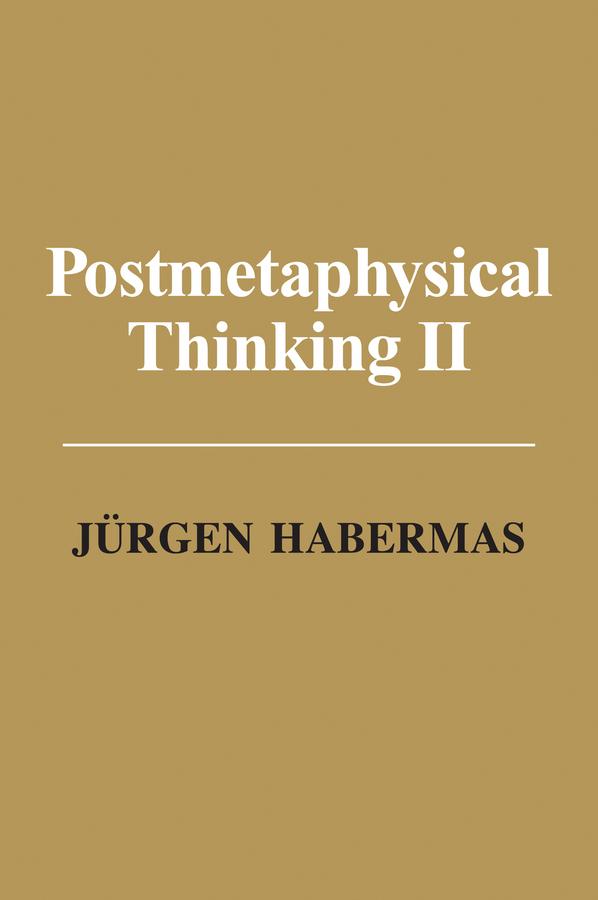
‘There is no alternative to postmetaphysical thinking’: this statement, made by Jürgen Habermas in 1988, has lost none of its relevance. Postmetaphysical thinking is, in the first place, the historical answer to the crisis of metaphysics following Hegel, when the central metaphysical figures of thought began to totter under the pressure exerted by social developments and by developments within science. As a result, philosophy’s epistemological privilege was shaken to its core, its basic concepts were de-transcendentalized, and the primacy of theory over practice was opened to question. For good reasons, philosophy ‘lost its extraordinary status’, but as a result it also courted new problems. In Postmetaphysical Thinking II, the sequel to the 1988 volume that bears the same title (English translation, Polity 1992), Habermas addresses some of these problems.
The first section of the book deals with the shift in perspective from metaphysical worldviews to the lifeworld, the unarticulated meanings and assumptions that accompany everyday thought and action in the mode of ‘background knowledge’. Habermas analyses the lifeworld as a ‘space of reasons’ – even where language is not (yet) involved, such as, for example, in gestural communication and rituals. In the second section, the uneasy relationship between religion and postmetaphysical thinking takes centre stage. Habermas picks up where he left off in 1988, when he made the far-sighted observation that ‘philosophy, even in its postmetaphysical form, will be able neither to replace nor to repress religion’, and explores philosophy’s new-found interest in religion, among other topics. The final section includes essays on the role of religion in the political context of a post-secular, liberal society.
This volume will be of great interest to students and scholars in philosophy, religion and the social sciences and humanities generally.
Before Memmo my notes were scattered across PDFs. Now a workspace pulls everything into one place — I see exactly what's still left to study.
Memmo's summaries are gold before exams. I don't have to re-read 800 pages two weeks before — just the important parts.
The AI chat has saved me the night before an exam more than once. I just keep asking until I get it — no waiting on a study group to reply.
The quizzes hit exactly what I need to know. Memmo tracks what I get stuck on — so I only practice what's worth it.
Flashcards with spaced repetition are magic. Memmo knows when I'm about to forget something and brings it back.
The AI podcasts are my favorite. I listen on my way to school and get a recap without sitting at a computer.

Handbok i kvalitativa metoder
281 kr

Hållbar utveckling: en introduktion för ingenjörer och andra problemlösare
334 kr

Brymans Samhällsvetenskapliga metoder
390 kr

Projektledning
491 kr

Den orättvisa hälsan: om socioekonomiska skillnader i hälsa och livslängd
326 kr

Organizational Leadership
429 kr

Vetenskapsteori för nybörjare
196 kr

På väg mot läraryrket
172 kr

Det sociala livet i skolan: Socialpsykologiska perspektiv
253 kr

Betygsättningens didaktik
151 kr

Personality
402 kr

Studying Leadership
404 kr

Managing Innovation
477 kr

Introduktion till samhällsvetenskaplig metod
347 kr

The Psychology of Sex and Gender
698 kr

Evidens och kunskap för socialt arbete
207 kr

Introduction to Leadership
605 kr