
Before Memmo my notes were scattered across PDFs. Now a workspace pulls everything into one place — I see exactly what's still left to study.
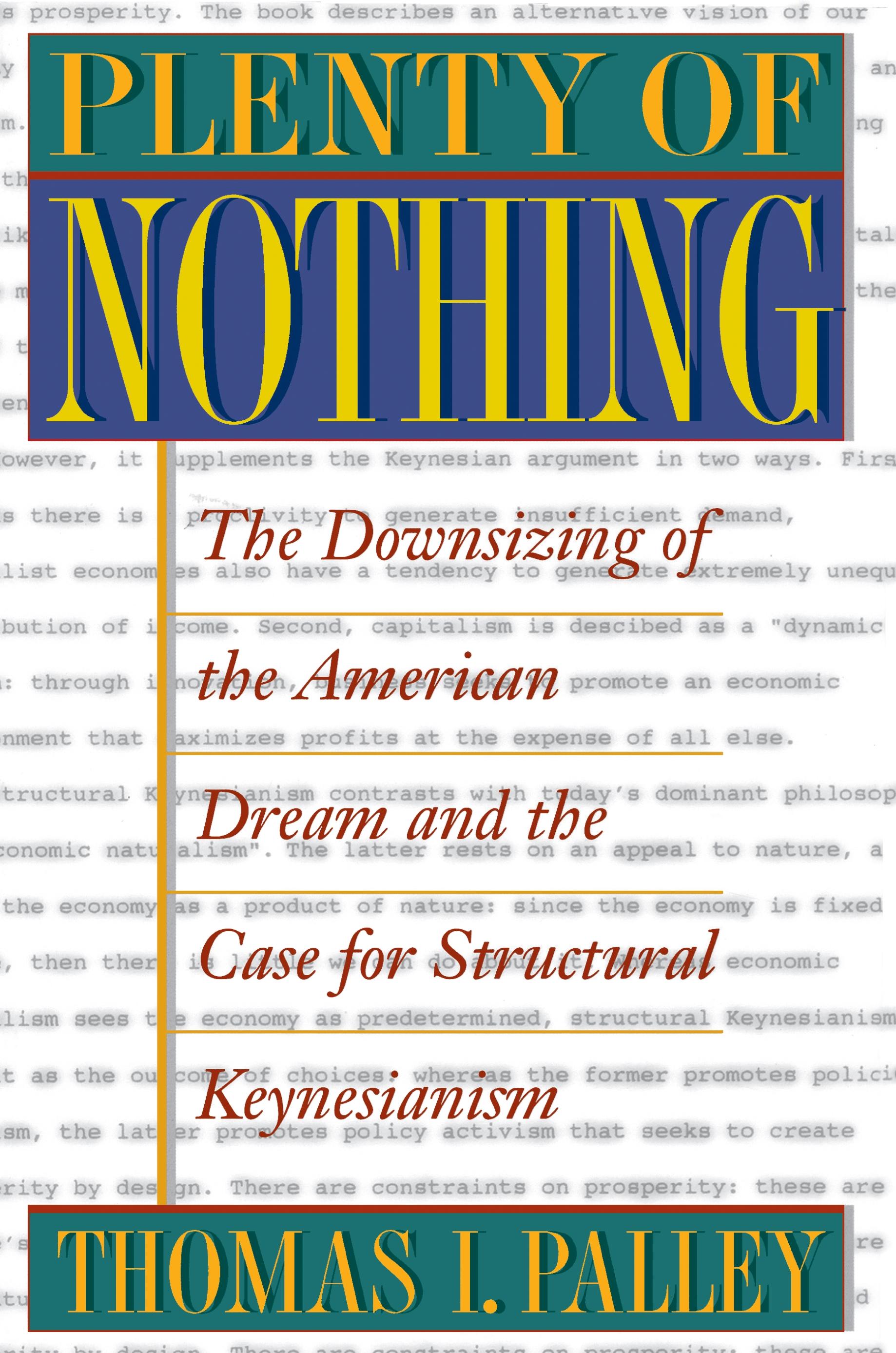
Business papers today are in a triumphant mood, buoyed by a conviction that the economic stagnation of the last quarter century has vanished in favor of a new age of robust growth. But if we are doing so well, many ask, why does it feel like we are working harder for less? Why, despite economic growth, does inequality between rich and poor keep rising? In this wide-ranging and provocative book, Thomas Palley pulls together many threads of "new liberal" economic thought to offer detailed answers to these pressing questions. And he proposes a new economic model--structural Keynesianism--that he argues would return America to sustainable, fairly shared prosperity. The key, he writes, is to abandon the myth of a natural competitive economy, which has justified unleashing capital and attacking unions. This has resulted in an economy dominated by business.
Palley's book, which began as a cover article for The Atlantic Monthly in 1996, challenges the economic orthodoxies of the political right and center, popularized by such economists as Milton Friedman and Paul Krugman. He marshals a powerful array of economic facts and arguments to show that the interests of working families have gradually been sacrificed to those of corporations. Expanding on traditional Keynesian economics, he argues that, although capitalism is the most productive system ever devised, it also tends to generate deep economic inequalities and encourage the pursuit of profit at the expense of all else. He challenges fatalists who say we can do nothing about this--that economic insecurity and stagnant wages are the inevitable results of irresistible globalization. Palley argues that capitalism comes in a range of forms and that government can and should shape it from a "mean street" system into a "main street" system through monetary, fiscal, trade, and regulatory policies that promote widespread prosperity.
Plenty of Nothing offers a compelling alternative to conventional economic wisdom. The book is clearly and powerfully written and will provoke debate among economists and the general public about the most stubborn problems in the American economy.
Before Memmo my notes were scattered across PDFs. Now a workspace pulls everything into one place — I see exactly what's still left to study.
Memmo's summaries are gold before exams. I don't have to re-read 800 pages two weeks before — just the important parts.
The AI chat has saved me the night before an exam more than once. I just keep asking until I get it — no waiting on a study group to reply.
The quizzes hit exactly what I need to know. Memmo tracks what I get stuck on — so I only practice what's worth it.
Flashcards with spaced repetition are magic. Memmo knows when I'm about to forget something and brings it back.
The AI podcasts are my favorite. I listen on my way to school and get a recap without sitting at a computer.

Handbok i kvalitativa metoder
281 kr

Hållbar utveckling: en introduktion för ingenjörer och andra problemlösare
334 kr

Brymans Samhällsvetenskapliga metoder
390 kr

Projektledning
491 kr

Den orättvisa hälsan: om socioekonomiska skillnader i hälsa och livslängd
326 kr

Vetenskapsteori för nybörjare
196 kr

Organizational Leadership
429 kr

På väg mot läraryrket
172 kr

Det sociala livet i skolan: Socialpsykologiska perspektiv
253 kr

Betygsättningens didaktik
151 kr

Personality
402 kr

Studying Leadership
404 kr

Managing Innovation
477 kr

Introduktion till samhällsvetenskaplig metod
347 kr

The Psychology of Sex and Gender
698 kr

Evidens och kunskap för socialt arbete
207 kr

Introduction to Leadership
605 kr