
Before Memmo my notes were scattered across PDFs. Now a workspace pulls everything into one place — I see exactly what's still left to study.
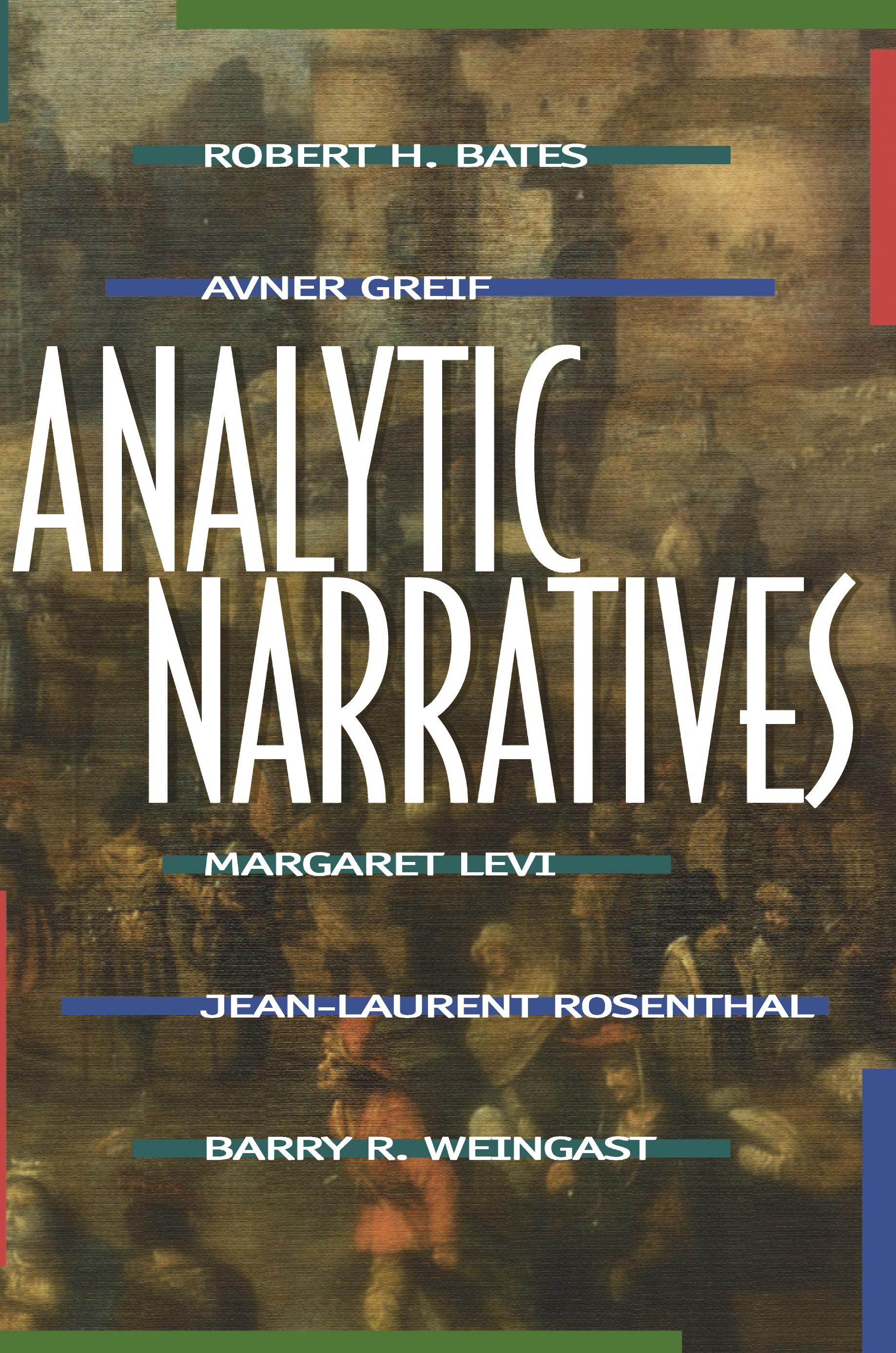
Students of comparative politics have long faced a vexing dilemma: how can social scientists draw broad, applicable principles of political order from specific historical examples? In Analytic Narratives, five senior scholars offer a new and ambitious methodological response to this important question. By employing rational-choice and game theory, the authors propose a way of extracting empirically testable, general hypotheses from particular cases. The result is both a methodological manifesto and an applied handbook that political scientists, economic historians, sociologists, and students of political economy will find essential.
In their jointly written introduction, the authors frame their approach to the origins and evolution of political institutions. The individual essays that follow demonstrate the concept of the analytic narrative--a rational-choice approach to explain political outcomes--in case studies. Avner Greif traces the institutional foundations of commercial expansion in twelfth-century Genoa. Jean-Laurent Rosenthal analyzes how divergent fiscal policies affected absolutist European governments, while Margaret Levi examines the transformation of nineteenth-century conscription laws in France, the United States, and Prussia. Robert Bates explores the emergence of a regulatory organization in the international coffee market. Finally, Barry Weingast studies the institutional foundations of democracy in the antebellum United States and its breakdown in the Civil War. In the process, these studies highlight the economic role of political organizations, the rise and deterioration of political communities, and the role of coercion, especially warfare, in political life. The results are both empirically relevant and theoretically sophisticated.
Analytic Narratives is an innovative and provocative work that bridges the gap between the game-theoretic and empirically driven approaches in political economy. Political historians will find the use of rational-choice models novel; theorists will discover arguments more robust and nuanced than those derived from abstract models. The book improves on earlier studies by advocating--and applying--a cross-disciplinary approach to explain strategic decision making in history.
Before Memmo my notes were scattered across PDFs. Now a workspace pulls everything into one place — I see exactly what's still left to study.
Memmo's summaries are gold before exams. I don't have to re-read 800 pages two weeks before — just the important parts.
The AI chat has saved me the night before an exam more than once. I just keep asking until I get it — no waiting on a study group to reply.
The quizzes hit exactly what I need to know. Memmo tracks what I get stuck on — so I only practice what's worth it.
Flashcards with spaced repetition are magic. Memmo knows when I'm about to forget something and brings it back.
The AI podcasts are my favorite. I listen on my way to school and get a recap without sitting at a computer.

Handbok i kvalitativa metoder
281 kr

Hållbar utveckling: en introduktion för ingenjörer och andra problemlösare
334 kr

Brymans Samhällsvetenskapliga metoder
390 kr

Projektledning
491 kr

Den orättvisa hälsan: om socioekonomiska skillnader i hälsa och livslängd
326 kr

Vetenskapsteori för nybörjare
196 kr

Organizational Leadership
429 kr

På väg mot läraryrket
172 kr

Det sociala livet i skolan: Socialpsykologiska perspektiv
253 kr

Betygsättningens didaktik
151 kr

Personality
402 kr

Studying Leadership
404 kr

Managing Innovation
477 kr

Introduktion till samhällsvetenskaplig metod
347 kr

The Psychology of Sex and Gender
698 kr

Evidens och kunskap för socialt arbete
207 kr

Introduction to Leadership
605 kr