
Before Memmo my notes were scattered across PDFs. Now a workspace pulls everything into one place — I see exactly what's still left to study.
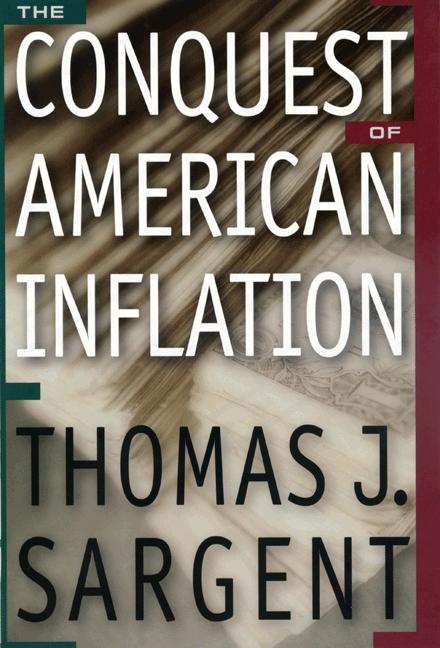
In the past fifteen years, inflation has been conquered by many advanced countries. History reveals, however, that it has been conquered before and returned. In The Conquest of American Inflation, Thomas J. Sargent presents a groundbreaking analysis of the rise and fall of U.S. inflation after 1960. He examines two broad explanations for the behavior of inflation and unemployment in this period: the natural-rate hypothesis joined to the Lucas critique and a more traditional econometric policy evaluation modified to include adaptive expectations and learning. His purpose is not only to determine which is the better account, but also to codify for the benefit of the next generation the economic forces that cause inflation.
Sargent begins with an explanation of how American policymakers increased inflation in the early 1960s by following erroneous assumptions about the exploitability of the Phillips curve--the inverse relationship between inflation and unemployment. In subsequent chapters, he connects a sequence of ideas--self-confirming equilibria, least-squares and other adaptive or recursive learning algorithms, convergence of least-squares learners with self-confirming equilibria, and recurrent dynamics along escape routes from self-confirming equilibria. Sargent synthesizes results from macroeconomics, game theory, control theory, and other fields to extend both adaptive expectations and rational expectations theory, and he compellingly describes postwar inflation in terms of drifting coefficients. He interprets his results in favor of adaptive expectations as the relevant mechanism affecting inflation policy.
Providing an original methodological link between theoretical and policy economics, this book will engender much debate and become an indispensable text for academics, graduate students, and professional economists.
Before Memmo my notes were scattered across PDFs. Now a workspace pulls everything into one place — I see exactly what's still left to study.
Memmo's summaries are gold before exams. I don't have to re-read 800 pages two weeks before — just the important parts.
The AI chat has saved me the night before an exam more than once. I just keep asking until I get it — no waiting on a study group to reply.
The quizzes hit exactly what I need to know. Memmo tracks what I get stuck on — so I only practice what's worth it.
Flashcards with spaced repetition are magic. Memmo knows when I'm about to forget something and brings it back.
The AI podcasts are my favorite. I listen on my way to school and get a recap without sitting at a computer.

Handbok i kvalitativa metoder
281 kr

Hållbar utveckling: en introduktion för ingenjörer och andra problemlösare
334 kr

Brymans Samhällsvetenskapliga metoder
390 kr

Projektledning
491 kr

Den orättvisa hälsan: om socioekonomiska skillnader i hälsa och livslängd
326 kr

Vetenskapsteori för nybörjare
196 kr

Organizational Leadership
429 kr

På väg mot läraryrket
172 kr

Det sociala livet i skolan: Socialpsykologiska perspektiv
253 kr

Betygsättningens didaktik
151 kr

Personality
402 kr

Studying Leadership
404 kr

Managing Innovation
477 kr

Introduktion till samhällsvetenskaplig metod
347 kr

The Psychology of Sex and Gender
698 kr

Evidens och kunskap för socialt arbete
207 kr

Introduction to Leadership
605 kr