
Before Memmo my notes were scattered across PDFs. Now a workspace pulls everything into one place — I see exactly what's still left to study.
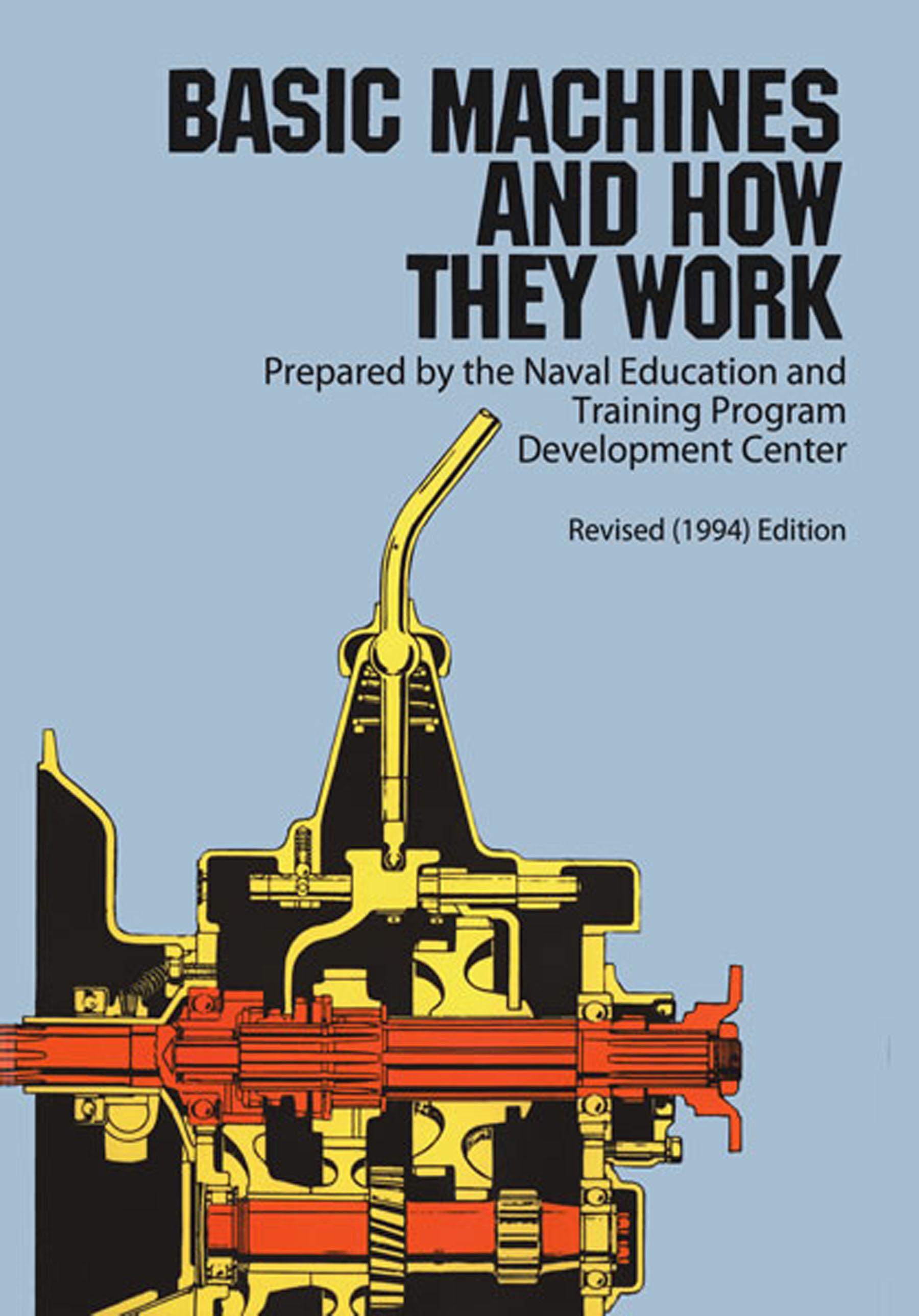
This revised edition of an extremely clear Navy training manual leaves nothing to be desired in its presentation. Thorough in its coverage of basic theory, from the lever and inclined plane to internal combustion engines and power trains, it requires nothing more than an understanding of the most elementary mathematics.
Beginning with the simplest of machines — the lever — the text proceeds to discussions of the block and tackle (pulleys and hoists), wheel and axle, the inclined plane and the wedge, the screw, and different types of gears (simple, spur, bevel, herringbone, spiral, worm, etc.). A chapter on the concept of work discusses the measurement of work, friction, and efficiency; this is followed by investigations of power, force, and pressure, with explanations of the uses of scales, balances, gauges, and barometers. The fundamentals of hydrostatic and hydraulic machines (such as the hydraulic braking system and the hydraulic press) are discussed in detail.
The remaining chapters cover machine elements (bearings and springs), basic mechanisms (gear differential, couplings, cams, clutches), the internal combustion engine and power trains (including explanations of various transmission systems — synchromesh, auxiliary, etc.).
Every concept is clearly defined, and discussions always build easily from elementary theory to specific applications familiar to anyone with the slightest interest in mechanics. Important concepts, machine components, and techniques are clearly illustrated in more than 200 diagrams, drawings, and cross-sections that reveal inner workings — all of these help to clarify even further an already clear and well-organized presentation.
Although it was originally designed for use in U.S. Naval Training Schools, this book can be used to great advantage as a basic text in mechanical engineering in standard technical schools, and it will be immensely valuable even to lay readers who desire a basic knowledge of mechanics.
Before Memmo my notes were scattered across PDFs. Now a workspace pulls everything into one place — I see exactly what's still left to study.
Memmo's summaries are gold before exams. I don't have to re-read 800 pages two weeks before — just the important parts.
The AI chat has saved me the night before an exam more than once. I just keep asking until I get it — no waiting on a study group to reply.
The quizzes hit exactly what I need to know. Memmo tracks what I get stuck on — so I only practice what's worth it.
Flashcards with spaced repetition are magic. Memmo knows when I'm about to forget something and brings it back.
The AI podcasts are my favorite. I listen on my way to school and get a recap without sitting at a computer.

Handbok i kvalitativa metoder
281 kr

Hållbar utveckling: en introduktion för ingenjörer och andra problemlösare
334 kr

Brymans Samhällsvetenskapliga metoder
390 kr

Projektledning
491 kr

Den orättvisa hälsan: om socioekonomiska skillnader i hälsa och livslängd
326 kr

Vetenskapsteori för nybörjare
196 kr

Organizational Leadership
429 kr

På väg mot läraryrket
172 kr

Det sociala livet i skolan: Socialpsykologiska perspektiv
253 kr

Betygsättningens didaktik
151 kr

Personality
402 kr

Studying Leadership
404 kr

Managing Innovation
477 kr

Introduktion till samhällsvetenskaplig metod
347 kr

The Psychology of Sex and Gender
698 kr

Evidens och kunskap för socialt arbete
207 kr

Introduction to Leadership
605 kr