
Before Memmo my notes were scattered across PDFs. Now a workspace pulls everything into one place — I see exactly what's still left to study.
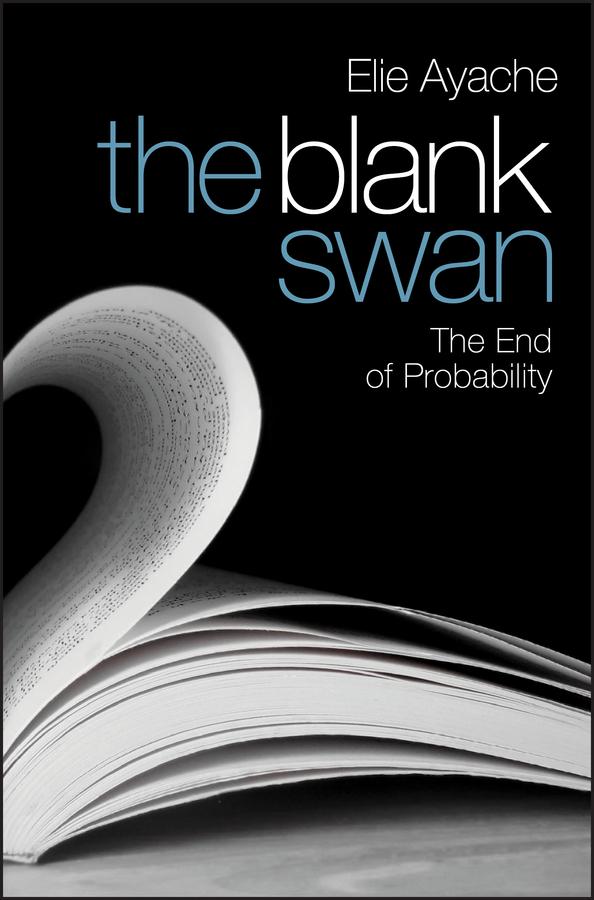
October 19th 1987 was a day of huge change for the global finance industry. On this day the stock market crashed, the Nobel Prize winning Black-Scholes formula failed and volatility smiles were born, and on this day Elie Ayache began his career, on the trading floor of the French Futures and Options Exchange.
Experts everywhere sought to find a model for this event, and ways to simulate it in order to avoid a recurrence in the future, but the one thing that struck Elie that day was the belief that what actually happened on 19th October 1987 is simply non reproducible outside 19th October 1987 - you cannot reduce it to a chain of causes and effects, or even to a random generator, that can then be reproduced or represented in a theoretical framework.
The Blank Swan is Elie's highly original treatise on the financial markets presenting a totally revolutionary rethinking of derivative pricing and technology. It is not a diatribe against Nassim Taleb's The Black Swan, but criticises the whole background or framework of predictable and unpredictable events white and black swans alike , i.e. the very category of prediction.
In this revolutionary book, Elie redefines the components of the technology needed to price and trade derivatives. Most importantly, and drawing on a long tradition of philosophy of the event from Henri Bergson to Gilles Deleuze, to Alain Badiou, and on a recent brand of philosophy of contingency, embodied by the speculative materialism of Quentin Meillassoux, Elie redefines the market itself against the common perceptions of orthodox financial theory, general equilibrium theory and the sociology of finance.
This book will change the way that we think about derivatives and approach the market. If anything, derivatives should be renamed contingent claims, where contingency is now absolute and no longer derivative, and the market is just its medium. The book also establishes the missing link between quantitative modelling (no longer dependent on probability theory but on a novel brand of mathematics which Elie calls the mathematics of price) and the reality of the market.
Before Memmo my notes were scattered across PDFs. Now a workspace pulls everything into one place — I see exactly what's still left to study.
Memmo's summaries are gold before exams. I don't have to re-read 800 pages two weeks before — just the important parts.
The AI chat has saved me the night before an exam more than once. I just keep asking until I get it — no waiting on a study group to reply.
The quizzes hit exactly what I need to know. Memmo tracks what I get stuck on — so I only practice what's worth it.
Flashcards with spaced repetition are magic. Memmo knows when I'm about to forget something and brings it back.
The AI podcasts are my favorite. I listen on my way to school and get a recap without sitting at a computer.

Handbok i kvalitativa metoder
281 kr

Hållbar utveckling: en introduktion för ingenjörer och andra problemlösare
334 kr

Brymans Samhällsvetenskapliga metoder
390 kr

Projektledning
491 kr

Den orättvisa hälsan: om socioekonomiska skillnader i hälsa och livslängd
326 kr

Organizational Leadership
429 kr

Vetenskapsteori för nybörjare
196 kr

På väg mot läraryrket
172 kr

Det sociala livet i skolan: Socialpsykologiska perspektiv
253 kr

Betygsättningens didaktik
151 kr

Personality
402 kr

Studying Leadership
404 kr

Managing Innovation
477 kr

Introduktion till samhällsvetenskaplig metod
347 kr

The Psychology of Sex and Gender
698 kr

Evidens och kunskap för socialt arbete
207 kr

Introduction to Leadership
605 kr