
Before Memmo my notes were scattered across PDFs. Now a workspace pulls everything into one place — I see exactly what's still left to study.
The origins of the maritime dispute between Chile and Peru go back to 1952, when these countries, along with Ecuador, asserted sovereignty over 200 nautical miles from their coasts. This maritime claim is widely regarded as one of the most important contributions by a group of developing countries to the law of the sea. Peru then asked the Court of International Justice to delimit its lateral boundary with Chile in accordance with principles of international law. Chile asked the Court to dismiss the request. The question before the ICJ Justice was whether the treaty concluded by the parties when they made their claim had also delimited their lateral boundary.
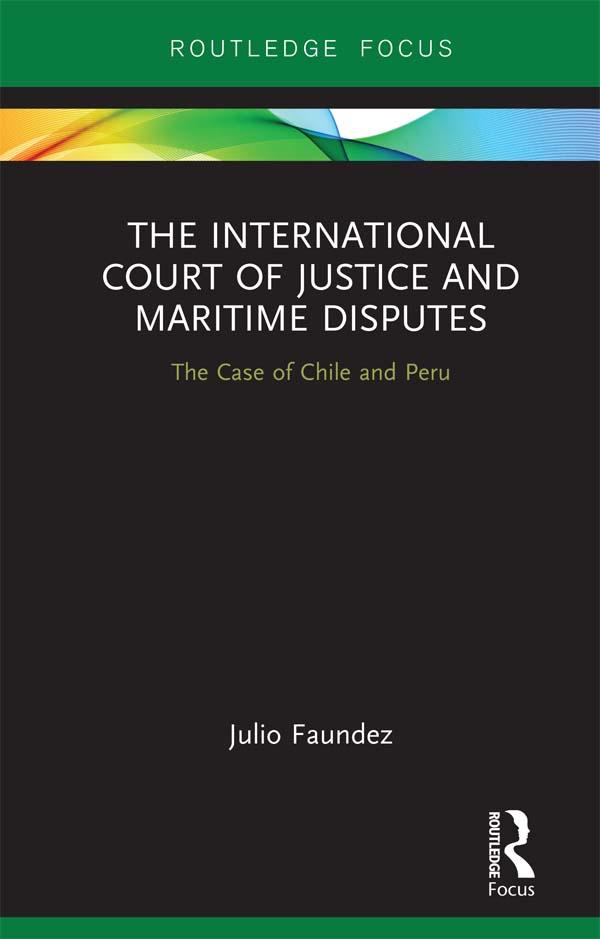
This book provides a critical analysis of the approach to treaty interpretation by the International Court of Justice in Maritime Disputes. Focusing on the case of Chile and Peru, the book explores two main issues: the interpretation of the Santiago Declaration and its connected treaties; and the tacit agreement that established a lateral maritime boundary with a seaward extension of 80 nautical miles. Part I argues that the Court’s finding that the Santiago Declaration did not delimit the lateral boundary is mistaken because it ignores its context, as well as its object and purpose. Part II argues that the finding that the parties had entered into a tacit agreement is an unjustified legal inference derived from a hasty interpretation of the Special Agreement of 1954. It questions that the reliability of the evidence used to determine the seaward extent of the lateral boundary and argues that the Court failed to demonstrate the bearing of contemporaneous developments in the law of the sea on the content of the tacit agreement.
Before Memmo my notes were scattered across PDFs. Now a workspace pulls everything into one place — I see exactly what's still left to study.
Memmo's summaries are gold before exams. I don't have to re-read 800 pages two weeks before — just the important parts.
The AI chat has saved me the night before an exam more than once. I just keep asking until I get it — no waiting on a study group to reply.
The quizzes hit exactly what I need to know. Memmo tracks what I get stuck on — so I only practice what's worth it.
Flashcards with spaced repetition are magic. Memmo knows when I'm about to forget something and brings it back.
The AI podcasts are my favorite. I listen on my way to school and get a recap without sitting at a computer.

Handbok i kvalitativa metoder
281 kr

Hållbar utveckling: en introduktion för ingenjörer och andra problemlösare
334 kr

Brymans Samhällsvetenskapliga metoder
390 kr

Projektledning
491 kr

Den orättvisa hälsan: om socioekonomiska skillnader i hälsa och livslängd
326 kr

Vetenskapsteori för nybörjare
196 kr

Organizational Leadership
429 kr

På väg mot läraryrket
172 kr

Det sociala livet i skolan: Socialpsykologiska perspektiv
253 kr

Betygsättningens didaktik
151 kr

Personality
402 kr

Studying Leadership
404 kr

Managing Innovation
477 kr

Introduktion till samhällsvetenskaplig metod
347 kr

The Psychology of Sex and Gender
698 kr

Evidens och kunskap för socialt arbete
207 kr

Introduction to Leadership
605 kr