
Before Memmo my notes were scattered across PDFs. Now a workspace pulls everything into one place — I see exactly what's still left to study.
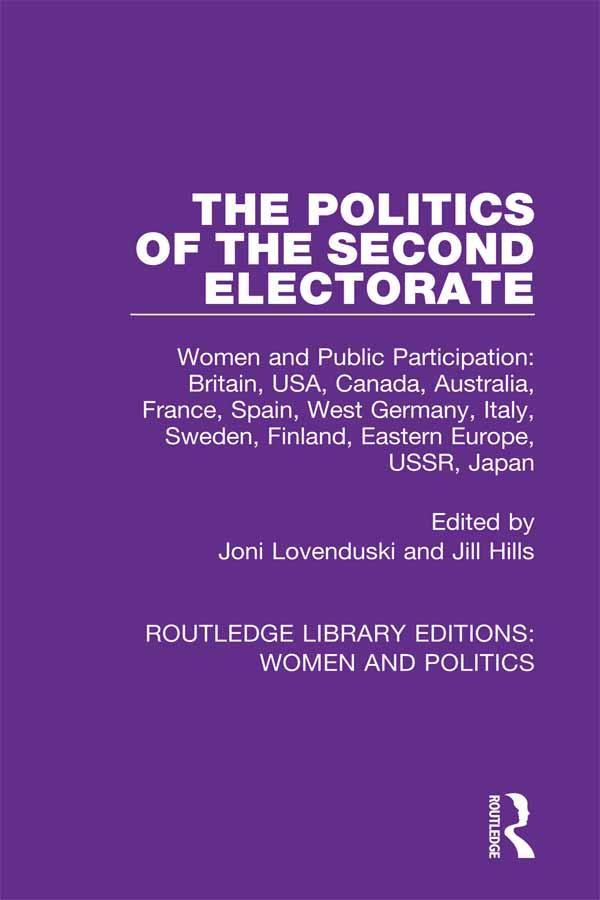
Prior to publication there had been little study of the political role of women. Gender had been seen only as a background variable in social surveys of political behaviour, and women had rarely been extensively or separately considered. Now, in essays specially written for this volume, first published in 1981, the authors map out the political behaviour of women in twenty ‘industrially developed’ countries, bringing together and analysing contemporary material on a variety of topics, such as voting, standing for public office, entering the political elite, and engaging in political activity outside the formal structures of government.
In each chapter the history of women’s political activity is outlined, from the first movements for female suffrage and emancipation to the new political involvement occasioned by the women’s movements of the 1970s. The impact of differing political systems on the experience of women is considered, and some striking similarities and differences are pointed out.
It has been generally agreed that women’s participation in politics has been less than that of men, although reasons postulated for this have varied widely. The essays in this book offer further suggestions in this area, while charting a steady increase in activity by women in all political spheres as feminism politicises issues previously restricted to private or male-dominated spheres and women become increasingly concerned to participate in the political process. The authors indicate current trends and explode prevailing myths and the ‘second electorate’, and they suggest future possibilities, both for Political Woman and the Political Science which must take account of feminist political activity.
Students of social and political science, readers seeking comprehensive, cross-national coverage of party and election data, and all interested women will find the book to be a mine of information and a rare and readable picture of half the world’s electorate.
Before Memmo my notes were scattered across PDFs. Now a workspace pulls everything into one place — I see exactly what's still left to study.
Memmo's summaries are gold before exams. I don't have to re-read 800 pages two weeks before — just the important parts.
The AI chat has saved me the night before an exam more than once. I just keep asking until I get it — no waiting on a study group to reply.
The quizzes hit exactly what I need to know. Memmo tracks what I get stuck on — so I only practice what's worth it.
Flashcards with spaced repetition are magic. Memmo knows when I'm about to forget something and brings it back.
The AI podcasts are my favorite. I listen on my way to school and get a recap without sitting at a computer.

Handbok i kvalitativa metoder
281 kr

Hållbar utveckling: en introduktion för ingenjörer och andra problemlösare
334 kr

Brymans Samhällsvetenskapliga metoder
390 kr

Projektledning
491 kr

Den orättvisa hälsan: om socioekonomiska skillnader i hälsa och livslängd
326 kr

Vetenskapsteori för nybörjare
196 kr

Organizational Leadership
429 kr

På väg mot läraryrket
172 kr

Det sociala livet i skolan: Socialpsykologiska perspektiv
253 kr

Betygsättningens didaktik
151 kr

Personality
402 kr

Studying Leadership
404 kr

Managing Innovation
477 kr

Introduktion till samhällsvetenskaplig metod
347 kr

The Psychology of Sex and Gender
698 kr

Evidens och kunskap för socialt arbete
207 kr

Introduction to Leadership
605 kr