
Before Memmo my notes were scattered across PDFs. Now a workspace pulls everything into one place — I see exactly what's still left to study.
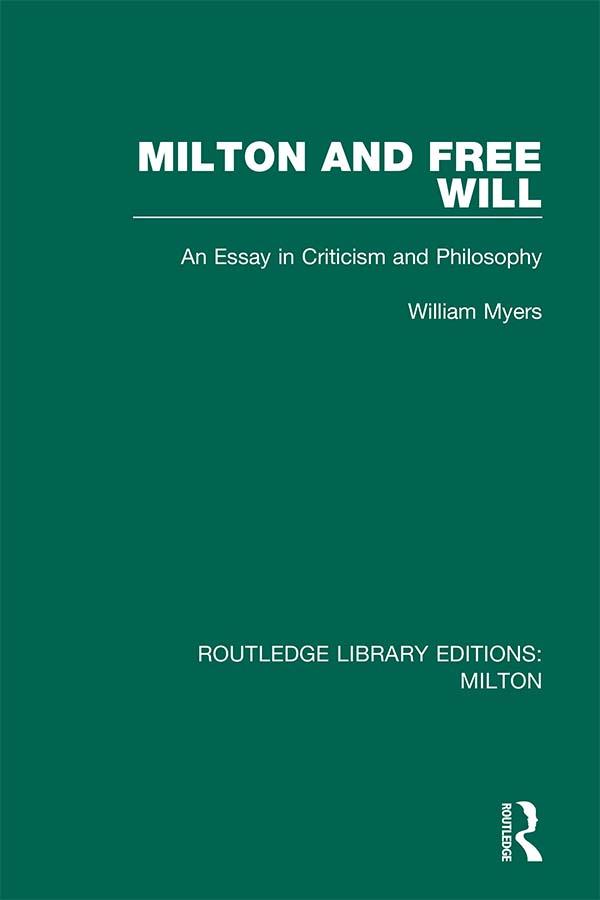
First published in 1987. Milton and Free Will is an incisive, ambitious and comprehensive analysis and defence of the concept of free will, using Milton as an example and exemplar. Written with passion, and out of a lifelong engagement with the poetry of Milton and the philosophical and theological problems it encompasses, the book will illuminate both Milton studies and philosophical debate. The author engages with all the major currents of the free will debate, starting with Aristotle and Aquinas and considering arguments advanced by Hume and Kant as well as those of a number of modern philosophers including Polanyi, Kenny, Parfit, Plantinga, Swinburne, Dennett and Davidson. He pays particular attention to the Marxist formalism of Bakhtin, the Catholic phenomenology of Pope John Paul II and the evolutionism of Monod and Sober. He concludes with a rebuttal of the deconstructionism of Barthes, Derrida and Foucault.
He claims that all the major difficulties faced by defenders of free will can be overcome if a notion of willing implicit in the work of Milton is properly understood. Freedom as Milton represented and understood it, he suggests, is a condition of mind arising out of inter-personal awareness and not a property or consequence of practical reasoning. He finds supporting evidence for this view in the writings of Newman and in Henry James’s The Portrait of a Lady, which he reads as a narrative structurally reversing Milton’s representation of the fall of Eve in Paradise Lost. The author systematically analyses and reanalyses key passages in his texts in the light of the many arguments for and against free will, seeking thereby to affirm the validity in principle, and the personal and political importance in practice, of the Christian humanist tradition of which he sees Milton, Newman and the Pope as important (if sometimes misleading) spokesmen.
Before Memmo my notes were scattered across PDFs. Now a workspace pulls everything into one place — I see exactly what's still left to study.
Memmo's summaries are gold before exams. I don't have to re-read 800 pages two weeks before — just the important parts.
The AI chat has saved me the night before an exam more than once. I just keep asking until I get it — no waiting on a study group to reply.
The quizzes hit exactly what I need to know. Memmo tracks what I get stuck on — so I only practice what's worth it.
Flashcards with spaced repetition are magic. Memmo knows when I'm about to forget something and brings it back.
The AI podcasts are my favorite. I listen on my way to school and get a recap without sitting at a computer.

Handbok i kvalitativa metoder
281 kr

Hållbar utveckling: en introduktion för ingenjörer och andra problemlösare
334 kr

Brymans Samhällsvetenskapliga metoder
390 kr

Projektledning
491 kr

Den orättvisa hälsan: om socioekonomiska skillnader i hälsa och livslängd
326 kr

Vetenskapsteori för nybörjare
196 kr

Organizational Leadership
429 kr

På väg mot läraryrket
172 kr

Det sociala livet i skolan: Socialpsykologiska perspektiv
253 kr

Betygsättningens didaktik
151 kr

Personality
402 kr

Studying Leadership
404 kr

Managing Innovation
477 kr

Introduktion till samhällsvetenskaplig metod
347 kr

The Psychology of Sex and Gender
698 kr

Evidens och kunskap för socialt arbete
207 kr

Introduction to Leadership
605 kr