
Before Memmo my notes were scattered across PDFs. Now a workspace pulls everything into one place — I see exactly what's still left to study.
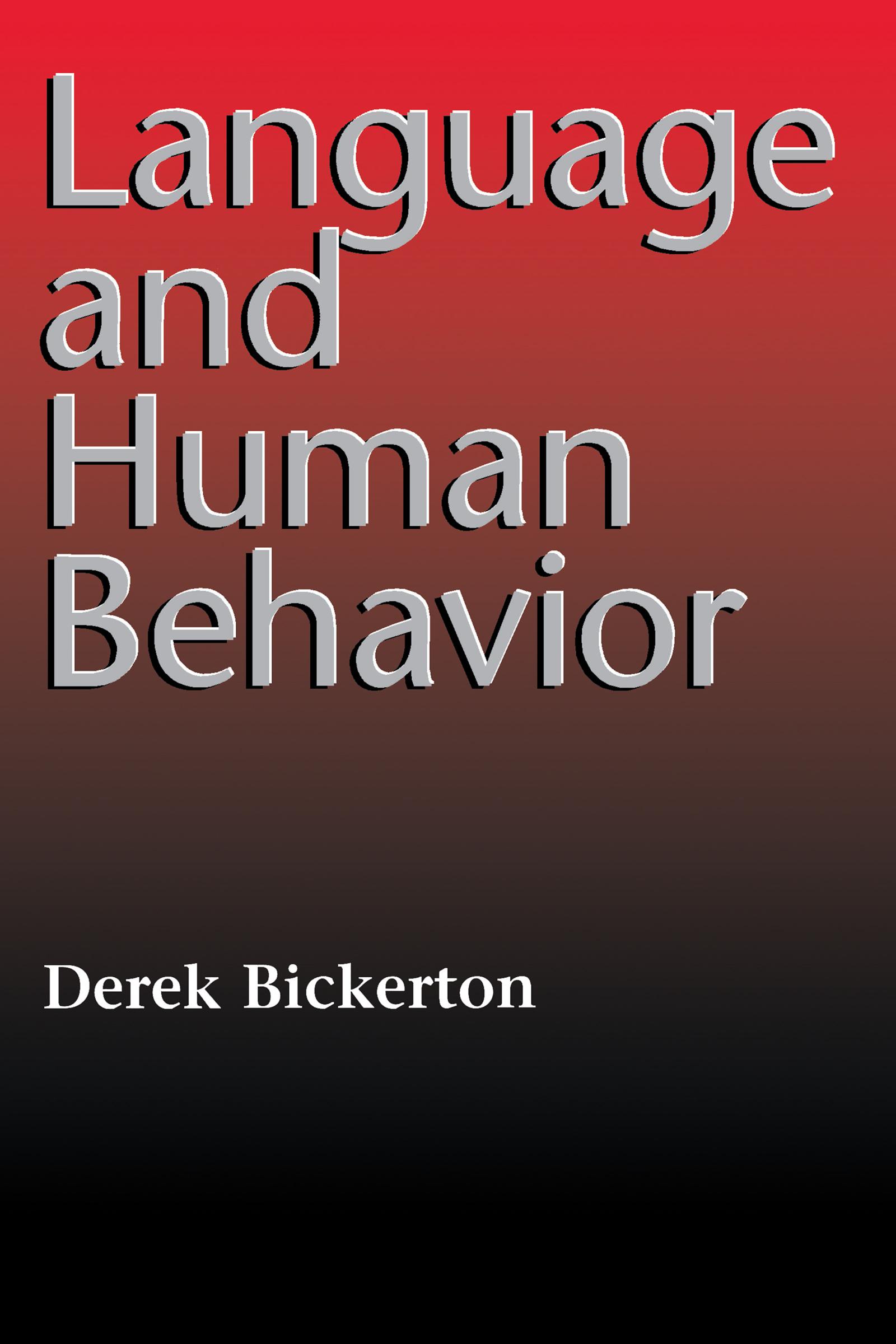
“What this book proposes to do,” writes Derek Bickerton, “is to stand the conventional wisdom of the behavioral sciences on its head: instead of the human species growing clever enough to invent language, it will view that species as blundering into language and, as a direct result of that, becoming clever.” According to Bickerton, the behavioral sciences have failed to give an adequate account of human nature at least partly because of the conjunction and mutual reinforcement of two widespread beliefs: that language is simply a means of communication and that human intelligence is the result of the rapid growth and unusual size of human brains.
Bickerton argues that each of the properties distinguishing human intelligence and consciousness from that of other animals can be shown to derive straightforwardly from properties of language. In essence, language arose as a representational system, not a means of communication or a skill, and not a product of culture but an evolutionary adaptation.
The author stresses the necessity of viewing intelligence in evolutionary terms, seeing it not as problem solving but as a way of maintaining homeostasis—the preservation of those conditions most favorable to an organism, the optimal achievable conditions for survival and well-being. Nonhumans practice what he calls “on-line thinking” to maintain homeostasis, but only humans can employ off-line thinking: “only humans can assemble fragments of information to form a pattern that they can later act upon without having to wait on that great but unpunctual teacher, experience.”
The term protolanguage is used to describe the stringing together of symbols that prehuman hominids employed. “It did not allow them to turn today’s imagination into tomorrow’s fact. But it is just this power to transform imagination into fact that distinguishes human behavior from that of our ancestral species, and indeed from that of all other species. It is exactly what enables us to change our behavior, or invent vast ranges of new behavior, practically overnight, with no concomitant genetic changes.”
Language and Human Behavior should be of interest to anyone in the behavioral and evolutionary sciences and to all those concerned with the role of language in human behavior.
Before Memmo my notes were scattered across PDFs. Now a workspace pulls everything into one place — I see exactly what's still left to study.
Memmo's summaries are gold before exams. I don't have to re-read 800 pages two weeks before — just the important parts.
The AI chat has saved me the night before an exam more than once. I just keep asking until I get it — no waiting on a study group to reply.
The quizzes hit exactly what I need to know. Memmo tracks what I get stuck on — so I only practice what's worth it.
Flashcards with spaced repetition are magic. Memmo knows when I'm about to forget something and brings it back.
The AI podcasts are my favorite. I listen on my way to school and get a recap without sitting at a computer.

Handbok i kvalitativa metoder
281 kr

Hållbar utveckling: en introduktion för ingenjörer och andra problemlösare
334 kr

Brymans Samhällsvetenskapliga metoder
390 kr

Projektledning
491 kr

Den orättvisa hälsan: om socioekonomiska skillnader i hälsa och livslängd
326 kr

Organizational Leadership
429 kr

Vetenskapsteori för nybörjare
196 kr

På väg mot läraryrket
172 kr

Det sociala livet i skolan: Socialpsykologiska perspektiv
253 kr

Betygsättningens didaktik
151 kr

Personality
402 kr

Studying Leadership
404 kr

Managing Innovation
477 kr

Introduktion till samhällsvetenskaplig metod
347 kr

The Psychology of Sex and Gender
698 kr

Evidens och kunskap för socialt arbete
207 kr

Introduction to Leadership
605 kr