
Before Memmo my notes were scattered across PDFs. Now a workspace pulls everything into one place — I see exactly what's still left to study.
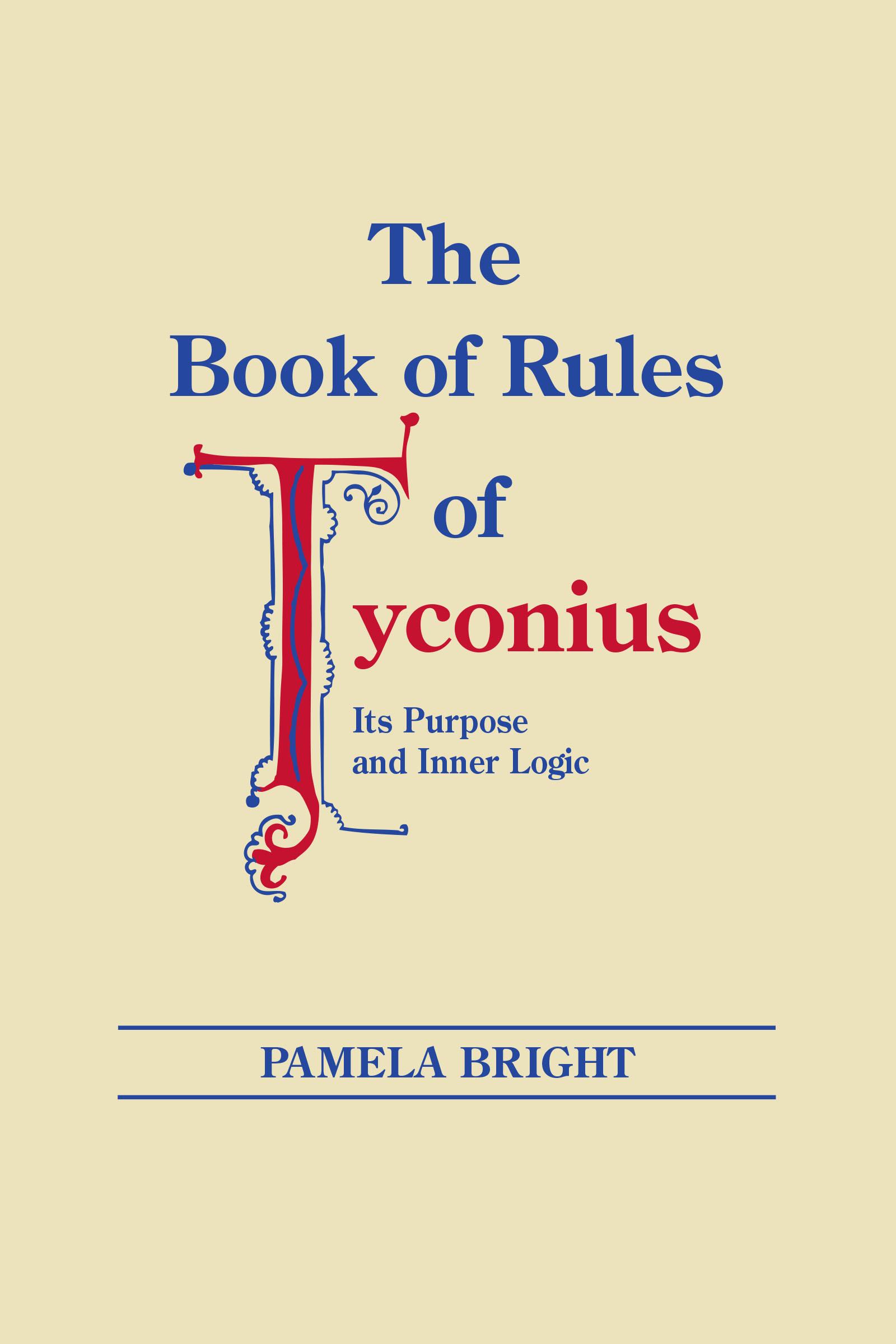
The Liber Regularum, written by Tyconius in the Fourth Century A.D., was the first system of biblical interpretation proposed by a Latin theologian. Augustine was very interested in this work and included an extraordinary summation of it in his De doctrina christiana. Although this treatment insured the preservation of the work and its lasting fame, Augustine's summary became better known than the original. Pamela Bright's The Book of Rules of Tyconius: Its Purpose and Inner Logic reintroduces this neglected classic of early church literature. Bright asserts that although Augustine was greatly influenced by the Liber Regularum, his philosophical differences caused him to misunderstand its meaning. Bright reexamines the meaning of “prophecy” and “rule” from Tyconius's perspective and reveals that the purpose of the book was not to provide a general guide to scriptural interpretation, but rather a way to interpret apocalyptic texts. She cites Tyconius's intense concern with evil in the church as the genesis of his interest in the apocalypse and subsequently the meaning of the scripture concerning it. Tyconius speaks of the “seven mystical rules” of scripture that with the grace of the Holy Spirit reveal the true meaning of prophecy. If an interpreter follows the “logic” of these rules, the nature of the church as composed by both good and evil membership is revealed. Bright argues that Tyconius was not illogical or incompetent in the work's composition as many critics have claimed but rather that he organized his material in a concentric pattern so that Rule Four, the center of the seven rules, is also the central development of his theory. Of interest to theologians, students of biblical interpretation and of Augustine, The Book of Rules of Tyconius focuses attention upon a work that had great influence on the understanding of the nature of the church, on interpreting scripture, and its meaning for the Church of its day.
Before Memmo my notes were scattered across PDFs. Now a workspace pulls everything into one place — I see exactly what's still left to study.
Memmo's summaries are gold before exams. I don't have to re-read 800 pages two weeks before — just the important parts.
The AI chat has saved me the night before an exam more than once. I just keep asking until I get it — no waiting on a study group to reply.
The quizzes hit exactly what I need to know. Memmo tracks what I get stuck on — so I only practice what's worth it.
Flashcards with spaced repetition are magic. Memmo knows when I'm about to forget something and brings it back.
The AI podcasts are my favorite. I listen on my way to school and get a recap without sitting at a computer.

Handbok i kvalitativa metoder
281 kr

Hållbar utveckling: en introduktion för ingenjörer och andra problemlösare
334 kr

Brymans Samhällsvetenskapliga metoder
390 kr

Projektledning
491 kr

Den orättvisa hälsan: om socioekonomiska skillnader i hälsa och livslängd
326 kr

Vetenskapsteori för nybörjare
196 kr

Organizational Leadership
429 kr

På väg mot läraryrket
172 kr

Det sociala livet i skolan: Socialpsykologiska perspektiv
253 kr

Betygsättningens didaktik
151 kr

Personality
402 kr

Studying Leadership
404 kr

Managing Innovation
477 kr

Introduktion till samhällsvetenskaplig metod
347 kr

The Psychology of Sex and Gender
698 kr

Evidens och kunskap för socialt arbete
207 kr

Introduction to Leadership
605 kr