
Before Memmo my notes were scattered across PDFs. Now a workspace pulls everything into one place — I see exactly what's still left to study.
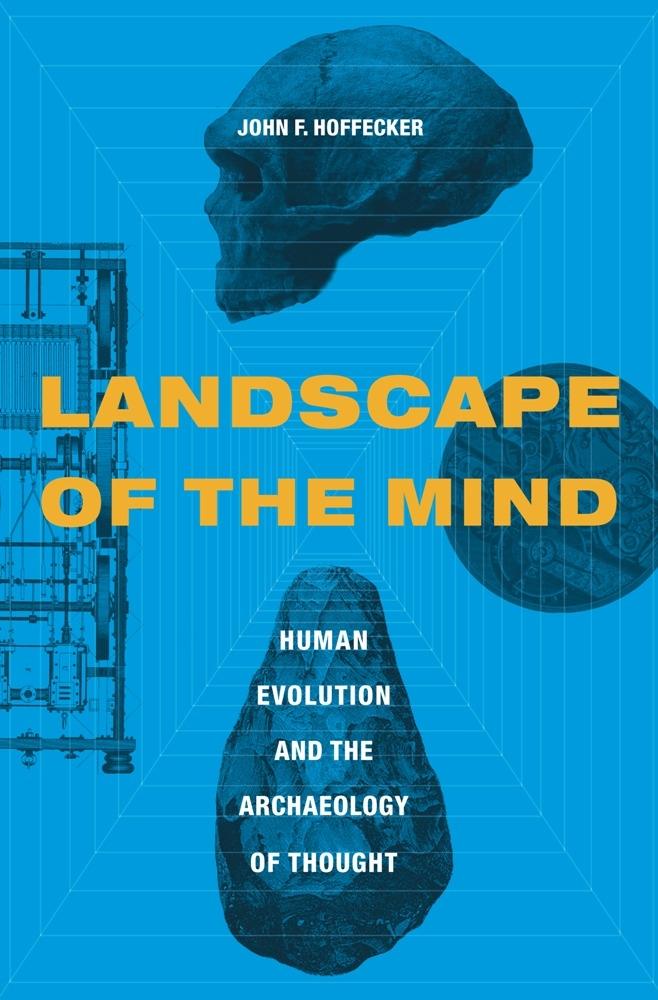
In Landscape of the Mind, John F. Hoffecker explores the origin and growth of the human mind, drawing on archaeology, history, and the fossil record. He suggests that, as an indirect result of bipedal locomotion, early humans developed a feedback relationship among their hands, brains, and tools that evolved into the capacity to externalize thoughts in the form of shaped stone objects. When anatomically modern humans evolved a parallel capacity to externalize thoughts as symbolic language, individual brains within social groups became integrated into a "neocortical Internet," or super-brain, giving birth to the mind.
Noting that archaeological traces of symbolism coincide with evidence of the ability to generate novel technology, Hoffecker contends that human creativity, as well as higher order consciousness, is a product of the superbrain. He equates the subsequent growth of the mind with human history, which began in Africa more than 50,000 years ago. As anatomically modern humans spread across the globe, adapting to a variety of climates and habitats, they redesigned themselves technologically and created alternative realities through tools, language, and art. Hoffecker connects the rise of civilization to a hierarchical reorganization of the super-brain, triggered by explosive population growth. Subsequent human history reflects to varying degrees the suppression of the mind's creative powers by the rigid hierarchies of nationstates and empires, constraining the further accumulation of knowledge. The modern world emerged after 1200 from the fragments of the Roman Empire, whose collapse had eliminated a central authority that could thwart innovation. Hoffecker concludes with speculation about the possibility of artificial intelligence and the consequences of a mind liberated from its organic antecedents to exist in an independent, nonbiological form.
Before Memmo my notes were scattered across PDFs. Now a workspace pulls everything into one place — I see exactly what's still left to study.
Memmo's summaries are gold before exams. I don't have to re-read 800 pages two weeks before — just the important parts.
The AI chat has saved me the night before an exam more than once. I just keep asking until I get it — no waiting on a study group to reply.
The quizzes hit exactly what I need to know. Memmo tracks what I get stuck on — so I only practice what's worth it.
Flashcards with spaced repetition are magic. Memmo knows when I'm about to forget something and brings it back.
The AI podcasts are my favorite. I listen on my way to school and get a recap without sitting at a computer.

Handbok i kvalitativa metoder
281 kr

Hållbar utveckling: en introduktion för ingenjörer och andra problemlösare
334 kr

Brymans Samhällsvetenskapliga metoder
390 kr

Projektledning
491 kr

Den orättvisa hälsan: om socioekonomiska skillnader i hälsa och livslängd
326 kr

Vetenskapsteori för nybörjare
196 kr

Organizational Leadership
429 kr

På väg mot läraryrket
172 kr

Det sociala livet i skolan: Socialpsykologiska perspektiv
253 kr

Betygsättningens didaktik
151 kr

Personality
402 kr

Studying Leadership
404 kr

Managing Innovation
477 kr

Introduktion till samhällsvetenskaplig metod
347 kr

The Psychology of Sex and Gender
698 kr

Evidens och kunskap för socialt arbete
207 kr

Introduction to Leadership
605 kr