
Before Memmo my notes were scattered across PDFs. Now a workspace pulls everything into one place — I see exactly what's still left to study.
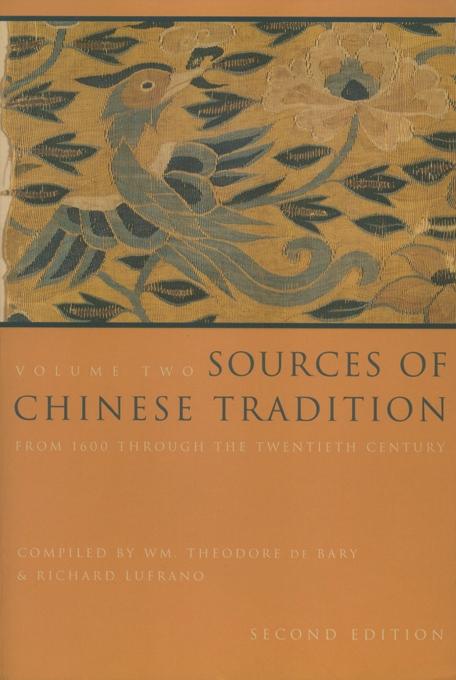
For four decades Sources of Chinese Tradition has served to introduce Western readers to Chinese civilization as it has been seen through basic writings and historical documents of the Chinese themselves. Now in its second edition, revised and extended through Deng Xiaoping and Jiang Zemin–era China, this classic volume remains unrivaled for its wide selection of source readings on history, society, and thought in the world's largest nation. Award-winning China scholar Wm. Theodore de Bary—who edited the first edition in 1960—and his coeditor Richard Lufrano have revised and updated the second volume of Sources to reflect the interactions of ideas, institutions, and historical events from the seventeenth century up to the present day.
Beginning with Qing civilization and continuing to contemporary times, volume II brings together key source texts from more than three centuries of Chinese history, with opening essays by noted China authorities providing context for readers not familiar with the period in question.
Here are just a few of the topics covered in this second volume of Sources of Chinese Tradition:
Early Sino-Western contacts in the seventeenth century;
Four centuries of Chinese reflections on differences between Eastern and Western civilizations;
Nineteenth- and twentieth-century reform movements, with treatises on women's rights, modern science, and literary reform;
Controversies over the place of Confucianism in modern Chinese society;
The nationalist revolution—including readings from Sun Yat-sen and Chiang Kai-shek;
The communist revolution—with central writings by Mao Zedong;
Works from contemporary China—featuring political essays from Deng Xiaoping and dissidents including Wei Jingsheng.
With more than two hundred selections in lucid, readable translation by today's most renowned experts on Chinese language and civilization, Sources of Chinese Tradition will continue to be recognized as the standard for source readings on Chinese civilization, an indispensable learning tool for scholars and students of Asian civilizations.
Before Memmo my notes were scattered across PDFs. Now a workspace pulls everything into one place — I see exactly what's still left to study.
Memmo's summaries are gold before exams. I don't have to re-read 800 pages two weeks before — just the important parts.
The AI chat has saved me the night before an exam more than once. I just keep asking until I get it — no waiting on a study group to reply.
The quizzes hit exactly what I need to know. Memmo tracks what I get stuck on — so I only practice what's worth it.
Flashcards with spaced repetition are magic. Memmo knows when I'm about to forget something and brings it back.
The AI podcasts are my favorite. I listen on my way to school and get a recap without sitting at a computer.

Handbok i kvalitativa metoder
281 kr

Hållbar utveckling: en introduktion för ingenjörer och andra problemlösare
334 kr

Brymans Samhällsvetenskapliga metoder
390 kr

Projektledning
491 kr

Den orättvisa hälsan: om socioekonomiska skillnader i hälsa och livslängd
326 kr

Vetenskapsteori för nybörjare
196 kr

Organizational Leadership
429 kr

På väg mot läraryrket
172 kr

Det sociala livet i skolan: Socialpsykologiska perspektiv
253 kr

Betygsättningens didaktik
151 kr

Personality
402 kr

Studying Leadership
404 kr

Managing Innovation
477 kr

Introduktion till samhällsvetenskaplig metod
347 kr

The Psychology of Sex and Gender
698 kr

Evidens och kunskap för socialt arbete
207 kr

Introduction to Leadership
605 kr