
Before Memmo my notes were scattered across PDFs. Now a workspace pulls everything into one place — I see exactly what's still left to study.
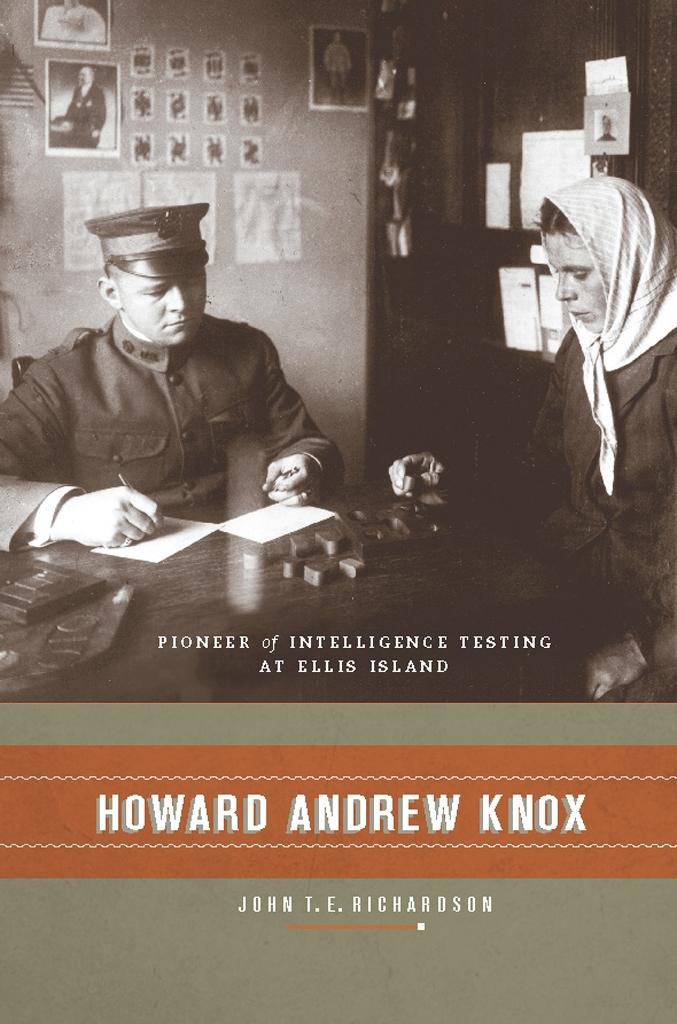
Howard Andrew Knox (1885–1949) served as assistant surgeon at Ellis Island during the 1910s, administering a range of verbal and nonverbal tests to determine the mental capacity of potential immigrants. An early proponent of nonverbal intelligence testing (largely through the use of formboards and picture puzzles), Knox developed an evaluative approach that today informs the techniques of practitioners and researchers. Whether adapted to measure intelligence and performance in children, military recruits, neurological and psychiatric patients, or the average job applicant, Knox's pioneering methods are part of contemporary psychological practice and deserve in-depth investigation.
Completing the first biography of this unjustly overlooked figure, John T. E. Richardson, former president of the International Society for the History of the Neurosciences, takes stock of Knox's understanding of intelligence and his legacy beyond Ellis Island. Consulting published and unpublished sources, Richardson establishes a chronology of Knox's life, including details of his medical training and his time as a physician for the U.S. Army. He describes the conditions that gave rise to intelligence testing, including the public's concern that the United States was opening its doors to the mentally unfit. He then recounts the development of intelligence tests by Knox and his colleagues and the widely-discussed publication of their research. Their work presents a useful and extremely human portrait of psychological testing and its limits, particularly the predicament of the people examined at Ellis Island. Richardson concludes with the development of Knox's work in later decades and its changing application in conjunction with modern psychological theory.
Before Memmo my notes were scattered across PDFs. Now a workspace pulls everything into one place — I see exactly what's still left to study.
Memmo's summaries are gold before exams. I don't have to re-read 800 pages two weeks before — just the important parts.
The AI chat has saved me the night before an exam more than once. I just keep asking until I get it — no waiting on a study group to reply.
The quizzes hit exactly what I need to know. Memmo tracks what I get stuck on — so I only practice what's worth it.
Flashcards with spaced repetition are magic. Memmo knows when I'm about to forget something and brings it back.
The AI podcasts are my favorite. I listen on my way to school and get a recap without sitting at a computer.

Handbok i kvalitativa metoder
281 kr

Hållbar utveckling: en introduktion för ingenjörer och andra problemlösare
334 kr

Brymans Samhällsvetenskapliga metoder
390 kr

Projektledning
491 kr

Den orättvisa hälsan: om socioekonomiska skillnader i hälsa och livslängd
326 kr

Vetenskapsteori för nybörjare
196 kr

Organizational Leadership
429 kr

På väg mot läraryrket
172 kr

Det sociala livet i skolan: Socialpsykologiska perspektiv
253 kr

Betygsättningens didaktik
151 kr

Personality
402 kr

Studying Leadership
404 kr

Managing Innovation
477 kr

Introduktion till samhällsvetenskaplig metod
347 kr

The Psychology of Sex and Gender
698 kr

Evidens och kunskap för socialt arbete
207 kr

Introduction to Leadership
605 kr