
Before Memmo my notes were scattered across PDFs. Now a workspace pulls everything into one place — I see exactly what's still left to study.
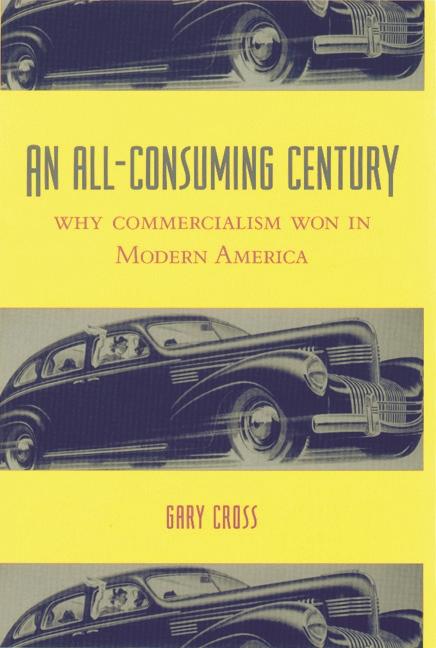
The unqualified victory of consumerism in America was not a foregone conclusion. The United States has traditionally been the home of the most aggressive and often thoughtful criticism of consumption, including Puritanism, Prohibition, the simplicity movement, the '60s hippies, and the consumer rights movement. But at the dawn of the twenty-first century, not only has American consumerism triumphed, there isn't even an "ism" left to challenge it. An All-Consuming Century is a rich history of how market goods came to dominate American life over that remarkable hundred years between 1900 and 2000 and why for the first time in history there are no practical limits to consumerism.
By 1930 a distinct consumer society had emerged in the United States in which the taste, speed, control, and comfort of goods offered new meanings of freedom, thus laying the groundwork for a full-scale ideology of consumer's democracy after World War II. From the introduction of Henry Ford's Model T ("so low in price that no man making a good salary will be unable to own one") and the innovations in selling that arrived with the department store (window displays, self service, the installment plan) to the development of new arenas for spending (amusement parks, penny arcades, baseball parks, and dance halls), Americans embraced the new culture of commercialism—with reservations. However, Gary Cross shows that even the Depression, the counterculture of the 1960s, and the inflation of the 1970s made Americans more materialistic, opening new channels of desire and offering opportunities for more innovative and aggressive marketing. The conservative upsurge of the 1980s and '90s indulged in its own brand of self-aggrandizement by promoting unrestricted markets. The consumerism of today, thriving and largely unchecked, no longer brings families and communities together; instead, it increasingly divides and isolates Americans.
Consumer culture has provided affluent societies with peaceful alternatives to tribalism and class war, Cross writes, and it has fueled extraordinary economic growth. The challenge for the future is to find ways to revive the still valid portion of the culture of constraint and control the overpowering success of the all-consuming twentieth century.
Before Memmo my notes were scattered across PDFs. Now a workspace pulls everything into one place — I see exactly what's still left to study.
Memmo's summaries are gold before exams. I don't have to re-read 800 pages two weeks before — just the important parts.
The AI chat has saved me the night before an exam more than once. I just keep asking until I get it — no waiting on a study group to reply.
The quizzes hit exactly what I need to know. Memmo tracks what I get stuck on — so I only practice what's worth it.
Flashcards with spaced repetition are magic. Memmo knows when I'm about to forget something and brings it back.
The AI podcasts are my favorite. I listen on my way to school and get a recap without sitting at a computer.

Handbok i kvalitativa metoder
281 kr

Hållbar utveckling: en introduktion för ingenjörer och andra problemlösare
334 kr

Brymans Samhällsvetenskapliga metoder
390 kr

Projektledning
491 kr

Den orättvisa hälsan: om socioekonomiska skillnader i hälsa och livslängd
326 kr

Vetenskapsteori för nybörjare
196 kr

Organizational Leadership
429 kr

På väg mot läraryrket
172 kr

Det sociala livet i skolan: Socialpsykologiska perspektiv
253 kr

Betygsättningens didaktik
151 kr

Personality
402 kr

Studying Leadership
404 kr

Managing Innovation
477 kr

Introduktion till samhällsvetenskaplig metod
347 kr

The Psychology of Sex and Gender
698 kr

Evidens och kunskap för socialt arbete
207 kr

Introduction to Leadership
605 kr