
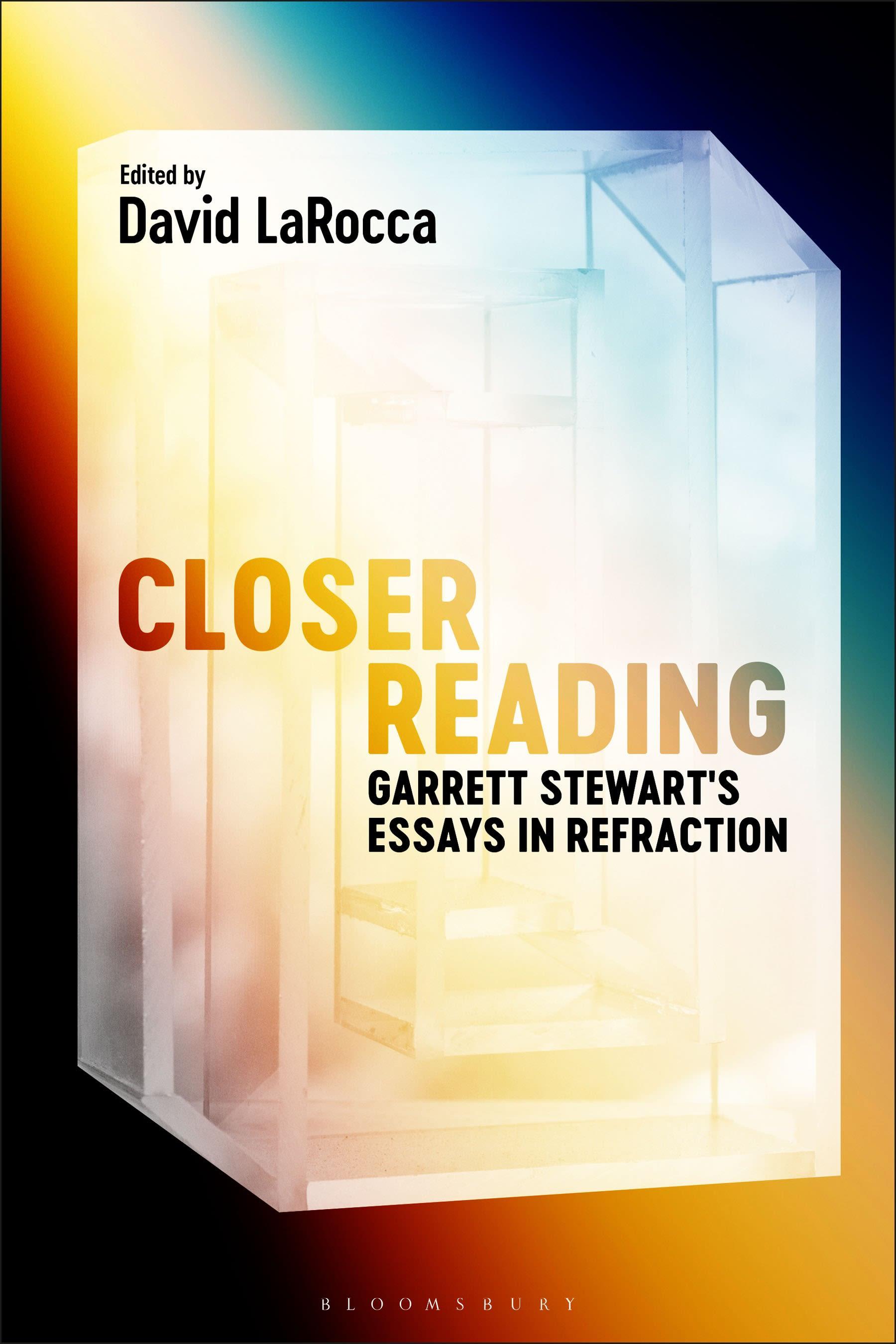
In his first book of essays, Garrett Stewart demonstrates and reframes his formidable powers as a close reader of a vast range of texts: novels, films, songs, book art, digital media, and more.
Among the most prolific and exacting readers of his generation, Stewart is renowned for his virtuosic interventions across a number of humanistic fields, including prose narrative, screen studies, and literary theory. Elected to the American Academy of Arts and Sciences in 2010 and winner of the International Society for the Study of Narrative's prize for Novel Violence (2009), Stewart draws on these varied realms in his intensive readings of enduring works across media – ones worthy of a re-view and a closer look.
Closer Reading, like Stewart's writing more broadly, offers up-close analyses of novels, poetry, cinema, and conceptual art, including chapters on Gerard Manley Hopkins, Charles Dickens, Francis Ford Coppola, Stanley Cavell, and John le Carré. A collection a half-century in the making – yet brimming with critical notes from the vanguard – Closer Reading finds Stewart demonstrating, from sentence to sentence, a sustained rethinking of the value of close reading not just as a methodology but also as a cognitive disposition.
Leaving paranoid, symptomatic, and surface reading to the side, Stewart revels in the workings of sentences and the many senses of media. Such a “prismatic reading” affords insight into the spectrum of interpretation and the bent light of interaction, refraction, and diffraction. To dwell in the astute and generous line of Stewart's inquiry is to experience an exhilaration rare in critical commentary. Featuring full-length essays, including still-potent early publications and accompanied by an entirely new and wide-ranging interview with David LaRocca, Closer Reading provides a deep and satisfying critical survey of and immersion in Garrett Stewart's inimitable oeuvre.
Among the most prolific and exacting readers of his generation, Stewart is renowned for his virtuosic interventions across a number of humanistic fields, including prose narrative, screen studies, and literary theory. Elected to the American Academy of Arts and Sciences in 2010 and winner of the International Society for the Study of Narrative's prize for Novel Violence (2009), Stewart draws on these varied realms in his intensive readings of enduring works across media – ones worthy of a re-view and a closer look.
Closer Reading, like Stewart's writing more broadly, offers up-close analyses of novels, poetry, cinema, and conceptual art, including chapters on Gerard Manley Hopkins, Charles Dickens, Francis Ford Coppola, Stanley Cavell, and John le Carré. A collection a half-century in the making – yet brimming with critical notes from the vanguard – Closer Reading finds Stewart demonstrating, from sentence to sentence, a sustained rethinking of the value of close reading not just as a methodology but also as a cognitive disposition.
Leaving paranoid, symptomatic, and surface reading to the side, Stewart revels in the workings of sentences and the many senses of media. Such a “prismatic reading” affords insight into the spectrum of interpretation and the bent light of interaction, refraction, and diffraction. To dwell in the astute and generous line of Stewart's inquiry is to experience an exhilaration rare in critical commentary. Featuring full-length essays, including still-potent early publications and accompanied by an entirely new and wide-ranging interview with David LaRocca, Closer Reading provides a deep and satisfying critical survey of and immersion in Garrett Stewart's inimitable oeuvre.
Seiten: 304
Kategorie: Litteraturvetenskap & Teori
e-ISBN: 9798765140307
Versandgewicht: 1.2 kg
Versand in: 1-2 Tage
Zahle einfach mit Karte, Klarna, Apple Pay oder Google Pay. Nicht zufrieden? Du hast immer ein 14-tägiges Widerrufsrecht. Lies mehr in unseren AGB. Hast du Fragen, schreib uns eine E-Mail an hello@memmo.org.
Memmo macht das Lernen einfacher – wo auch immer du bist. Bei uns findest du deine Kursbücher und smarte Lerntools an einem Ort: Zusammenfassungen, Quizzes, Podcasts und Lernkarten. Und Ted, dein Lernbuddy, beantwortet alles, was du wissen möchtest. Über 50.000 Studierende lernen bereits hier – gemacht, damit du schneller lernst und weniger Stress hast.