
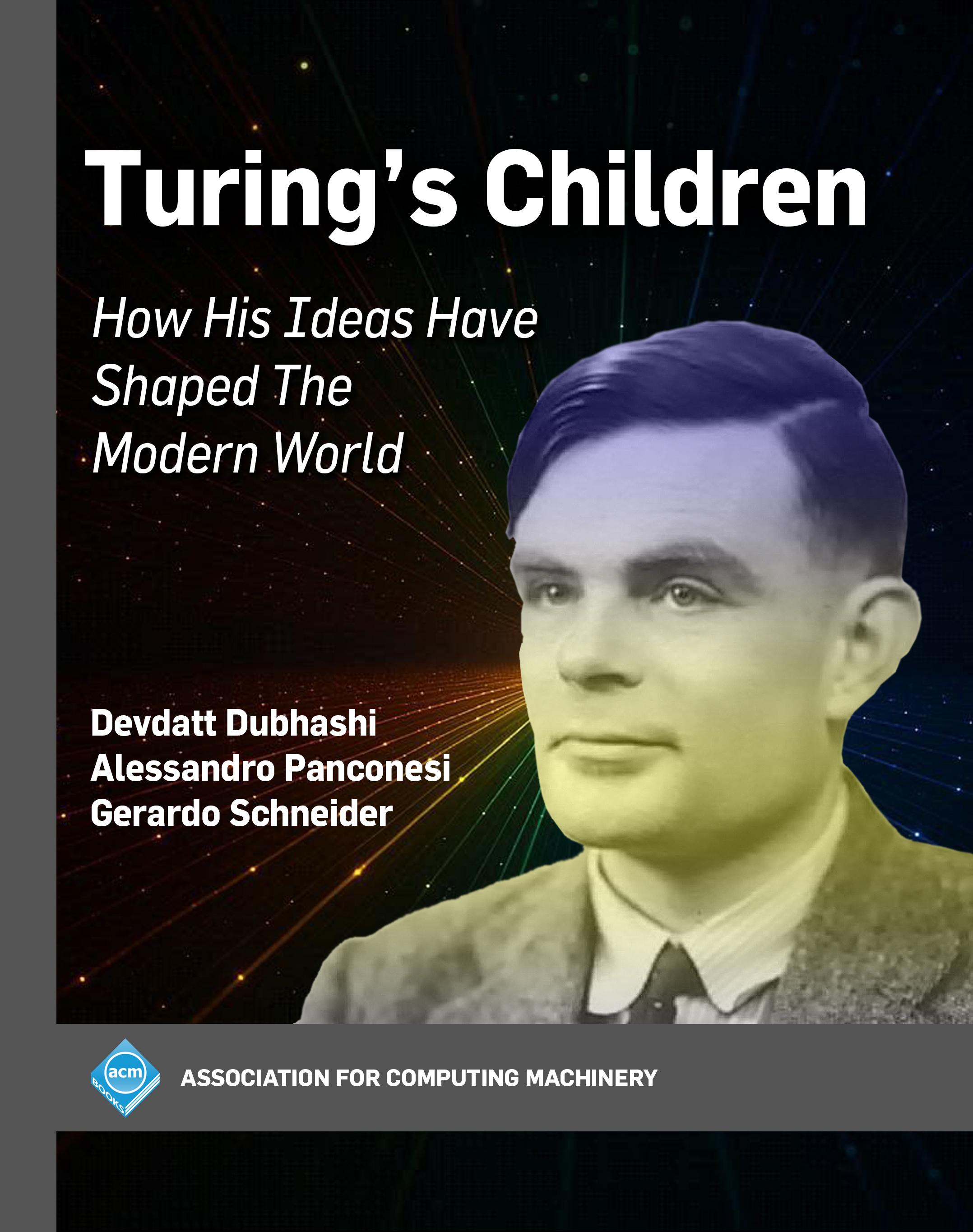
This book explores the profound legacy of Alan Turing, and how his five great ideas have been developed by the winners of the Turing Prize to shape the digital world we live in today. These five groundbreaking concepts—universal computability and insolvability, cryptography, electronic digital computers and software, artificial intelligence (AI), and computational biology—serve as the pillars of the narrative.
Turing’s Children makes the complex ideas in the work of the Turing prize winners accessible to a broad audience. It traces the evolution of these ideas from abstract mathematical principles to their real-world applications, demonstrating their influence on everyday life. Readers will discover how Turing’s legacy is woven into the fabric of modern technology: from the smartphones in our pockets and secure online banking, to the development of life-saving drugs and the conversational abilities of AI systems like ChatGPT.
The book weaves together historical anecdotes, profiles of pioneering scientists, and vivid examples of current innovations. It offers a comprehensive view of how Turing’s vision continues to inspire breakthroughs across science and technology. Turing’s Children reveals the enduring relevance of Turing’s ideas and the ongoing quest to push the boundaries of what machines—and humanity—can achieve.Advance Praise for Turing’s Children“In Turing’s Children, the authors offer a bird’s eye view of computer science in a compact and accessible way... the lay reader will have a broad picture as computer science and a field of science and engineering.” – Moshe Vardi, the Karen Ostrum George Distinguished Service Professor in Computational Engineering at Rice University and former Editor in Chief of the Communications of the ACM
“An engrossing tour de force of the greatest ideas in modern computer science.” –Prabhakar Raghavan, Chief Technologist, Google
Zahle einfach mit Karte, Klarna, Apple Pay oder Google Pay. Nicht zufrieden? Du hast immer ein 14-tägiges Widerrufsrecht. Lies mehr in unseren AGB. Hast du Fragen, schreib uns eine E-Mail an hello@memmo.org.
Memmo macht das Lernen einfacher – wo auch immer du bist. Bei uns findest du deine Kursbücher und smarte Lerntools an einem Ort: Zusammenfassungen, Quizzes, Podcasts und Lernkarten. Und Ted, dein Lernbuddy, beantwortet alles, was du wissen möchtest. Über 50.000 Studierende lernen bereits hier – gemacht, damit du schneller lernst und weniger Stress hast.