
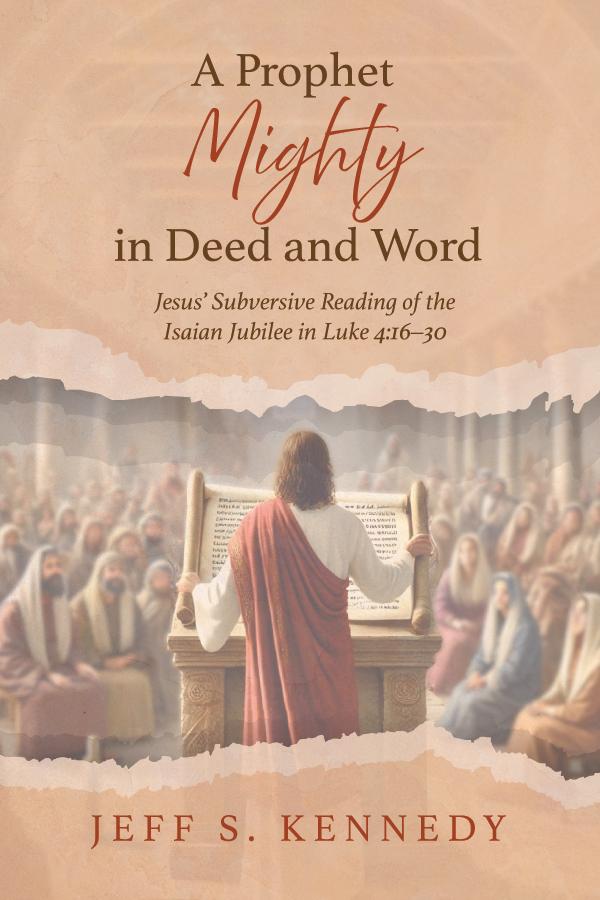
Did Jesus, the revolutionary figure who changed the world, struggle to read a scroll? A growing number of scholars think so. Luke's account of Jesus reading in the synagogue (Luke 4:16-30) is routinely challenged today in academia. The claim is that Luke either fabricated the account outright or relied upon a mistaken social memory of Jesus reading in the synagogue. Accordingly, Jesus has been recast as an illiterate peasant or semi-literate artisan unable to read and teach the way Luke portrays.
In A Prophet Mighty in Deed and Word, Jeff Kennedy offers a fresh perspective. He contends that Luke's "reading Jesus" wasn't an attempt to appeal to the cultured sensibilities of his Greek audience, who preferred literate philosophers over illiterate carpenters. Instead, it reflects Jesus' self-understanding as Israel's prophet-sage, anointed to read and proclaim the year of Yahweh's favor.
Jesus announces a shocking and provocative message for unbelieving Israel, and he does so with a singular authority. This incident sparks escalating tensions between Jesus and his countrymen, resulting in Christ's glorification through suffering. And Luke tells us that suffering began in Jesus' hometown of Nazareth.
Zahle einfach mit Karte, Klarna, Apple Pay oder Google Pay. Nicht zufrieden? Du hast immer ein 14-tägiges Widerrufsrecht. Lies mehr in unseren AGB. Hast du Fragen, schreib uns eine E-Mail an hello@memmo.org.
Memmo macht das Lernen einfacher – wo auch immer du bist. Bei uns findest du deine Kursbücher und smarte Lerntools an einem Ort: Zusammenfassungen, Quizzes, Podcasts und Lernkarten. Und Ted, dein Lernbuddy, beantwortet alles, was du wissen möchtest. Über 50.000 Studierende lernen bereits hier – gemacht, damit du schneller lernst und weniger Stress hast.
Das könnte dir auch gefallen
Buch kaufen0