
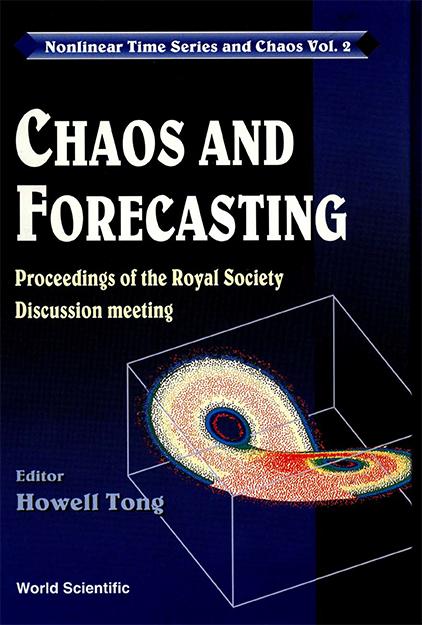
It is now generally recognised that very simple dynamical systems can produce apparently random behaviour. In the last couple of years, attention has turned to focus on the flip side of this coin: random-looking time series (or random-looking patterns in space) may indeed be the result of very complicated processes or “real noise”, but they may equally well be produced by some very simple mechanism (a low-dimensional attractor). In either case, a long-term prediction will be possible only in probabilistic terms. However, in the very short term, random systems will still be unpredictable but low-dimensional chaotic ones may be predictable (appearances to the contrary). The Royal Society held a two-day discussion meeting on topics covering diverse fields, including biology, economics, geophysics, meteorology, statistics, epidemiology, earthquake science and many others. Each topic was covered by a leading expert in the field. The meeting dealt with different basic approaches to the problem of chaos and forecasting, and covered applications to nonlinear forecasting of both artificially-generated time series and real data from context in the above-mentioned diverse fields. This book marks a rather special and rare occasion on which prominent scientists from different areas converge on the same theme. It forms an informative introduction to the science of chaos, with special reference to real data.
Zahle einfach mit Karte, Klarna, Apple Pay oder Google Pay. Nicht zufrieden? Du hast immer ein 14-tägiges Widerrufsrecht. Lies mehr in unseren AGB. Hast du Fragen, schreib uns eine E-Mail an hello@memmo.org.
Memmo macht das Lernen einfacher – wo auch immer du bist. Bei uns findest du deine Kursbücher und smarte Lerntools an einem Ort: Zusammenfassungen, Quizzes, Podcasts und Lernkarten. Und Ted, dein Lernbuddy, beantwortet alles, was du wissen möchtest. Über 50.000 Studierende lernen bereits hier – gemacht, damit du schneller lernst und weniger Stress hast.
Das könnte dir auch gefallen
Buch kaufen0